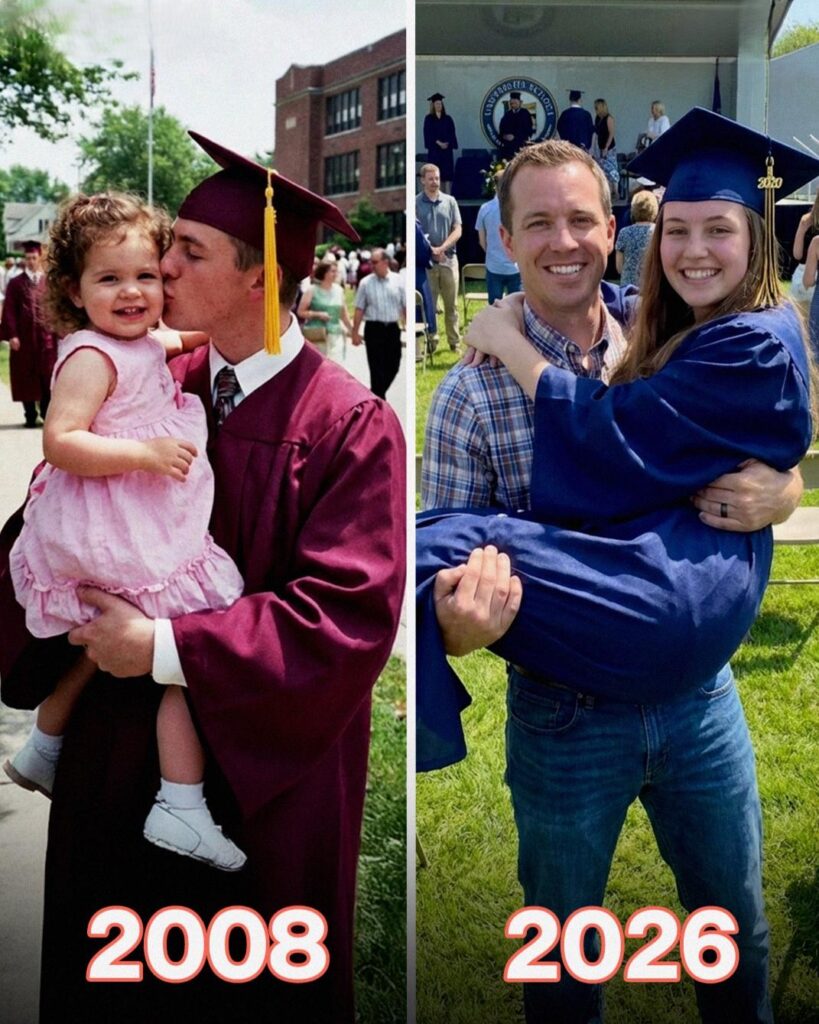
I Became a Dad at 17—And Years Later, My Daughter Gave Me the Second Chance I Never Asked For
I became a father at seventeen, long before I understood what that really meant. There was no plan, no financial safety, no sense of readiness—just a newborn in my arms and a decision I made quietly but firmly: I was not going anywhere. Whatever came next, I would stay.
Back then, Ainsley’s mom and I believed in a future that felt certain, the way young people often do when love still feels enough to solve everything. But life has a way of testing those beliefs early. By the time my daughter could say “Daddy,” it was just the two of us.
Fear doesn’t give you time to sit still when someone depends on you. So I worked. I took whatever job I could find, started at a hardware store, stayed in school as long as I was able, and learned how to stretch money until it almost felt unreal. There was no room to think about what I wanted. My focus narrowed to what was necessary—diapers, rent, food, and making sure she never felt the instability I was carrying.
Single fatherhood wasn’t inspiring in the way people like to imagine. It wasn’t a montage of victories. It was missed sleep, small compromises, and constant calculation. I taught myself how to cook because takeout wasn’t an option. I learned how to braid hair because my daughter wanted it done, and I refused to let her feel like she was missing something just because I didn’t know how.
We built our own version of normal. Saturday mornings with cheap cereal and cartoons. Small traditions that didn’t cost anything but meant everything. I wasn’t perfect—far from it—but I showed up. Every school event, every meeting, every quiet moment where she needed someone steady.
And somehow, without me noticing when it happened, Ainsley grew into someone strong in ways that didn’t need to be announced.
The night she graduated should have been simple. I stood in the gym watching her walk across that stage, feeling something I hadn’t allowed myself to feel in years—pride without worry attached to it. She came home still glowing from the moment, and for a brief time, everything felt complete.
Then there was a knock at the door.
Two officers stood outside, not aggressive, not urgent—but serious enough to shift the air around me. They told me Ainsley wasn’t in trouble, but there was something I needed to know. That alone was enough to bring back a kind of fear I thought I had learned to control.
When they explained what she had been doing, it didn’t make sense at first. She had been going to a construction site for months, working quietly, taking on small tasks, earning money wherever she could. Not out of rebellion, not out of boredom—but with purpose.
Before I could fully process it, she came downstairs.
Still in her graduation dress, still looking like the moment hadn’t ended—but carrying something heavier than I had ever seen her hold.
She brought a shoebox with her.
I recognized it immediately. It held something I had buried years ago without really saying goodbye to it—an acceptance letter to an engineering program, something I had once believed would define my future. I had put it away the day she was born, telling myself I would return to it later.
Later never came.
She had found it. Read it. Understood more than I ever told her.
“You always told me I could be anything,” she said quietly. “But you never told me what you gave up.”
There’s no easy response to that kind of truth. Not because it’s unfair, but because it’s accurate in a way that leaves no room to hide.
Then she showed me what she had been working toward.
Every job, every hour, every sacrifice she made—it wasn’t random. She had been saving, planning, looking for a way to give something back. She had already contacted programs, already found a path forward that I had convinced myself was no longer available to me.
“I was supposed to give you everything,” I told her.
And I meant it.
But she didn’t see it as unfinished.
“You did,” she said. “Now let me give something back.”
Three weeks later, I stood outside a university building feeling out of place in a way I hadn’t felt in years. Surrounded by people younger, more certain, moving forward without hesitation. I questioned everything—whether I was too late, whether I had missed my chance entirely.
She stood next to me, steady as always.
“You gave me a life,” she said. “This is me giving yours back.”
There are moments when everything becomes clear, not because the path is easy, but because you finally accept that it’s still open.
I had spent years believing that responsibility had closed certain doors permanently. What I didn’t understand was that some doors don’t close—they wait.
And sometimes, the person you carried forward becomes the one who helps you walk back through them.
Final Thought
Sacrifice doesn’t disappear. It stays, quietly shaping everything that follows.
But when it’s given with sincerity, it doesn’t end in loss.
Sometimes, it returns—unexpected, undeserved, but real.
Not as a reward.
As a continuation.