
She Walked In at 11:00 a.m.—And Found a Truth She Wasn’t Prepared For
Just after eleven that morning, Clara stood outside her apartment door, grocery bags pressing into her fingers, her thoughts light for the first time in months.
Four months on the road had worn her down—early flights, late meetings, quiet dinners that stretched too long. She carried it all because she believed in what waited at home. In Daniel. In Mateo. In the life they kept promising each other.
She hadn’t told them she was coming back early.
She wanted to arrive without warning—to step into something warm, familiar, hers.
But something felt wrong before she even turned the key.
The Kind of Silence That Speaks First
She knocked once. Then again, louder.
Nothing.
No footsteps. No voice calling out. No sign of life from inside.
She unlocked the door.
The apartment was too quiet. And too clean.
Not the kind of clean that comes from effort. The kind that feels arranged. Prepared. Almost careful in a way that doesn’t belong to ordinary mornings.
Then she saw the shoes.
Beige heels, placed near the hallway. Not hers. Not something that belonged in her home without explanation.
Her mind reached for softer answers first. It tried to protect her.
But her body already knew something was off.
She walked toward the bedroom.
The Moment Before Judgment
The door was slightly open.
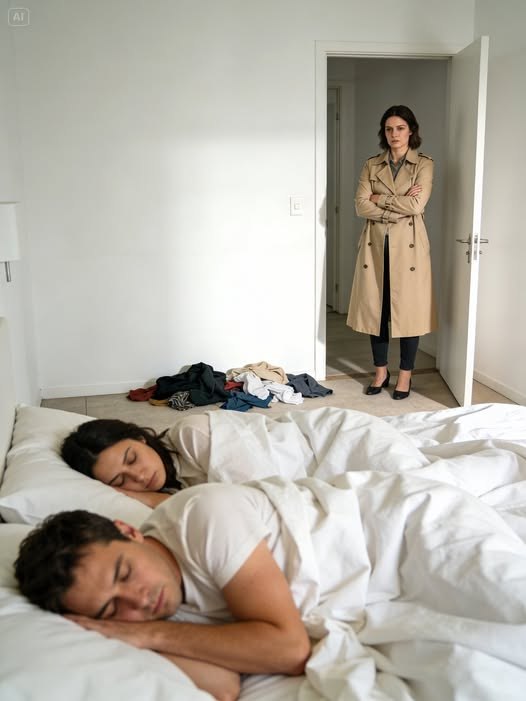
The bed was disturbed. Two figures beneath the covers.
Her heart moved faster than her thoughts. The conclusion came quickly, almost automatically—sharp, painful, familiar in the way fear often is.
She stepped closer.
And then the picture shifted.
What She Found Was Not What She Expected
The woman in the bed was not who Clara imagined.
She was old. Fragile. Worn by something deeper than time alone.
An oxygen machine hummed quietly beside her.
Daniel wasn’t lying with her. He was half-sitting, still dressed, as if he had been holding her there and simply fell asleep.
He woke suddenly.
“Clara—wait.”
His voice didn’t carry guilt in the way betrayal does. It carried something else—panic mixed with being exposed.
Mateo stood behind Clara, silent, unsure.
And the woman… looked at Clara not with defiance, but with fear.
The Truth That Was Hidden
“She’s my mother,” Daniel said.
Clara froze. “You told me she died.”
A pause.
Then the kind of truth that doesn’t come easily.
“She didn’t. It was easier to say that.”
Not to deceive. But to bury something that never settled properly.
A hospital had called. Illness. No one left to take her in.
And Daniel had opened the door.
Without telling Clara.
Where the Real Hurt Lives
The room held more than one kind of pain.
There was the woman in the bed—reduced, dependent, nearing the end.
There was Daniel—caught between past wounds and present responsibility.
There was Mateo—too young to carry the weight, but already feeling it.
And there was Clara.
Not betrayed in the way she feared.
But still hurt.
Because something this large had been decided without her.
Without trust.
Without honesty.
Choosing How to Stand in It
Clara didn’t rush to comfort.
She didn’t turn away either.
She looked at the woman again—really looked this time. Not as a stranger, not as a threat, but as someone who had reached the end of her road.
Then she spoke, quietly:
“You should have been brought here openly. Not hidden.”
It wasn’t forgiveness.
It wasn’t rejection.
It was truth, held without cruelty.
What Comes After the Shock
Clara turned to Daniel.
“We’re going to talk. Properly. No more hiding things and calling it protection.”
Her voice wasn’t loud.
But it was firm.
Because love without honesty weakens over time, no matter how good the intention.
Returning to What Holds a Home Together
She went to the kitchen.
Not because everything was resolved.
But because someone still needed to cook. To care. To keep something steady while the rest found its place.
The sound of water running. Vegetables being cut. A pot beginning to simmer.
Small things.
But real.
Final Thought
Sometimes, the fear we carry into a moment is not what breaks us.
It’s the truth we weren’t prepared to face.
And in that space, you don’t choose between anger or compassion.
You learn to hold both—without letting either take more than it should.
Because a home isn’t built on the absence of problems.
It’s built on what you refuse to hide when they arrive.