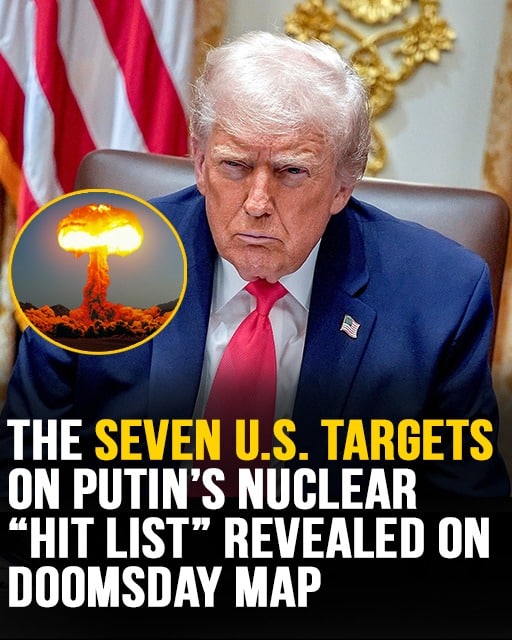
Rising geopolitical tensions have led to renewed anxiety online after reports referenced what some outlets described as a “doomsday map” — a hypothetical list of U.S. strategic locations discussed during a Russian state TV broadcast.
It’s important to separate verified facts from speculation:
There is no official confirmation of any active Russian targeting list, and no verified intelligence indicating imminent nuclear action. What has circulated appears to stem from commentary and theoretical war-gaming discussion rather than confirmed military plans.
Still, the conversation reflects how sensitive global security dynamics have become.
Strained Relations Between Major Powers
Tensions between the United States and Russia have remained high since the start of the Ukraine war. The U.S. has provided military and financial support to Ukraine, while Moscow has repeatedly criticized NATO expansion and Western weapons transfers.
Officials such as Dmitry Peskov have previously warned that Western involvement increases the risk of escalation.
At the same time, Donald Trump has taken assertive positions on global security issues, including recent military actions in the Middle East, adding further complexity to international dynamics.
Middle East Escalation
Recent developments have also increased global unease. The U.S. conducted airstrikes on Iranian nuclear facilities, including:
-
Fordow Fuel Enrichment Plant
-
Natanz Nuclear Facility
-
Isfahan Nuclear Technology Center
Shortly afterward, Iran launched missiles toward Al Udeid Air Base, the largest U.S. military installation in the region.
These events have raised defense readiness levels and intensified discussions about deterrence and regional stability.
Locations Mentioned in Broadcast Discussions
According to media reports about a now-deleted Russian state TV segment, several U.S. sites were referenced in a hypothetical conflict scenario. Again, there is no verified evidence these are active targets.
The locations reportedly mentioned included:
-
The Pentagon – U.S. Department of Defense headquarters
-
Camp David – Presidential retreat
-
Jim Creek Naval Radio Station – Submarine communications facility
-
Fort Ritchie – Former strategic installation
-
McClellan Air Force Base – Decommissioned base
-
Kirtland Air Force Base – Nuclear weapons research/storage site
-
Pantex Plant – U.S. nuclear weapons assembly/disassembly facility
Defense analysts note that such facilities frequently appear in theoretical war-gaming simulations, which are common in military planning discussions worldwide.
What “Nuclear Deterrence” Actually Means
Modern nuclear strategy is built around deterrence — the idea that mutual destruction prevents action.
Key pillars include:
-
Mutually Assured Destruction (MAD)
-
Second-strike capability
-
Strategic communication to avoid miscalculation
In reality, direct nuclear conflict between major powers remains extraordinarily unlikely because the consequences would be catastrophic for all sides.
Security experts consistently emphasize that diplomatic channels, intelligence monitoring, and strategic stability mechanisms remain active precisely to prevent escalation.
Why These Stories Go Viral
When geopolitical tensions rise, media segments or online clips referencing “target lists” can spread quickly. The phrase “doomsday map” generates fear — even when based on speculative commentary.
In the current global climate — with conflict in Ukraine, instability in the Middle East, and heightened rhetoric — audiences are understandably sensitive to nuclear risk narratives.
But there is a significant difference between:
-
Hypothetical discussion
-
Propaganda messaging
-
Confirmed military planning
As of now, no credible evidence confirms any operational targeting directive.
The Bigger Picture
The global security environment is tense — but tension does not equal inevitability.
Diplomatic engagement, arms control frameworks, intelligence coordination, and economic interdependence all function as stabilizing forces.
Periods like this underscore:
-
The importance of strategic restraint
-
The role of communication between nuclear powers
-
The need to evaluate information carefully before drawing conclusions
While headlines referencing nuclear scenarios are alarming, experts continue to stress that deterrence systems exist specifically to prevent such outcomes.