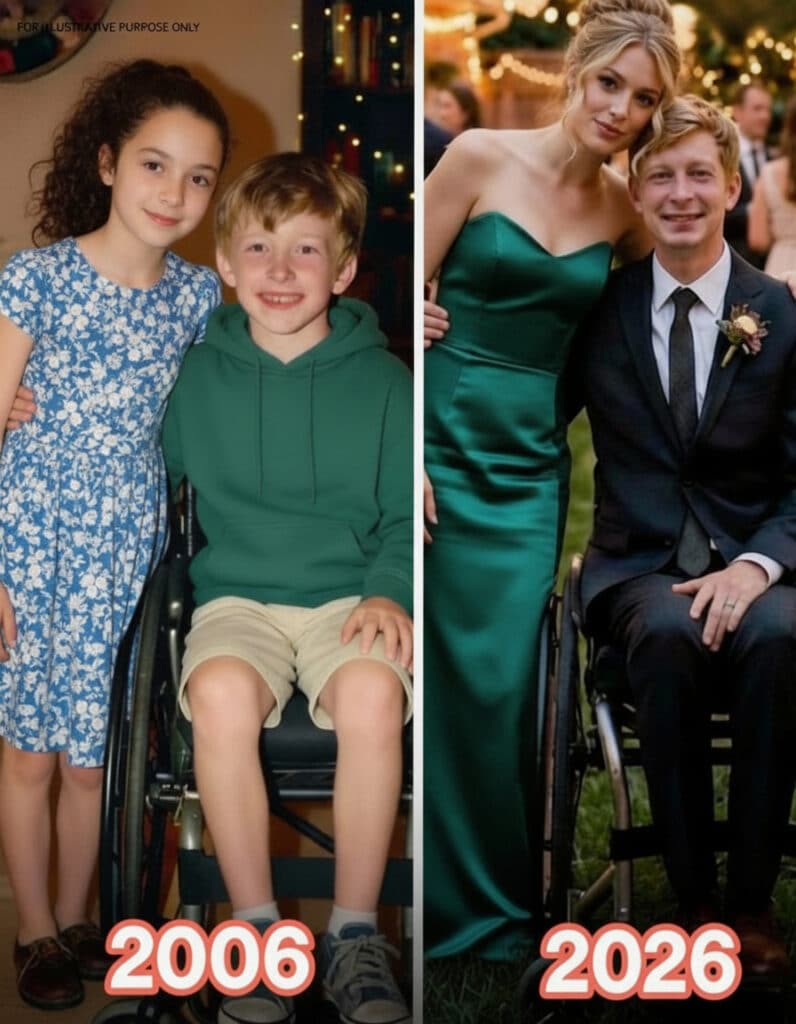
I’m Claire, 28, and I understand the foster system in a way you only do when you’ve lived inside it.
By eight, I had already memorized the sound of garbage bags being filled with my things. New homes blurred together. New rules. New kitchens. New promises. People like to call kids like me “resilient.” What they really mean is we learn how not to expect permanence.
Attachment felt dangerous. Hope felt expensive.
Then I met Noah.
He was nine, sharp-eyed and observant, sitting in a wheelchair that seemed to make adults overly careful and kids unsure of what to say. No one was openly cruel. They were just distant. They waved politely, then ran off to games he couldn’t join. Staff spoke around him instead of to him, as if the chair arrived before the person did.
One afternoon, I sat beside him by the window with a book and said, “If you’re guarding the best view in the building, you should at least share it.”
He studied me for a moment. “You’re new.”
“Returned,” I replied. “I’m Claire.”
“Noah.”
That was it. No dramatic music. No big moment. Just two kids who recognized something familiar in each other — the quiet understanding of not being chosen.
From then on, we were inseparable.
Growing up together meant seeing every version of each other: stubborn, hopeful, angry, tired, brave. When prospective parents toured the home, we stopped pretending it might be our turn. We knew how this worked. They wanted someone uncomplicated. Someone without a wheelchair. Someone without a thick file labeled “behavioral history” and “placement disruptions.”
So we joked instead.
“If you get adopted, I get your headphones.”
“If you do, I’m taking your hoodie.”
We laughed because it was easier than admitting we both knew no one was coming.
When we turned eighteen, the system did what it does. A folder of paperwork. A bus pass. A handshake. Good luck.
No celebration. No safety net. Just the quiet finality of the door closing behind us.
We walked out together, carrying everything we owned in plastic bags.
We found a small apartment above a laundromat. It smelled like detergent and heat. The stairs were awful for Noah, but the rent was low and it was ours. For the first time in our lives, the walls felt steady.
He took on remote IT work and tutoring. I worked early coffee shifts and stocked shelves at night. We enrolled in community college, one class at a time. We measured progress in semesters survived, in rent paid on time, in nights when the lights stayed on.
Somewhere between exams and exhaustion, our friendship shifted.
There was no grand confession. Just one late night when I said, half-asleep, “We’re basically already together, aren’t we?”
He didn’t hesitate. “Good. I thought it was just me.”
We kept building — slowly, imperfectly, faithfully. When our diplomas arrived, we held them like proof that the story didn’t end where everyone expected it to.
A year later, Noah proposed in our tiny kitchen while I was stirring pasta sauce. No ring hidden in dessert. No staged speech. Just him looking at me and saying, “We’ve already done the hard parts. Want to keep going?”
I laughed and cried at the same time. “Yes.”
Our wedding was small. Simple. Honest. The kind you can afford when love has always been more important than appearance.
The morning after, there was a knock at the door.
A man in a dark coat introduced himself as Thomas, an attorney. Calm. Polite. He said there was something we needed to know.
He handed us a letter.
Years earlier, before I knew him, Noah had helped an older man who fell outside a grocery store. People walked by. Some glanced. Few stopped.
Noah did.
He waited. Called for help. Stayed until the man was steady. Spoke to him like a person, not an inconvenience.
The man’s name was Harold Peters.
He never forgot.
Harold had no children. No close relatives. But he had a house. Some savings. A lifetime of watching how easily kindness is overlooked.
In his will, he left everything to Noah.
Not out of pity.
Out of gratitude.
It wasn’t unimaginable wealth. But it was something we had never known: stability. A home that couldn’t vanish because a landlord changed their mind. A future that didn’t hinge on whether next month’s hours were cut.
When we first visited the house, Noah rolled slowly through the living room, taking it in.
“I don’t know how to live in a place that can’t disappear,” he said quietly.
I understood that fear. When you grow up temporary, permanence feels almost suspicious.
“We’ll learn,” I told him. “We’ve learned harder things.”
Growing up, no one chose us.
We learned not to expect it.
But one man, on an ordinary day in a parking lot, saw kindness and decided it mattered. He saw a boy in a wheelchair and recognized dignity. He saw goodness and chose to honor it.
And in doing so, he changed the direction of our lives.
What I’ve learned is this: systems can fail. People can overlook. Doors can close.
But a single act of sincere kindness can echo further than anyone expects.
We were never the easy choice.
But we were — finally — chosen.