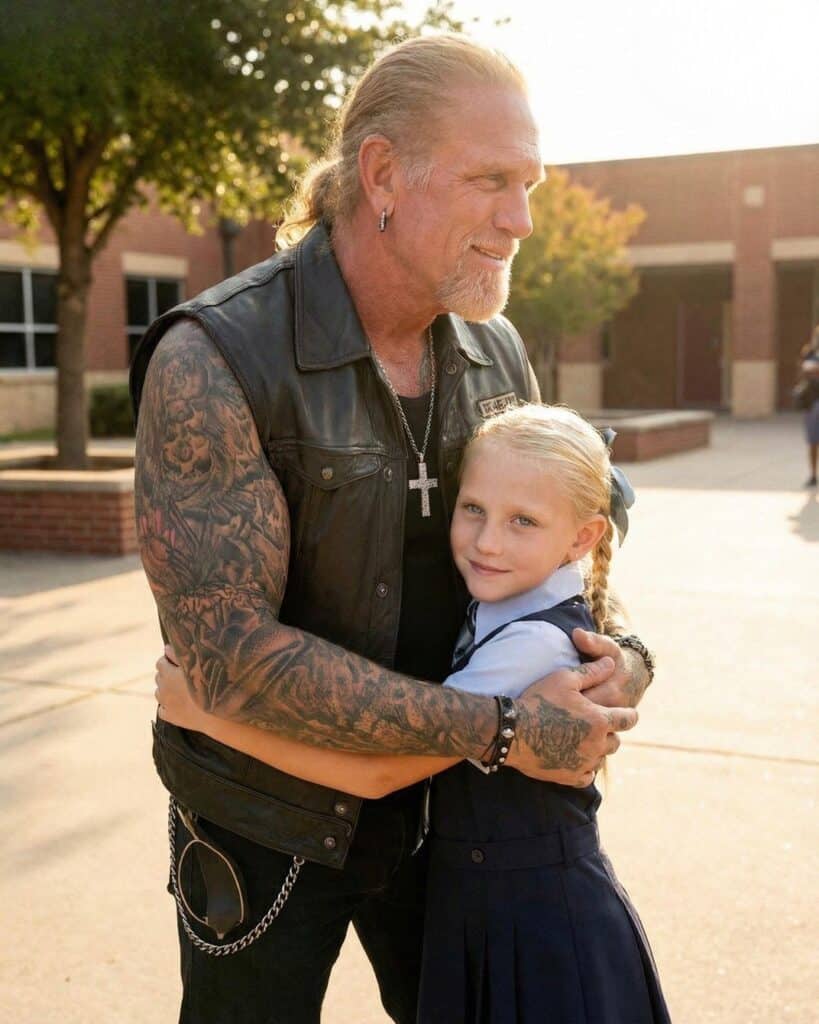
For two years, I walked a little girl to school every morning. It began after a long night shift when I heard soft crying behind my apartment building and found her curled in her school uniform, trying to disappear into the concrete. It was daddy-daughter day, she whispered. Her father was in prison. Her mother was gone. Her grandmother was too sick to make the walk.
I was a stranger. A man who had grown used to quiet rooms and careful distance. I told myself I would just walk her that one day.
She took my hand as if it had always belonged there.
At the school gate she held on tightly. When someone asked who I was, she smiled and called me her angel man. I didn’t correct her. Some names don’t need editing; they need protecting.
I said I wouldn’t return the next morning.
But I did.
She waited on the porch with her backpack ready, scanning the street like my arrival decided something important. Soon it became rhythm — small footsteps beside mine, her voice filling the silence I had mistaken for peace. She talked about spelling tests and playground dramas as if they were matters of state. She shared fears without apology. Slowly, she made space for my own guarded corners too.
One morning she pointed at me proudly and announced, “This is my Daddy Mike.”
I started to protest, but her grandmother touched my arm and said gently, “If the name helps her heal, don’t take it away.”
So I didn’t.
I learned that fatherhood isn’t always spoken into existence. Sometimes it is practiced into being.
Then one morning the porch wasn’t empty — a man stood there holding her wrist while she pulled toward me, crying my name. He introduced himself as her uncle. Her grandmother had passed in the night. He had come to take her.
Or, he added casually, I could.
He spoke about her like logistics. Like an item to relocate. He admitted he didn’t want her. His life was elsewhere. She was attached to me, he said, and that made things complicated.
When he said the word adoption, fear rose in me — not fear of paperwork, but fear of failing her. I was older. I had never planned for this. What if love wasn’t enough.
But she was clutching my shirt, breathing hard, eyes searching my face for something steady. I remembered every morning she had waited for me. Every unspoken promise made in simple presence.
I understood then that love does not wait for perfect confidence. It asks for courage.
So I said yes.
Not loudly. Not dramatically. Just yes.
The sound of her relief was not celebration — it was release, like something that had been held too tightly finally unclenching.
That night she slept in my home for the first time, her hand wrapped around mine as if my pulse confirmed the world could still be trusted. I stayed awake longer than usual, not from worry, but from the weight of something sacred.
The next morning we walked to school again. At the front desk, the secretary slid a form toward me and asked one word.
Guardian?
For thirty years, I had carried names that felt borrowed — coworker, tenant, survivor of my own disappointments.
This one did not feel borrowed.
It felt earned.
“Yes,” I said.
And this time, it was true.