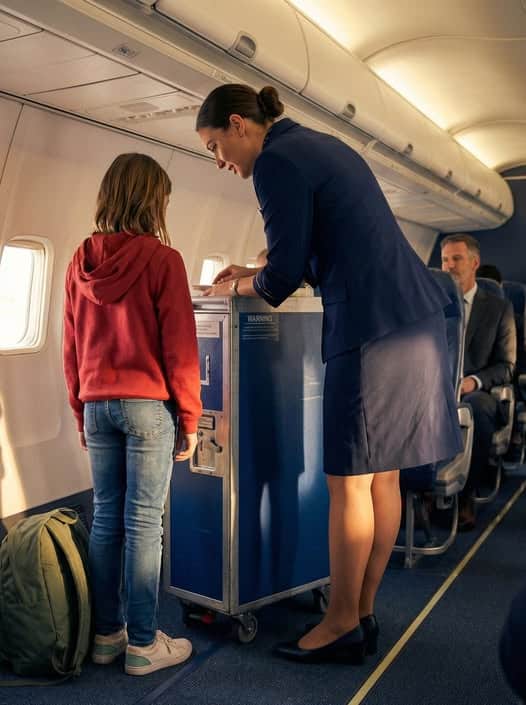
Megan Hartley had spent years in the narrow aisles of airplanes, learning how to keep her face calm no matter what she carried inside. On Flight RW482 from Denver to Portland, she moved through the First Class cabin with practiced grace, even as exhaustion and quiet financial worry weighed on her.
When she reached Seat 1D, she paused.
Ava Miller sat there alone — a small girl in worn jeans and a faded T-shirt, surrounded by pressed suits and polished shoes. Her ticket was valid. Everything checked out. Still, Megan felt an unease she couldn’t name. It wasn’t about rules. It was the instinctive friction that comes when something doesn’t fit the picture we expect.
During meal service, the difference became visible.
While other passengers received carefully plated dishes, Megan offered Ava a granola bar and a juice box instead. It wasn’t cruelty — it was fatigue mixed with assumption, a quiet decision made without reflection.
When the girl asked why she wasn’t given the same meal, Megan answered stiffly, leaning on policy instead of kindness.
The cabin noticed.
Silence settled in — not loud, not dramatic — just the uncomfortable awareness that something human had gone wrong.
A moment later, Ava stood.
Her hands trembled slightly as she pulled a neatly folded flag from her backpack.
“My father always dreamed of taking me to see the Oregon coast,” she said softly.
“Now I’m taking him home.”
She explained that her father’s remains were traveling beneath the cabin — a soldier who would never see the ocean he’d spoken of.
The air changed.
There was no outrage. No shouting. Just the sudden understanding of how small appearances are compared to what people carry.
Even the captain stepped out briefly, kneeling in the aisle in quiet respect.
In that space — suspended above the clouds — wealth, status, and comfort disappeared. What remained was grief, love, and the simple dignity of a child honoring her father.
Megan felt the weight of her choice fully for the first time.
Not as punishment.
As clarity.
The incident eventually cost her job. She didn’t fight it. Instead, she stepped into a quieter life, working at a small diner where faces had names and stories had time.
What stayed with her wasn’t shame — it was awareness.
She learned that exhaustion can harden judgment.
That systems can numb empathy.
And that every person arrives carrying something unseen.
Now, she measures service differently.
Not by protocol.
By presence.
By asking before assuming.
By offering dignity first.
Some lessons don’t come through correction.
They come through witnessing someone’s humanity in a moment when you almost missed it.
And once you truly see it, you don’t forget.
Because compassion isn’t an extra —
it’s the core of every interaction that matters.
Sometimes the greatest turbulence isn’t in the air.
It’s in the quiet space between assumption and understanding —
and the choice to bridge it with grace.