
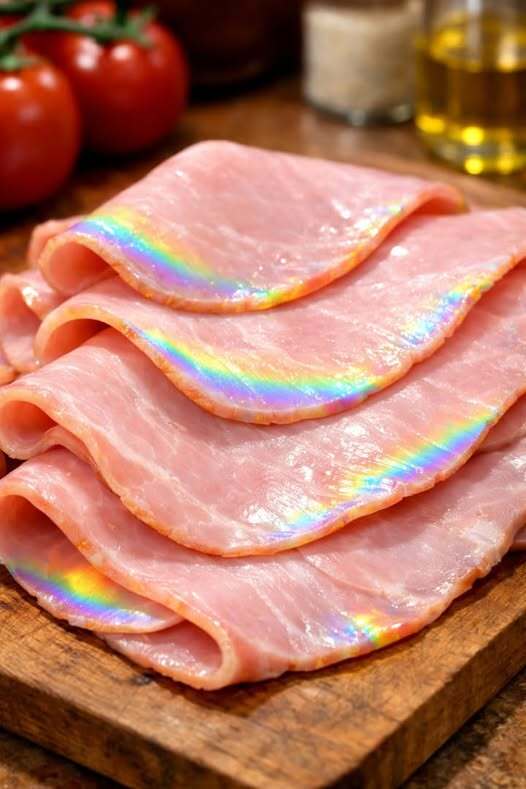
Why That Rainbow Shine on Your Ham Isn’t Always a Warning Sign
You’ve probably noticed it at least once. You open a fresh pack of deli ham, and the slices catch the light just right—suddenly flashing hints of green, blue, even purple. For many people, that moment brings a quiet unease. Meat isn’t supposed to look like that. Something must be wrong.
In most cases, nothing is.
That rainbow sheen is often harmless. It looks strange, but it isn’t a sign of decay.
What’s Actually Causing the “Meat Rainbow”
The shifting colors on sliced ham aren’t mold, chemicals, or spoilage. They’re the result of a simple physical effect called iridescence. It has more to do with light than with food safety.
Ham is made of tightly aligned muscle fibers. When the meat is sliced thin—especially cleanly and against the grain—those fibers are exposed in layers that bend and scatter light. A thin film of surface moisture helps reflect that light at different angles, splitting it into multiple colors, much like a soap bubble or the surface of a compact disc.
Cured meats tend to show this effect more clearly because salt helps them retain moisture. In that sense, a faint rainbow shimmer can actually indicate careful slicing and proper storage rather than a problem.
When the Shine Isn’t the Issue
The shine itself isn’t dangerous—but it also doesn’t override common sense. Meat can still spoil, and the signs that matter are quieter but more reliable.
Pay attention to texture.
Fresh deli ham should feel firm and slightly moist. If it feels sticky, slimy, or leaves a residue on your fingers, bacterial growth has likely begun. That’s not something to negotiate with.
Trust your nose.
Good ham smells mild and savory. Sour, sharp, ammonia-like, or rotten odors aren’t subtle warnings—they’re clear instructions to throw it away.
Look for real color changes.
Iridescence shifts as you move the meat under the light. Spoilage does not. Gray or brown patches, dull green areas that don’t move, or fuzzy spots signal oxidation or mold, not an optical illusion.
Time Still Matters
Even meat that looks and smells fine has limits. Once opened, sliced ham should generally be eaten within three to five days when kept cold. Some bacteria can grow at refrigerator temperatures without obvious visual cues. Appearance alone isn’t protection.
Good storage helps—airtight wrapping, minimal air exposure, and placement in the coldest part of the fridge—but it doesn’t grant immunity. Time remains the final factor.
The Bottom Line
That strange rainbow shimmer on your ham is usually just light reflecting off muscle fibers, not a health hazard. The real warnings are slime, strong odors, dull discoloration, and age. Pay attention to what actually signals harm, and don’t let an unfamiliar but harmless effect make the decision for you.
Sometimes food looks unsettling without being unsafe. Learning the difference keeps waste down—and judgment steady.