
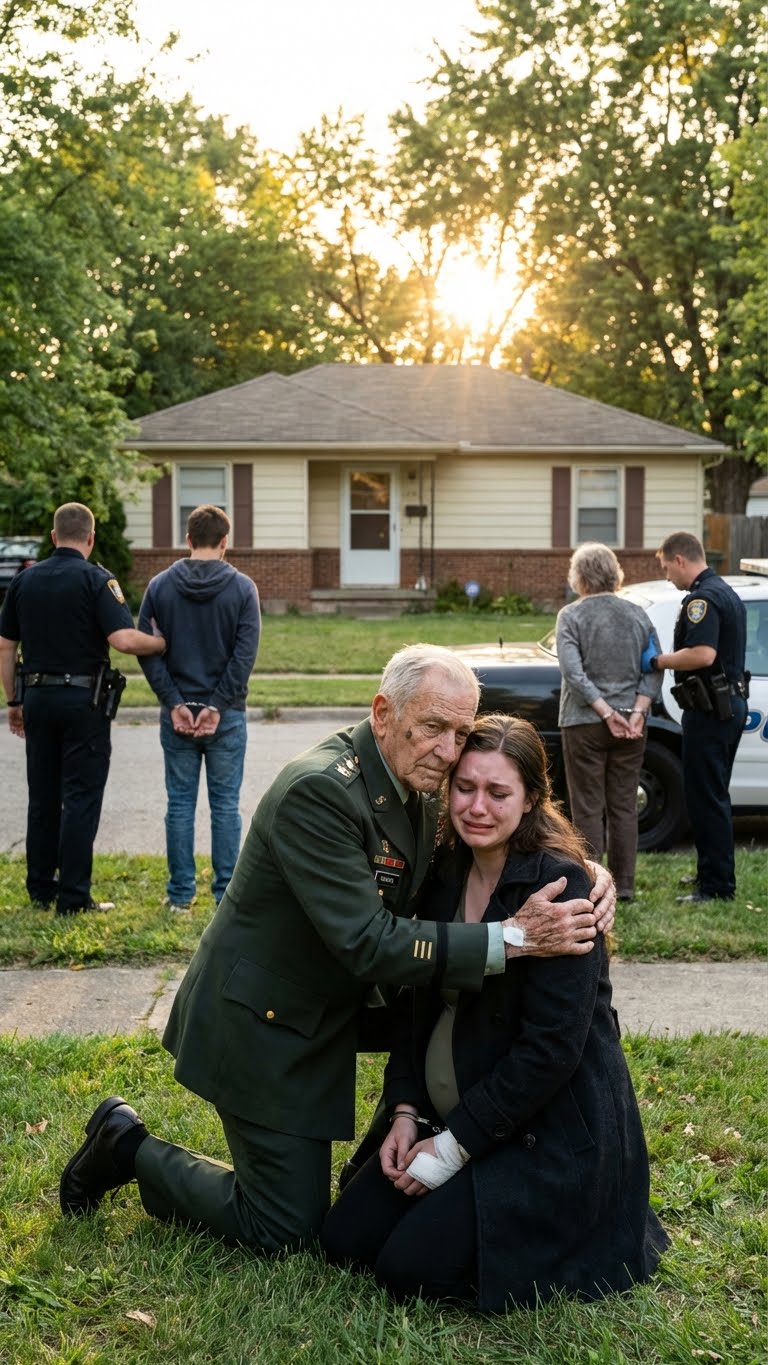
The beige colonial on Maplewood Drive was the kind of house no one noticed. Perfectly forgettable. Quiet. Safe-looking. The kind of place people passed without a second thought. But sitting in my truck, watching dandelions overtake the lawn, I knew better. Neglect rarely arrives alone.
My name is Frank. To most people, I look like a retired man with a stiff walk and a soft sweater, someone who blends easily into the background. What they don’t see is the discipline shaped into me by decades of service, or the instincts that never fully fade. I had promised myself those days were finished. I wanted to be a grandfather, not a man who intervened. But when family is unraveling, distance becomes a form of permission.
I picked up the small gift bag from the passenger seat—a teddy bear for my first grandchild—and walked to the door.
Sarah opened it with a smile that tried and failed. She looked worn down, thinner somehow, like someone carrying weight she hadn’t chosen. From inside the house came the sharp crack of video game gunfire and a man’s voice barking commands through a headset.
“He’s busy, Dad,” she said quietly. “There’s prize money.”
That was when I saw Derek. Thirty years old. Capable. Untethered. Sprawled across the couch, surrounded by empty cans and dishes that hadn’t moved in days, snapping at Sarah without looking at her. When he spoke, she flinched—small, almost invisible. I noticed.
The kitchen finished the picture. The clutter wasn’t laziness alone; it was abandonment. As Sarah reached for a glass, her sleeve slid back. Beneath careful makeup, a bruise was fading. It hadn’t come from clumsiness. It had come from fear learning where to hide.
Something settled in me—not anger, not impulse. Just clarity.
I walked past Sarah and unplugged the console. The room dropped into silence.
Derek jumped up, furious. “What are you doing? Do you know what you just cost me?”
I didn’t raise my voice.
“You’re done,” I said. “With the games. With the shouting. With acting like my daughter exists to absorb your weight.”
He laughed at first. Then he realized I wasn’t negotiating.
What followed wasn’t violence. It wasn’t humiliation. It was order. Expectation. Consequence. I gave him tasks tied directly to the damage he had created. When he resisted, the work restarted. When he argued, the boundaries narrowed. No insults. No threats. Just responsibility that could not be escaped by noise.
Sarah watched. Slowly, her posture changed. The man who had filled the room with tension became smaller—not diminished as a person, but stripped of the false power he’d been borrowing. The house grew quieter. The air lighter.
By evening, Derek sat on the floor, drained. His apologies came haltingly, imperfect, but no longer performative.
He looked at Sarah, waiting for rescue.
She stood. One hand rested on her belly. Her voice was calm.
She glanced at the clean kitchen, then back at him.
“You missed a spot,” she said.
It wasn’t punishment. It was a boundary finally spoken aloud.
Some lines aren’t drawn to dominate. They’re drawn to stop decay from spreading—so that what is still alive has a chance to breathe.