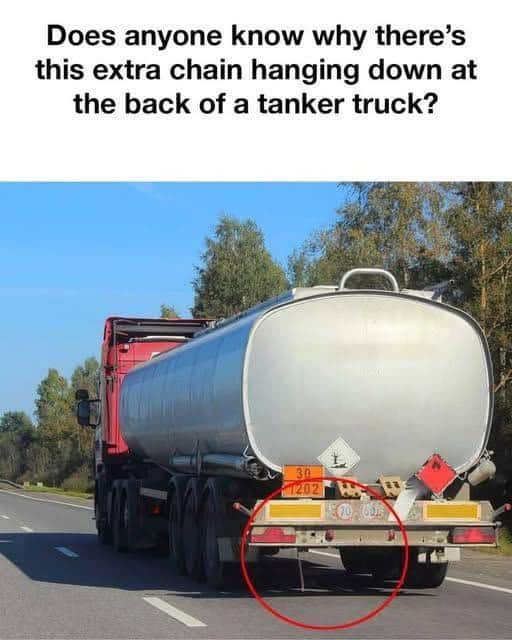
Tanker trucks are purpose-built to move liquids and gases—fuel, water, chemicals, and food-grade products—using a cylindrical tank mounted on a heavy chassis. Every element of that setup is engineered for containment, control, and safe delivery. Among the small details that often catch the eye is a short length of chain hanging near the rear bumper. Simple as it looks, that chain has an outsized job in the vehicle’s safety system.
Its function is grounding. As a tanker rolls down the road, friction between the product and the tank walls, plus normal vehicle motion and airflow, can generate static electricity. With flammable liquids, a stray spark is a serious hazard. The drag chain provides a low-resistance path for any static charge to bleed off into the ground, reducing the chance of ignition and helping keep fuel transport safe and uneventful.
This practice didn’t appear overnight. In the early days of bulk fuel hauling, static-related incidents were far more common, sometimes causing catastrophic fires and explosions. As investigators connected the dots, industry best practices and formal rules evolved to prioritize static dissipation. The humble grounding chain emerged as an inexpensive, effective solution and spread throughout the sector. Over time, standards bodies and regulators reinforced its use, and the chain became a familiar sight on tankers around the world.
Safety requirements for hazardous materials transport are stringent by design. Agencies such as the U.S. Department of Transportation (DOT) set rules for tank construction, allowable pressures, and procedures that limit ignition sources—including how to manage static buildup. Inspectors routinely check grounding systems, and the presence, condition, and effectiveness of static-dissipating equipment can be part of those reviews. Compliance isn’t optional; it’s a core layer of protection for drivers, loaders, and the public.
The science is straightforward. Static electricity results from charge imbalances when materials contact and separate. In a tanker, moving liquid and sloshing surfaces create opportunities for charge accumulation. If vapors are present and the charge discharges as a spark, ignition can occur. By dragging along the pavement, a conductive chain constantly touches earth potential, allowing charge to flow away continuously instead of building to a dangerous level. That continuous bleed-off is why such a small component can have such a big impact.
Modern fleets often supplement—or in some scenarios, replace—the chain with other grounding strategies. Static grounding reels with retractable cables connect to verified ground points during loading and unloading. Anti-static additives can be blended into fuels to lower charge generation. Some tanks use advanced linings and coatings to minimize friction and enhance conductivity. In practice, operators layer these methods to create redundancy: chains for continuous dissipation in transit, cables for positive bonding at terminals, and materials or additives to reduce static at the source.
Because it’s inconspicuous, the chain is sometimes misunderstood. It isn’t a brake aid, a trailer stabilizer, or a leftover piece of hardware. Nor is it a quaint relic made obsolete by newer technology. Simplicity is the point: it’s a reliable, passive way to control a real risk, and it still earns its place alongside more sophisticated systems in fuel transport safety.
Its effectiveness depends on condition. Road grime, corrosion, broken links, or a chain trimmed too short to touch the pavement can compromise performance. Routine inspections should confirm continuous ground contact, intact links, and secure attachment points. If wear or damage is found, replacement is quick and inexpensive—especially compared to the risk of leaving a faulty path to ground in service.
For an operation that moves potentially volatile cargo through neighborhoods, highways, and terminals every day, marginal gains in safety matter. The small chain at the rear of a tanker truck quietly does its part—bleeding off static, lowering ignition risk, and complementing the broader suite of safeguards that define modern hazardous-materials logistics. In a field where layers of protection save lives, that unassuming length of steel remains an essential link.