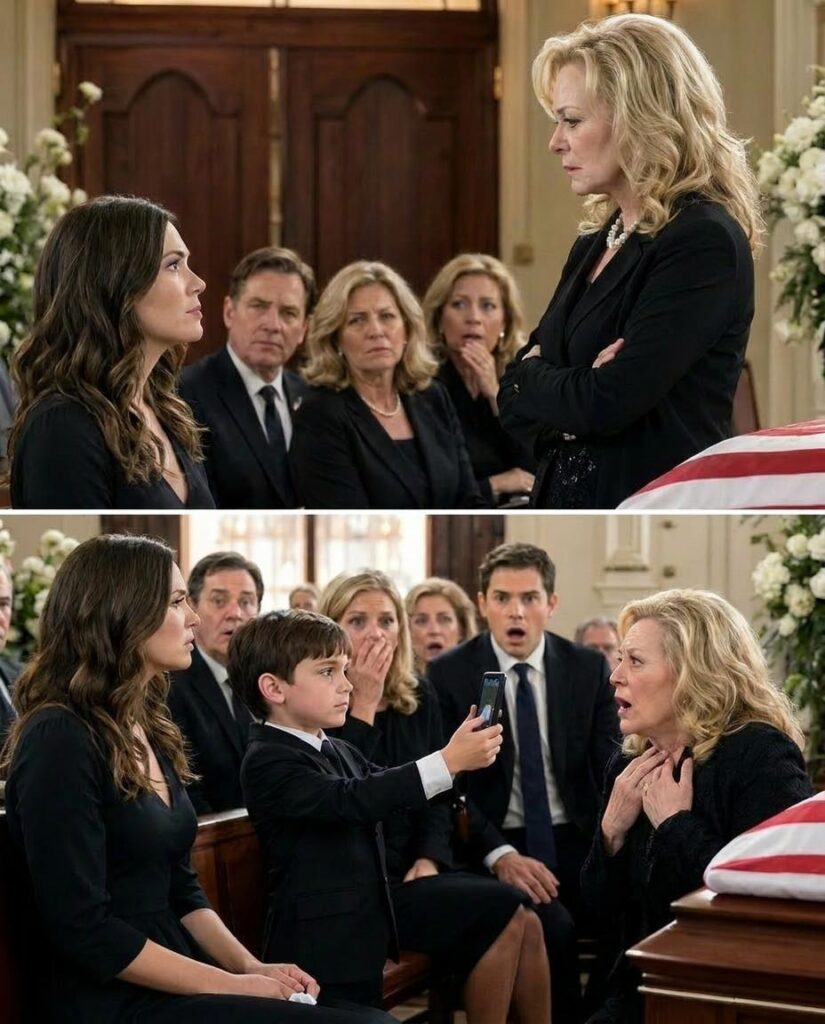
At my husband’s funeral, his mother didn’t mourn him—she used him.
She stood at the front of the chapel, framed by flowers that still smelled too fresh for grief, pearls gleaming against her throat, and fixed her gaze on me as if I were the one lying in the casket.
“Better he’s gone now,” she said, her voice calm enough to chill the air, “than forced to live with the embarrassment she brought him.”
A few relatives nodded. Not hesitantly—knowingly. Like this was something they had already agreed on long before today.
The words didn’t echo. They sank.
Someone behind me whispered, “Poor Daniel. He deserved better.”
I sat in the front row, my hands folded tightly in my lap, staring at the polished mahogany casket just feet away. Daniel lay inside, dressed in the navy tie I had picked for our anniversary dinner three weeks before the accident. I kept my breathing slow, steady, because I knew one thing for certain—
This was exactly what she wanted.
A reaction.
Tears. Rage. Collapse.
Anything that would confirm the version of me she had spent weeks crafting for everyone in this room.
Beside me, Noah sat unnaturally still. Eight years old, dressed in a suit that made him look smaller instead of older. He hadn’t cried since the morning. That worried me more than anything.
Vivian continued, her grief unfolding like a rehearsed performance.
“She came into our family with nothing,” she said, dabbing at her eyes with a perfectly folded handkerchief. “Daniel gave her everything. A home, a name, a life. And how did she repay him? Secrets. Shame. Humiliation.”
Grant stood behind her, arms crossed, solemn in appearance only. The same man who had quietly asked about Daniel’s life insurance before we had even chosen a burial date.
I said nothing.
That silence irritated her more than any outburst could have.
She leaned slightly closer, her voice dropping just enough for the front rows to hear. “You should be grateful we’re allowing you to sit with the family.”
Noah moved.
At first, I thought he was reaching for my hand.
Then I saw what he was holding.
Daniel’s phone.
My heart tightened instantly.
His small fingers gripped it tightly, knuckles pale, his expression steady in a way that didn’t belong to a child.
“Noah,” I whispered.
But he was already standing.
The shift in the room was immediate—quiet conversations died mid-sentence, heads turned, and for the first time, Vivian hesitated.
Annoyance flickered across her face.
Then uncertainty.
Noah looked straight at her.
“Grandma,” he said, his voice clear enough to reach the last row, “do you want me to play the recording Dad made about you last week?”
Everything broke in that moment.
The color drained from Vivian’s face so quickly it was almost violent. Grant’s posture stiffened. The murmurs vanished entirely.
Silence took hold—real silence this time.
Vivian recovered quickly, of course. People like her always do when they have an audience to protect.
“Noah,” she said gently, her tone tightening underneath the sweetness, “sweetheart, sit down. This isn’t the time for games.”
“It’s not a game,” he replied.
Grant stepped forward. “Give me the phone.”
I stood before he could take another step.
Just one.
It was enough.
He stopped.
He had always believed I was weak—because I spoke softly, because I didn’t argue at dinners, because I let Daniel navigate his family. Because I endured Vivian’s endless criticisms without raising my voice.
But silence isn’t weakness.
Sometimes it’s patience.
Sometimes it’s preparation.
“No one touches my son,” I said.
Vivian’s eyes sharpened. “Careful. You’ve already caused enough damage.”
Damage.
Their favorite word.
For weeks, they had been spreading it like truth. That I had been unfaithful. That Daniel had discovered it. That the stress had driven him to that rainy road, that sudden brake failure, that fatal moment.
They told neighbors I was unstable.
They told relatives I had emptied his accounts.
They told his colleagues I couldn’t be trusted.
What they didn’t know was that Daniel had told me everything before he died.
He had come home pale, shaken, holding a folder and his phone.
“My mother and Grant have been using my name,” he said. “Loans. Forged signatures. A shell company. And if it falls apart… they’re setting it up to look like you did it.”
I remember laughing, a hollow, disbelieving sound. “Me?”
“You’re the outsider,” he said quietly. “That’s why.”
He went to a lawyer the next morning.
Three days later, he was gone.
Now, standing in that chapel, Noah looked at Vivian with a clarity that cut deeper than any accusation.
“Dad said you would say that,” he told her.
The room shifted again.
I gently took the phone from his hands—not to stop him, but because he had already done enough.
“This funeral is over,” Grant snapped. “Don’t make this worse.”
I met his gaze. “Worse than stealing from your brother?”
His expression cracked.
Vivian hissed, “You don’t know what you’re talking about.”
“I’m a forensic accountant,” I said calmly.
The rain tapped softly against the stained glass as the room fell completely still.
“I know exactly what I’m talking about,” I continued. “And so did Daniel.”
Grant laughed too loudly. “This is ridiculous.”
“No,” I said. “Ridiculous was forging his signature. Moving money through your charity. Trying to shift the blame onto me when he refused to cover your debts.”
Vivian’s hand flew to her pearls.
Then the phone buzzed in my hand.
A message.
Scheduled.
For Elena. If they try it at the funeral, play this.
My throat tightened.
Even now, Daniel was protecting us.
I pressed play.
His voice filled the chapel—steady, tired, unmistakably him.
“If you’re hearing this, Mom probably decided grief wasn’t enough and tried to destroy Elena too.”
A collective breath swept through the room.
Vivian swayed.
“I know about the loans,” his voice continued. “About Grant’s gambling debt. About the forged signatures. About using my company login. And about trying to frame Elena because you thought no one would question it.”
Grant lunged, but someone grabbed him before he could reach me.
“I met with my lawyer,” Daniel went on. “Everything’s documented. With the bank. With the police. Elena doesn’t need to prove anything. I already did.”
“Turn it off,” Vivian whispered.
I didn’t.
“Elena… I’m sorry I didn’t stop it sooner. Noah—if you’re there, hold your mom’s hand. She’s stronger than all of them.”
Noah slipped his hand into mine.
That was the moment I nearly broke.
But Vivian made one last mistake.
“This is fake,” she said. “She made this. She poisoned him—”
The chapel doors opened.
The lawyer stepped in first. Then the detective. Then two officers.
And just like that, the performance ended.
What followed wasn’t loud. It didn’t need to be.
Documents were read.
Evidence was shown.
Truth didn’t shout—it unfolded.
By the time the handcuffs clicked, no one in that room was whispering anymore.
They were watching.
Three months later, everything Daniel had prepared came to light. The accounts were restored. The lies collapsed. The people who had spoken the loudest fell the quietest.
Vivian fought.
She lost.
Grant made a deal.
He paid.
Noah and I left the city not long after.
On Daniel’s birthday, we walked along the shore, the wind sharp and clean, the past finally behind us in a way it had never been before.
Noah placed a small wooden boat into the water and watched it drift.
“Do you think Dad saw?” he asked.
I held his hand a little tighter.
“Yes,” I said.
And for the first time in a long while, he smiled.