
Eleanor Mitchell didn’t understand the full weight of her husband’s final words when he said them.
“Do what’s right, not what’s easy.”
At the time, they felt like something meant for later—a quiet kind of guidance meant to surface in small decisions. Not something that would one day ask her to stand against her own child.
She only understood what he meant at the funeral.
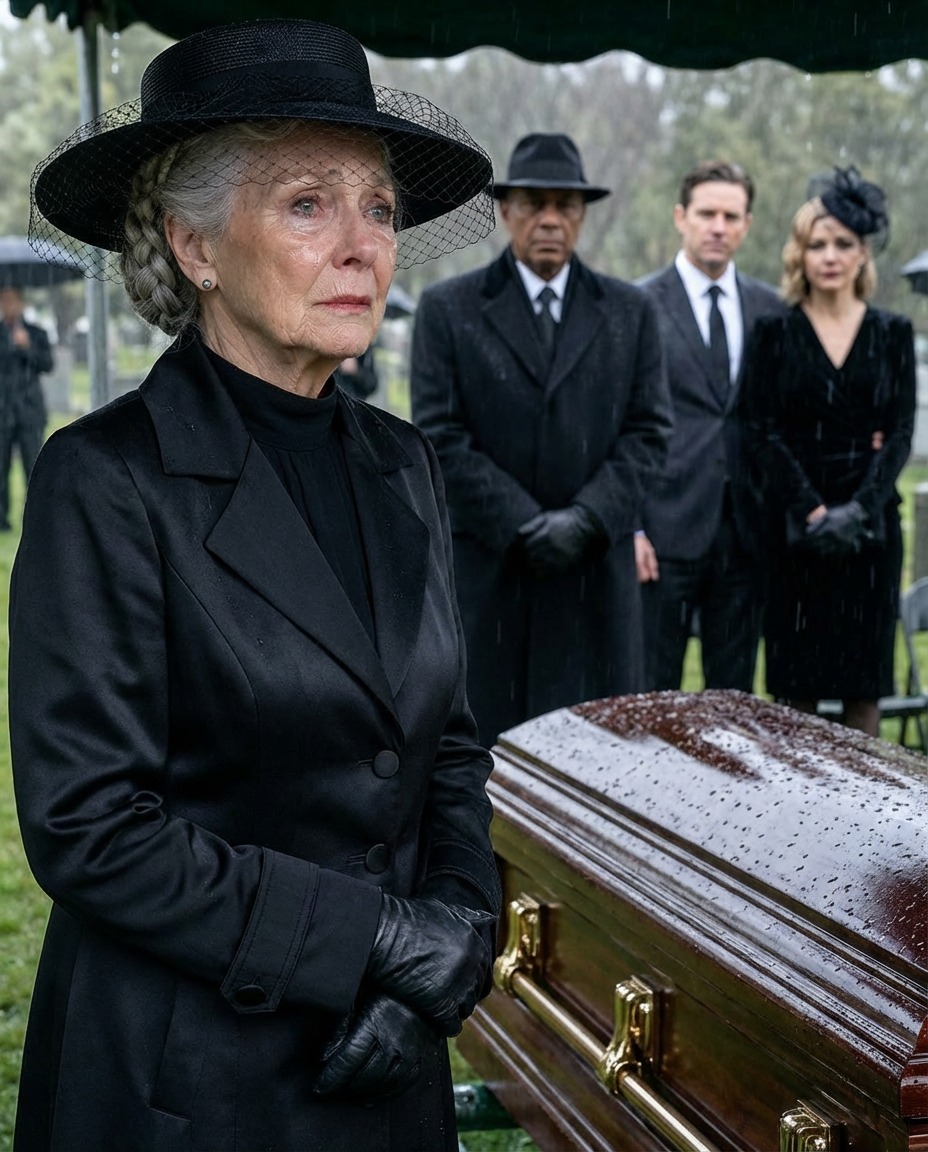
It was a gray November afternoon, the kind where the sky feels heavy enough to press down on everything beneath it. Rain fell in steady sheets as people gathered under black umbrellas to say goodbye to Richard Mitchell—founder, leader, husband, father.
Hundreds came.
Employees. Partners. Friends. People whose lives had been shaped, directly or quietly, by the man being lowered into the ground.
But in the front row, beside Eleanor, there was an empty chair.
It had been reserved for Thomas.
Their only son.
The boy Richard had raised with belief, defended long after it stopped being easy, and trusted with a future that now felt uncertain even in death.
Thomas wasn’t there.
He had chosen to be somewhere else—at a lavish birthday celebration in Aspen, surrounded by noise and distraction while silence settled over his father’s grave.
Eleanor didn’t cry in that moment.
Something else happened instead.
She stopped making excuses.
“Begin,” she told the pastor, her voice steady in a way that surprised even her.
What followed wasn’t an act of anger. It was clarity.
The next day, that clarity became something permanent.
At the reading of the will, Thomas arrived composed, almost impatient. He expected control—of the company, the legacy, the future his father had spent a lifetime building.
Instead, he was given a condition.
His inheritance depended not on blood, but on character. On Eleanor’s judgment.
“If his conduct proves unworthy,” the lawyer read, “the inheritance shall be redirected.”
Thomas didn’t understand at first. Then he looked at his mother, expecting reassurance.
Instead, he found truth.
“Mrs. Mitchell,” the attorney asked, “do you wish to invoke the clause?”
The room held its breath.
Eleanor looked at her son—not as a mother protecting a child, but as someone honoring the man she had buried the day before.
“Yes,” she said.
“I invoke the clause.”
In that moment, Thomas lost everything he thought was already his.
The company was divided. A large portion went to the foundation Richard had quietly built. Another to the employees who had spent decades helping him grow it. A share to Charlotte—Thomas’s daughter. And a portion to Eleanor herself.
Thomas received something else entirely.
His father’s first desk. A simple folding table.
And a set of books on ethics.
It didn’t feel like a lesson to him.
It felt like humiliation.
He fought it.
He went to court. Accused Eleanor of manipulation, instability, grief clouding her judgment. The story spread quickly, reshaped by headlines and speculation.
But Richard had prepared for that too.
Recordings surfaced. Documents. Statements.
In one video, he spoke calmly, directly, as if he knew this moment would come.
“This isn’t about one day,” he said. “My son is not ready. I gave him everything—except accountability. And I won’t risk what this company supports by pretending otherwise.”
Eleanor watched it alone.
It didn’t feel like betrayal.
It felt like being asked to carry something heavy—and necessary.
When the legal fight collapsed, everything else did too.
Thomas’s life had been built on a structure that no longer existed.
The money disappeared. The status followed. His wife left when the future she expected was gone. Friends drifted away, their loyalty tied more to convenience than connection.
For the first time, there was nothing left to protect him from himself.
He came back to Eleanor without warning.
Not polished. Not rehearsed.
Just quiet.
“Victoria’s gone,” he said.
Eleanor didn’t react with surprise. Only with understanding.
“You were right,” he added after a moment. “She loved what I had. Not who I was.”
Then he placed a notebook on the table.
Richard’s.
Inside, there were no financial plans. No strategies. Just words.
Simple, direct, and impossible to ignore.
That Thomas would find purpose beyond wealth. That he would learn to earn respect instead of inheriting it. That he would understand people were not tools. That he would not lose his daughter the way he had nearly lost himself.
Thomas read in silence.
Then, for the first time in years, he let himself feel the weight of what he had ignored.
“I didn’t know him,” he said.
Eleanor shook her head gently.
“You did,” she answered. “You just didn’t listen.”
What came after wasn’t dramatic.
No grand gestures. No instant redemption.
He withdrew the lawsuit. Not as a favor—but because it was the only honest thing left to do.
He stepped away from the company.
And then, quietly, he started over.
At the foundation his father had built.
Not as a leader. Not as an heir.
As someone who had to learn.
He listened more than he spoke. Walked docks his father had once walked. Met people whose lives depended on decisions he had never taken seriously.
One man told him, without anger, just fact, “Your father knew every name here. You called us ‘units.’”
Thomas didn’t defend himself.
“I’m sorry,” he said.
And meant it.
His relationship with Charlotte was slower.
More fragile.
“I don’t know what to say to you,” she told him once.
“You don’t have to,” he replied. “I just have to show you.”
And over time, he did.
A year later, they stood together at Richard’s grave.
No crowd. No rain.
Just the three of them.
“I missed his burial,” Thomas said quietly. “I don’t know how to carry that.”
Eleanor looked at him, not with judgment—but with something steadier.
“By becoming someone who would never make that choice again.”
He never became CEO.
He never reclaimed the empire.
But something else took shape in its place.
A life that didn’t depend on inheritance.
A sense of self that wasn’t borrowed.
Years later, when a foundation center opened in Richard’s name, Thomas stood on stage—not as a successor, but as someone who had learned the cost of not listening in time.
“My father didn’t leave me money,” he said.
“He left me responsibility.”
Eleanor stood in the front row, her hand resting quietly over her heart.
By then, she understood what Richard had meant.
A legacy isn’t what you pass down for someone to spend.
It’s what you leave behind for them to grow into.
Thomas never received the empire.
But he was given something rarer.
The chance to become worthy of it—even without owning it.