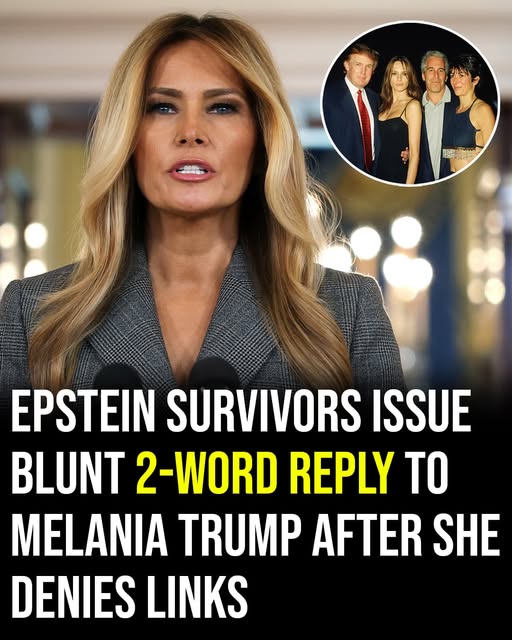
The political atmosphere in Washington has grown tense following a rare public statement by Melania Trump. Stepping forward to address long-circulating associations with Jeffrey Epstein and Ghislaine Maxwell, she aimed to draw a clear line between herself and a scandal that continues to unsettle public trust.
Her message was direct. She rejected claims of any meaningful relationship, describing them as misrepresentations, and acknowledged only brief social overlap during past events. In her view, the matter required closure—through clarity, not speculation.
But what followed showed that clarity, when sought publicly, can open other wounds.
Where Intention Meets Impact
In her statement, she called for public hearings where survivors could testify under oath, framing it as a step toward transparency. On the surface, that reflects a familiar principle: truth should be recorded, not hidden.
Yet for many who lived through the harm connected to Epstein’s network, the call landed differently.
A group of survivors responded quickly, not with dismissal, but with fatigue. Their position was not that truth should be avoided—but that they had already carried that burden, often at great personal cost. Courtrooms, statements, years of exposure. To be asked again, publicly, felt less like justice and more like repetition without resolution.
Their message was steady: accountability should not depend on how many times victims are willing to reopen what they have already endured.
The Weight of What Has Already Been Said
Over the years, substantial documentation has emerged—testimony, records, investigations. For survivors, the question is no longer whether the truth exists, but why it has not led to fuller accountability.
This is where the tension sharpens.
When institutions ask for more voices, more testimony, more visibility, it can appear as progress. But if earlier efforts have not led to meaningful outcomes, the request risks feeling like delay rather than advancement.
And that is where trust begins to strain.
What Was Not Addressed
Observers also noted what remained unspoken. While Melania Trump was precise in defending her own position, she did not extend that clarity to Donald Trump, whose historical proximity to Epstein has been widely discussed.
Silence, in moments like this, carries its own meaning.
Not always as admission, but often as omission—leaving others to fill the space with their own conclusions.
A Dividing Line
What emerges from this moment is not a simple disagreement, but a deeper divide in how justice is understood.
One side calls for formal processes, recorded testimony, visible proceedings.
The other asks whether those processes have already asked enough of the people most affected.
Both speak about truth.
But they differ on where the burden should rest.
Final Thought
There is a difference between seeking truth and placing the weight of proving it on those already harmed.
A just response does not ignore survivors, but it also does not repeatedly return them to the center of pain when the path forward lies elsewhere—in action, in accountability, and in the willingness of institutions to carry their share of responsibility.
In moments like this, the strongest position is not the loudest defense.
It is the one that moves carefully, recognizing that truth without care can still cause harm.