
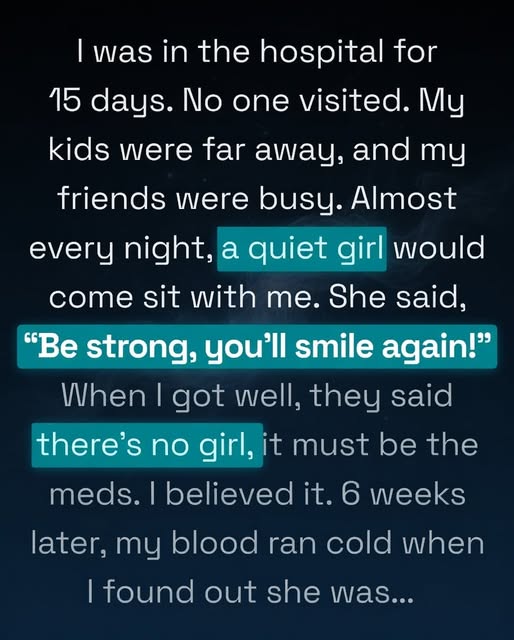
…tion-induced hallucinations, or simply the fractured remnants of a mind trying to process the wreckage of a life that had been shattered in a single, violent heartbeat. I lay in that hospital bed feeling abandoned by my own existence, trapped in a body that no longer felt like mine. Every beep of the monitor was a reminder of what I had lost, and every shadow in the corner of the room felt like a taunt.
Then, she appeared. She didn’t speak in riddles or demand attention. She simply existed in the periphery, a quiet girl with dark hair and eyes that looked straight through my pain. Her presence became my only anchor in a sea of sterile white walls and clinical indifference. She said little, but her calm gaze and that single, whispered promise—”You’ll smile again”—cut through the numbness more effectively than any morphine drip or physical therapy session. When the nurses denied she existed, checking my charts with pitying eyes, I almost let myself believe I had invented her just to survive the crushing isolation of my own recovery.
Weeks later, still fragile and navigating the hollowed-out shell of my home, I heard a knock at the front door. I expected a nurse or a social worker, but when I pulled the door open, I saw those same dark eyes in the harsh, unforgiving light of day. It wasn’t a hallucination. It was Tiffany.
She stood there, trembling, carrying the weight of a story I never expected to hear. She was the daughter of the woman who had caused the crash—the woman who had died in the impact that left me broken. The air between us grew heavy with the gravity of our shared history. She didn’t offer apologies that could fix the unfixable; instead, she reached out and placed a necklace in my hand. It was an heirloom, something lost in the chaos of the accident, a tangible piece of the past returned to me.
That necklace was more than just metal and stone; it was proof that our suffering was inextricably intertwined. We were two people connected by a tragedy that had destroyed one life and irrevocably altered two others. In the weeks that followed, we sat in the quiet of my living room, grieving together, finding a strange, jagged path toward healing. We learned that forgiveness isn’t a destination, but a slow, daily choice. Now, every time I catch myself smiling, I know her whispered promise in that hospital room was never a dream. It was a lifeline, cast out by a stranger who needed to be saved just as much as I did.