
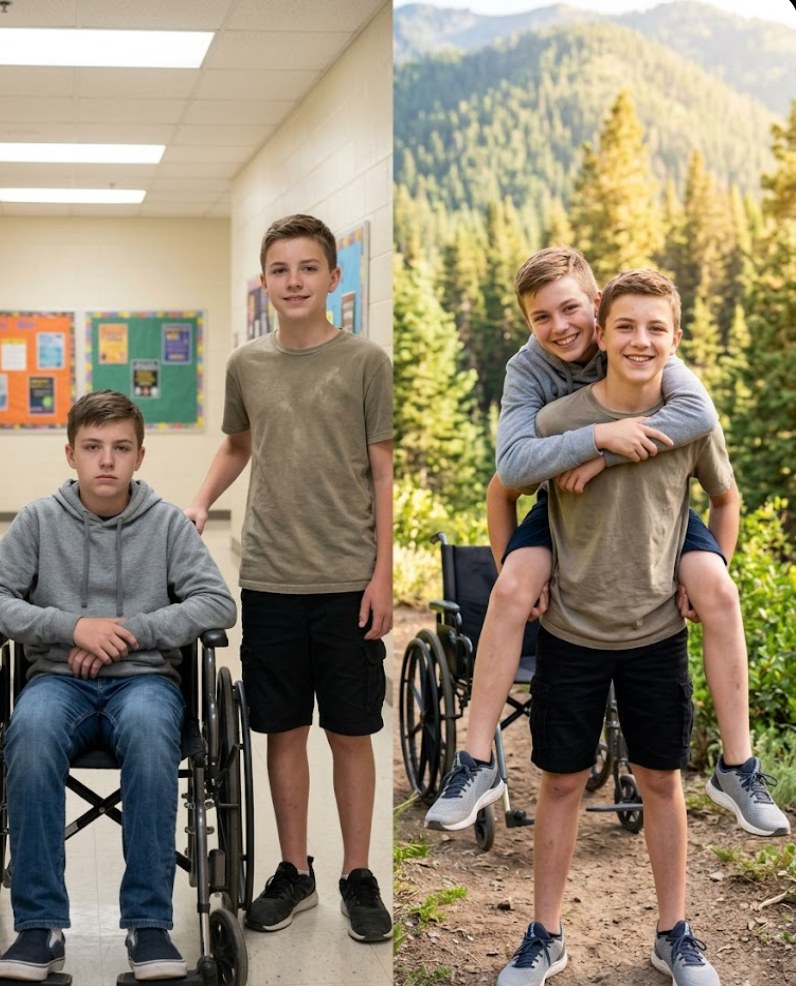
Raising my twelve-year-old son Leo has not been simple since his father passed away three years ago. Something in him grew quiet after that. Not distant in a cold way, but guarded, as if he had placed his feelings somewhere deep where no one could reach them. I often wondered if that brightness he once had was just… resting, or if it had faded for good.
Then one afternoon, he came home upset—more than usual. It was about his best friend Sam.
Sam has used a wheelchair his entire life, and the school had planned a six-mile hiking trip. The kind with steep trails and uneven ground. The administration decided it was too dangerous for him, so they arranged for Sam to stay behind at the base camp. It was meant as caution. But to Leo, it felt like something else. Like being left out of a moment that mattered.
He didn’t argue much at home. He rarely does. But something in him had already decided.
When the buses returned on Saturday, I saw him before he said a word. His clothes were covered in dried mud, his face pale with exhaustion. There was no pride in it—just weight. When I finally understood what he had done, my heart tightened.
He had carried Sam. The entire way.
Six miles. Uphill paths, narrow turns, terrain no child should handle alone, let alone while carrying another. He ignored instructions, avoided supervision, and chose a route that made it possible—but also made it dangerous. Even when Sam asked him to stop, he kept going.
It wasn’t just bravery. It was something heavier, something not yet shaped by judgment.
Mr. Dunn, his teacher, was right to be upset. Rules exist for a reason. Safety is not a suggestion. And as I listened to the lecture, I couldn’t argue with the facts. What Leo did could have ended very differently.
But facts are not always the full story.
The next morning, the principal called and asked me to come in immediately. His voice carried something unusual—uncertainty, maybe.
Outside the office stood five men in formal military uniforms. They were still, composed, not imposing, but unmistakably serious. Inside, Leo was crying, apologizing over and over. He thought he had done something unforgivable.
A lieutenant named Carlson spoke first. Calmly.
They were not there to punish him.
They had come because of what his actions represented.
Sam and his mother arrived soon after. She explained that Sam had lost his father not long ago—a military general who had served alongside those very men. For years, Sam had watched life from the edges, accepting limits without complaint. And for the first time, he had stood—at least in experience—on a mountain peak.
That mattered more than the distance itself.
The soldiers spoke about a principle they lived by: not leaving anyone behind. They saw something of that in Leo. Not in the way he broke rules, but in the reason he couldn’t accept leaving his friend behind.
Still, what Leo did was not without fault.
Courage without restraint can become recklessness. And love, when it refuses to listen, can put both people at risk. That part needed to be understood—not ignored because the outcome was good.
Lieutenant Carlson acknowledged both sides. He didn’t praise blindly. He honored the intention, while making clear that strength also means knowing when to stop, when to ask for help, when to protect not just the moment, but the people within it.
Then, unexpectedly, they offered Leo a scholarship—something arranged through their veteran community. Not as a reward for breaking rules, but as an investment in the kind of character they believed could grow, if guided well.
A captain named Reynolds removed a patch from his uniform and placed it in Leo’s hands. Not as a symbol of what he had done, but of what he was expected to become.
Later, I watched Leo and Sam in the hallway. Just two boys again. Laughing, relieved, lighter than they had been in a long time.
Something in Leo had shifted. Not suddenly, not perfectly. But there was movement. The quiet inside him was no longer empty. It held something steady now.
He had acted from a place of care. Now he would need to learn how to carry that care with wisdom.
And maybe that is how strength begins—not in doing something grand, but in learning how to hold both heart and judgment at the same time.