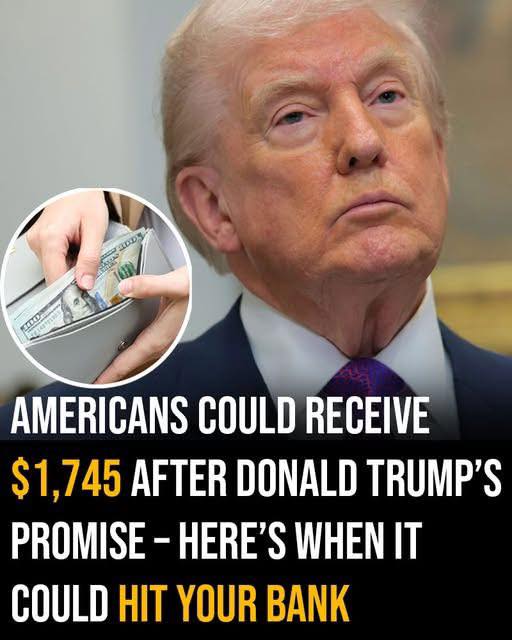
bank account, and why the Supreme Court just changed everything about how this money moves. The figure—$1,745—did not appear out of thin air. It represents your share of a staggering $231 billion that American families paid in tariff-related costs between February 2025 and January 2026, according to estimates from the Joint Economic Committee Democrats. That is not abstract policy. That is real money drained from household budgets, absorbed by higher prices on everyday goods, quietly vacuumed out of working-class pockets while Washington debated who deserved relief and who could afford to wait.
Donald Trump has been promising to return that cash. For months, he floated the idea of a dividend-style payment, reminiscent of the $2,000 stimulus checks that became a lifeline during earlier economic crises and cemented his reputation as a president who put money directly in people’s hands. The original vision was elegant in its simplicity: take the revenue generated by tariffs and redistribute it directly to the people bearing the cost. It sounded like justice, a rare moment when political rhetoric matched economic reality, when the government admitted that trade wars hurt real people and offered tangible compensation. But that version died the moment the Supreme Court of the United States overruled the mechanism, declaring that financing checks directly through tariff revenue crossed constitutional lines in a way that could not be remedied by legislative tweaks. The dividend became a legal impossibility overnight, leaving millions to wonder if the promise would vanish entirely or merely mutate into something unrecognizable.
What emerged from that judicial wreckage is different—less ambitious, more complicated, and legally fragile. Instead of a dividend, officials now discuss a refund. The distinction matters more than semantics or accounting terminology. A dividend implies profit-sharing, a bonus from a booming trade strategy that enriched the treasury beyond expectations, a gift from a generous administration. A refund acknowledges something darker and more honest: that you were overcharged, that the government extracted too much through indirect taxation disguised as trade policy, and that it now owes you restitution rather than generosity, repayment rather than charity. The targeting has sharpened too, reflecting political reality. Trump indicated these payments would focus specifically on Americans earning under $100,000 annually—the very households most crushed by eighteen months of inflated prices at the gas pump, the pharmacy counter, and the grocery store checkout line, the demographic that feels every price increase in their bones and their empty refrigerators.
The timeline remains infuriatingly vague, stretching patience to its breaking point. Trump has suggested that back-payments could begin circulating around mid-2026, a date that feels both distant and cruelly uncertain for households drowning in debt today. Even that projection hangs by a judicial thread, contingent on further Supreme Court clarifications and legislative maneuvering that has not yet begun in earnest. In October 2025, he floated the dividend approach with characteristic confidence; by November, a carefully worded post on Truth Social confirmed only that the idea was being worked on, offering no specifics, no guarantees, only the vague assurance that someone, somewhere was thinking about it. Since then, radio silence—except for the growing anxiety of families who have already paid the $1,745 through inflated receipts and shrunken purchasing power, now being asked to wait for permission to reclaim what was effectively taken from them while the bureaucracy grinds forward at its own indifferent pace.
This is where the story becomes painfully personal. Behind every policy debate sits a kitchen table where parents calculate whether they can afford new shoes for growing children or decide which bill to delay. Behind every tariff statistic stands a worker who skipped a doctor’s appointment to cover the electric bill, a senior choosing between medication and heat, a young couple postponing their wedding for the third time. The $1,745 is not a windfall or a gift; it is a correction, an admission that economic warfare has civilian casualties who never signed up for the fight. Whether it arrives in mid-2026 or evaporates into another broken promise depends on nine justices in robes and one president’s ability to navigate a legal maze while families watch their savings dwindle and their hope curdles into cynicism.
For now, the money remains theoretical, existing only in press releases and speculative news cycles that raise hopes before dashing them against the rocks of procedural reality. The checks are not printed. The direct deposits are not scheduled. All that exists is a number—$1,745—floating in the political ether, heavy with possibility and burdened by the weight of waiting. You have already paid it through higher prices and tighter budgets and the quiet desperation of making ends meet. The only question left is whether anyone in power will have the courage and competence to give it back before the waiting breaks something fundamental in the people who trusted them to lead.