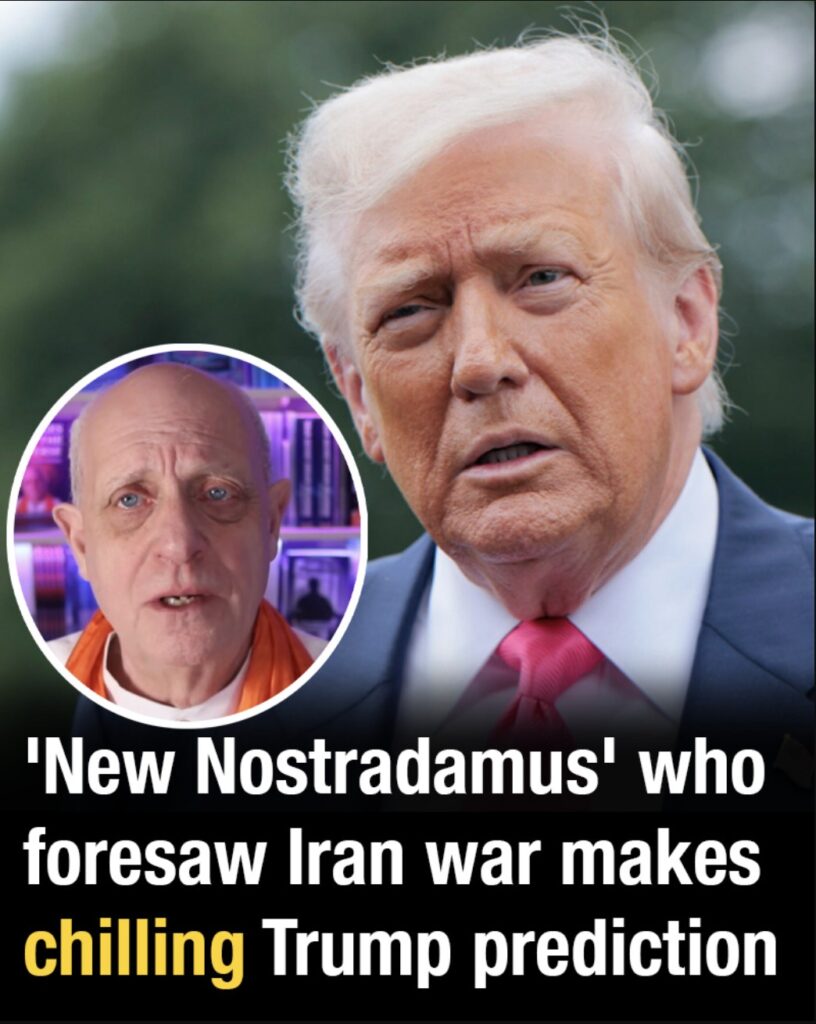
A recent claim by a self-described psychic has sparked renewed discussion about the limits of presidential power in the United States. Craig Hamilton-Parker, a British figure who has built a following through public predictions, has suggested that Donald Trump could, under certain conditions, return for a third term in the White House. While the statement has drawn attention online, it also raises a more grounded question about how firmly established political boundaries hold during periods of uncertainty.
Hamilton-Parker frames his prediction within a broader vision of global instability, pointing to rising geopolitical tensions, including concerns around Taiwan and ongoing conflicts in the Middle East. According to his interpretation, moments of sustained crisis can place pressure on political systems, creating an environment where previously unthinkable scenarios begin to be discussed more openly. His argument is not presented as a legal pathway, but as a reflection of how systems might be tested under strain.
From a constitutional standpoint, however, the framework remains clear. The 22nd Amendment to the United States Constitution explicitly limits presidents to two elected terms, a rule that has been in place for decades and is widely regarded as a cornerstone of modern American governance. Changing or bypassing that limit would require a complex legal process involving constitutional amendment or an unprecedented reinterpretation of existing law—neither of which can occur without significant institutional agreement.
Even so, the attention surrounding predictions like this often reveals less about their literal accuracy and more about the climate in which they emerge. Periods marked by political division, global uncertainty, and rapid information flow can amplify speculative ideas, especially those that challenge established norms. In that sense, the discussion is not necessarily about whether such a scenario is likely, but about why it resonates at a particular moment.
Hamilton-Parker’s comments also touch on a broader concern that extends beyond any single figure: how societies respond under pressure. History has shown that in times of crisis, public tolerance for change can shift, sometimes in ways that would have seemed unlikely under normal conditions. That does not mean established rules disappear, but it does highlight the importance of institutional resilience and public trust in maintaining them.
Ultimately, the claim of a potential third presidential term remains speculative and unsupported by current legal reality. Yet the conversation it generates reflects an ongoing tension between stability and uncertainty—between what is formally established and what people fear could be challenged. In that space, the responsibility falls not only on institutions to uphold clear boundaries, but also on the public to distinguish between possibility, perception, and fact.