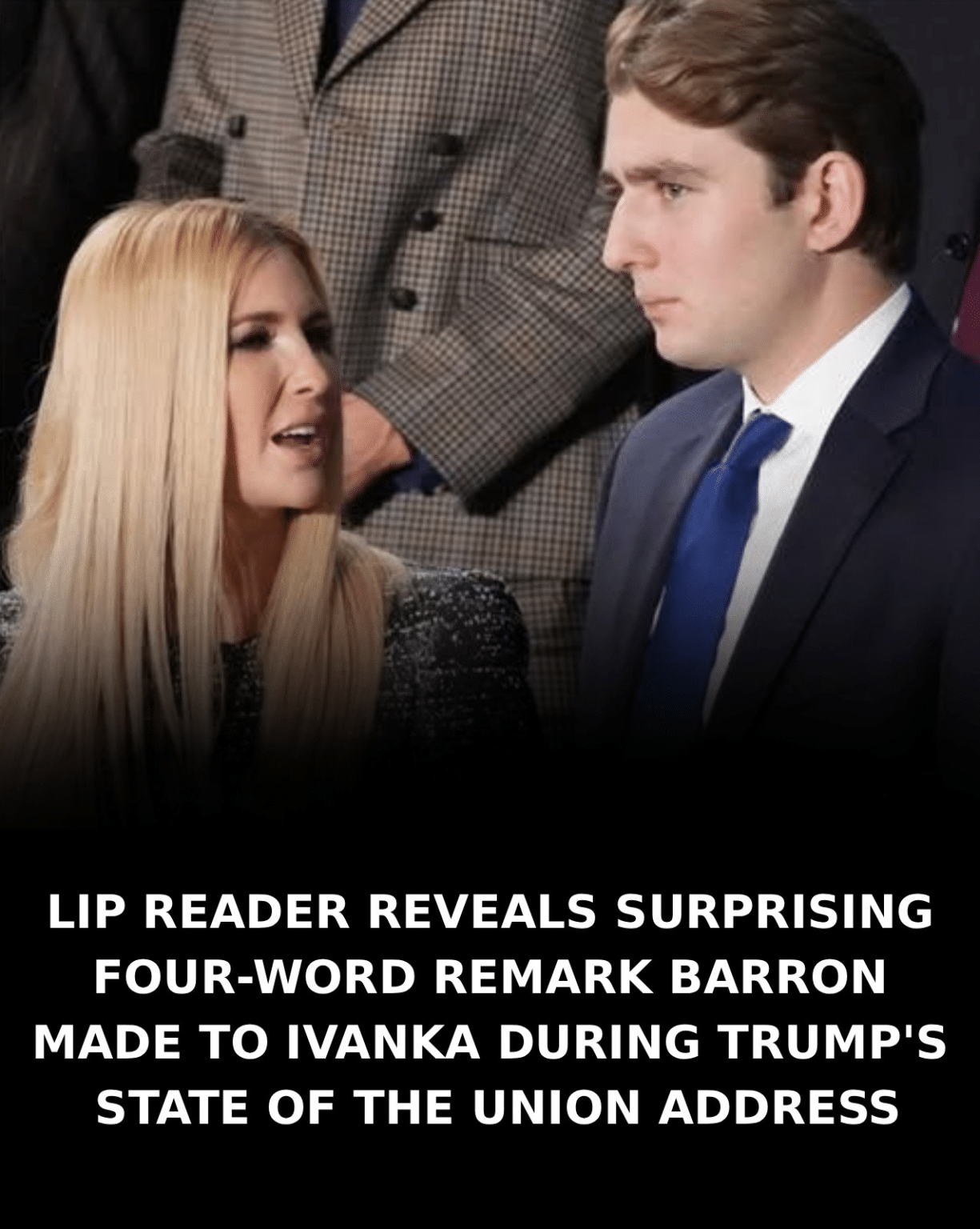
A recent media claim suggests that a lip reader interpreted a brief exchange between Barron Trump and Ivanka Trump during a State of the Union address delivered by Donald Trump.
According to reports, professional lip reader Jeremy Freeman told the Mirror that Ivanka appeared to turn toward Barron and ask, “What are you doing on…?” though the final word could not be interpreted. Freeman further claimed that Barron responded with a casual remark indicating uncertainty.
It is important to note that lip-reading interpretations are inherently speculative. Without audio confirmation, context, or verification from those involved, such reconstructions remain estimates rather than confirmed facts. Small shifts in camera angle, lighting, facial positioning, or partial visibility can significantly alter interpretation.
The Context of the Address
The speech itself — reported to have lasted 1 hour and 48 minutes — focused on economic performance, political criticism, foreign affairs, and references to religion. During the address, Donald Trump also praised Melania Trump, highlighting her public initiatives and joking about her bipartisan support.
Members of the Trump family, including Melania, Ivanka, and Barron, were present in attendance. For Barron, the appearance reportedly marked one of his first major public events since the inauguration.
Public Curiosity and Private Moments
Brief side conversations during long political speeches are common. Family members attending such events may exchange comments unrelated to the address itself — about seating, timing, or even fatigue during lengthy proceedings.
When cameras capture those moments, public curiosity often fills in the gaps. However, without clear audio or confirmation, assigning precise wording can risk overstating certainty.
Lip reading is a specialized skill, but it is not infallible. Experts themselves often caution that interpretation depends heavily on visible articulation and context.
A Broader Reflection
In an era where every glance and whisper can become a headline, even casual exchanges are amplified. Yet not every captured moment carries deeper meaning.
Particularly for younger family members of public officials, the balance between public visibility and personal privacy remains delicate. A short exchange during a long speech may simply be that — a brief, ordinary interaction magnified by attention.
Until confirmed by those involved, the reported wording remains unverified. What is clear is that the exchange itself was brief, its context uncertain, and its interpretation open to question.
In highly visible political settings, sometimes the smallest moments generate the loudest speculation — even when the meaning may be simple.