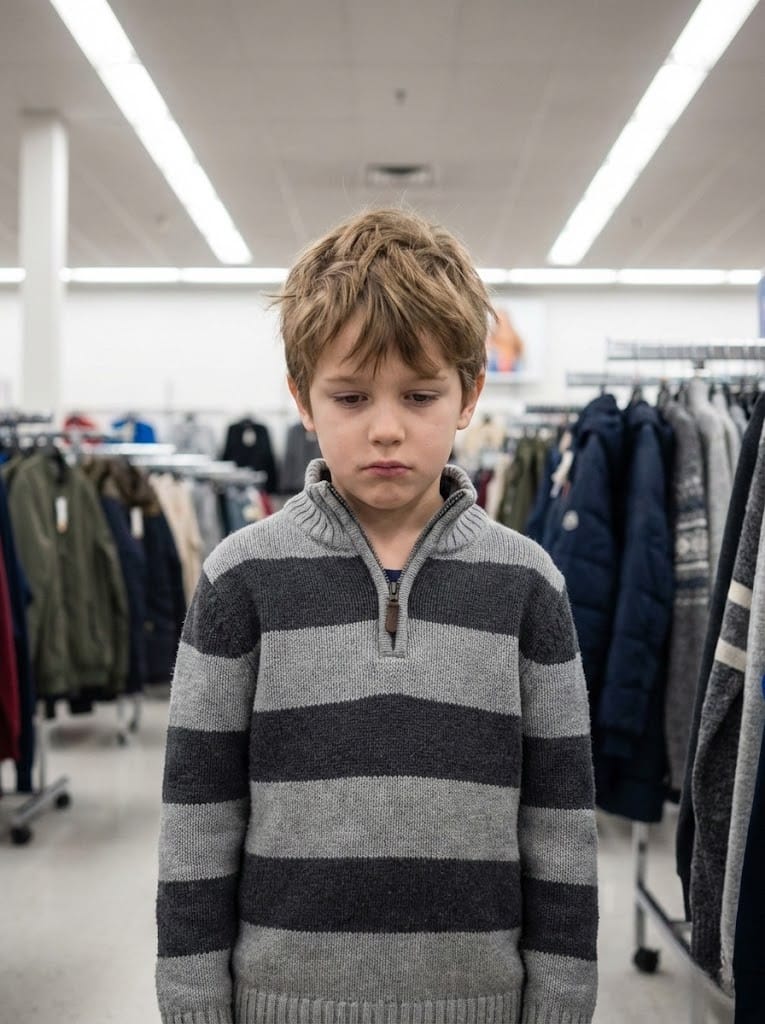
I was standing in the middle of a Goodwill aisle, holding a navy winter coat against my chest like it was something we could finally afford to hope for. Our son Liam stood beside me, shivering in a thin hoodie that had long stopped doing its job. His limp — the result of a surgery insurance had refused three times — was never far from my mind.
When my husband Mark reached over and pushed the coat back onto the rack, his voice was flat.
“We can’t.”
Twenty dollars.
That was all it cost.
For months, he had changed in ways I didn’t recognize. The garage was suddenly locked. Our spending was watched closely. He skipped meals. He walked instead of driving. He grew thinner, quieter, distant.
I told myself he must be hiding something — debt, another life, some quiet collapse I hadn’t seen coming.
That fear grew until I couldn’t hold it anymore.
One night, I found a small key taped under his nightstand and opened the locked box in the garage. I expected something ugly.
What I found was a bank book.
Money slowly added.
Then slowly drained.
Down to zero that very morning.
Underneath it were hospital invoices.
Liam’s surgery.
Paid in full.
My breath left me.
Mark came home not long after, still in the reflective vest from a second job I never knew existed. He didn’t get angry. He just sat beside me and explained — gently, tiredly — that we hadn’t been “broke.”
We had been twenty dollars short of the final deadline.
If that payment hadn’t gone through, we would’ve lost the surgery slot.
The coat could wait.
The doctor couldn’t.
He told me he’d been walking to work to save gas. Making coffee at home. Skipping lunches. Saying no to everything that wasn’t essential.
Not because he didn’t care about warmth.
Because he cared about Liam’s future more.
“Lunch: skip.
Coffee: home.
Gas: walk.
Doctor first.”
That night, a neighbor quietly left winter clothes on our porch — coats, gloves, scarves — no note, no recognition.
Liam slept between us in a warm parka, breathing easily for the first time in weeks.
And I understood how wrong I had been.
I had mistaken silence for secrecy.
Sacrifice for neglect.
Love for distance.
Some people don’t express devotion with words.
They express it with discipline.
With quiet endurance.
With choosing the long road when the short one hurts less.
Love isn’t always what feels comforting in the moment.
Sometimes it’s what carries you through years.
And I learned something that night:
The ones who seem hardest to reach are often the ones carrying the heaviest load — not away from you, but for you.
Not all love is loud.
Some of the strongest love works quietly in the background, making sure tomorrow is possible — even when today feels cold.
And sometimes, what looks like loss is actually protection in disguise.