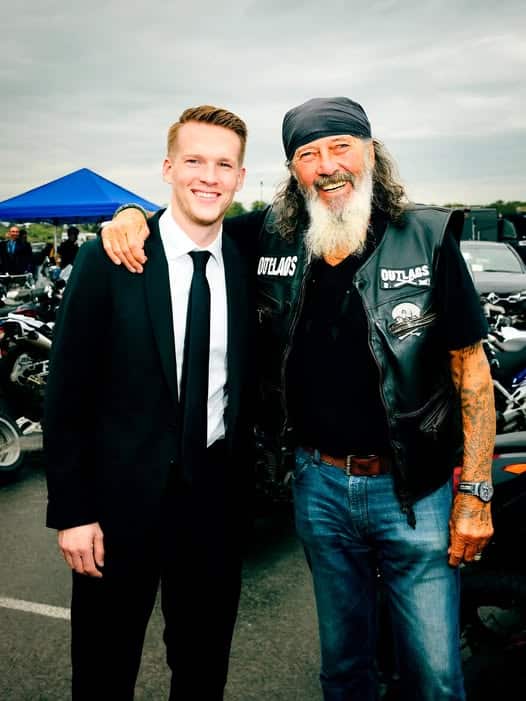
The story of Big Mike and David unsettles the familiar idea of what a “proper” family is supposed to look like. It doesn’t begin in a living room or a courtroom, but on an oil-stained concrete floor, where a six-foot-four mechanic found a fourteen-year-old foster runaway digging through a dumpster for food. Mike didn’t ask questions meant to corner the boy. He didn’t threaten him with rules or authorities that had already failed. He handed him a sandwich. Then he put a wrench in his hand and showed him where to stand.
That choice did not resemble rescue as it’s usually described. It was quiet, practical, and unrecorded. But over time, it changed everything. The boy who had been written off as disposable grew into a man who understood systems, contracts, and law. Not because he was lifted out of hardship all at once, but because someone decided he was worth keeping around long enough to learn.
For years, David struggled to reconcile that beginning with the world he later entered. In law school and professional offices, origins were something to be managed. Mike became a “family friend,” a partial truth designed to smooth conversations. David learned the language of polish and distance, even as it created a rift inside him. The shame wasn’t about Mike—it was about the fear that gratitude and respect might disqualify him from belonging.
That tension came to a head when the city moved to condemn Mike’s motorcycle shop, labeling it a blight. The language was procedural, neutral on the surface. But David recognized what it meant. The shop wasn’t being erased for safety or zoning alone. It was being erased because it didn’t fit the image of respectability.
Returning to defend the place where he’d been fed and taught was not nostalgia. It was accountability.
In court, the case shifted unexpectedly. One by one, people testified—not just David, but doctors, teachers, social workers, and professionals who had once slept on the shop’s backroom couch or eaten sandwiches at its workbench. One senior partner quietly identified himself as another “dumpster kid.” The proceedings stopped being about land use and became something harder to dismiss: evidence of lives that had been stabilized rather than discarded.
The city’s definition of “community impact” began to unravel.
The judge’s ruling did not romanticize Mike’s methods. They were informal. They weren’t documented. But the outcome was undeniable. What the state had failed to provide, this place had supplied—safety, skill, and a reason to stay alive. The shop was not a blight. It was an asset, precisely because it refused to sort people by their usefulness.
Today, Big Mike’s Custom Cycles still smells of grease and hot metal. Teenagers still drift in, often angry, often hungry. The response hasn’t changed. A sandwich. A tool. A chance to stay.
David moves easily now between the courtroom and the shop, no longer dividing himself. Grease under his fingernails doesn’t cancel the suit in his closet. Both belong. He understands what took years to accept: family is not defined by bloodlines or paperwork, but by the person who decides you are not disposable when the world has already made up its mind.
Some forms of mercy don’t announce themselves. They just keep showing up—one kid at a time.