Carrie Underwood Turns ‘Do-Re-Mi’ Into a Joyful, Heartwarming Moment That Transforms the Von Trapp Children and Fills the Room with Pure Musical Magic
The Rhythmic Do-Re-Mi: Carrie Underwood Brings Fresh Energy to a Classic Moment
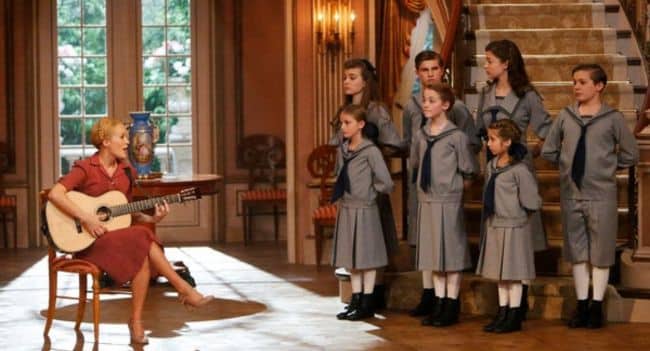
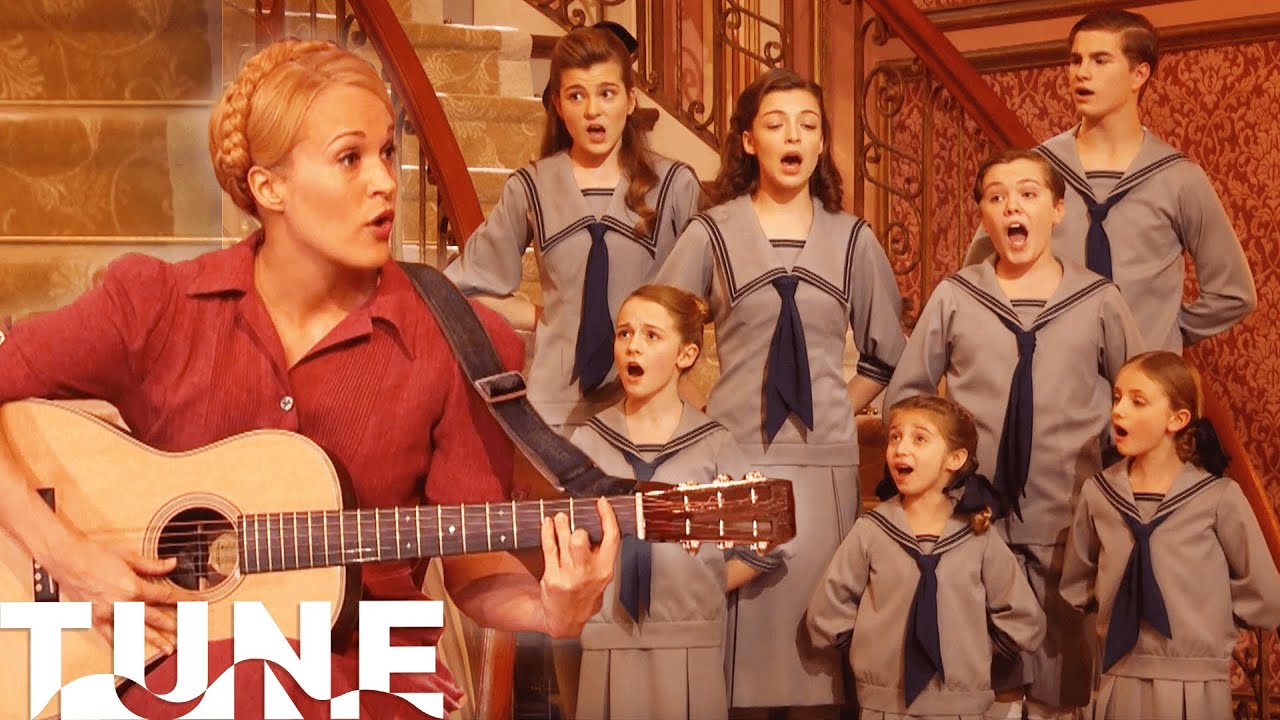
When Carrie Underwood stepped onto the Sound of Music Live set as Maria, she carried the gentle determination of someone trying to make a good first impression. Maria faces the Von Trapp children with nothing but a hopeful smile, aware that she’s walking into a home defined by discipline, loss, and silence. The children stand in their neat lines, unsure of who this newcomer is or what she expects from them.
Then Carrie does what Maria has always done best: she lets music speak first.
Her “Do-Re-Mi” doesn’t leap out of the gate. It unfolds. The opening notes feel like a soft invitation — patient, welcoming, almost shy. She guides the children through each syllable with the ease of someone opening a window, letting in a little fresh air and a new way of seeing the world. Slowly, the melody gathers buoyancy, and the stiffness in the room begins to loosen.
Carrie infuses the moment with a gentle playfulness. She never pushes the energy; she lets it build naturally around her, each chord shift giving the children another reason to trust her. Their faces move from guarded to intrigued to fully lit with excitement. Halfway through the number, they’re echoing her lines with genuine joy, their movements falling into an easy rhythm — as if the notes had been waiting inside them all along.
The staging leaves space for the moment to breathe. There’s motion, but never chaos. The harmonies land with a clean, buoyant lift that seems to brighten the room itself. Maria becomes less of an authority figure and more of an older sister, guiding them through the building blocks of music with tenderness, humor, and a quiet understanding of their fears.
By the time the final note settles, something fundamental has changed. The house no longer feels cold. The children look at Maria with new eyes. She’s not the stranger who walked in earlier — she’s the one who found the door into their hearts the only way it could be opened.
Carrie Underwood’s “Do-Re-Mi” works because it honors the essence of the story: that music is a bridge, a refuge, and sometimes the gentlest way to heal. It’s connection made audible — a reminder that when words fail, a melody can still lead the way.
{"post":94264,"page":1,"next":[{"id":94236,"title":"\u201cGO TOWARD THE LIGHT,\u201d NAOMI TOLD WYNONNA: Remembering The Judds\u2019 \u2018Final\u2019 Concert, The Hits That Defined A Generation, And The Heartfelt Reunions That Proved Goodbye Was Never Really Forever","url":"https:\/\/new24.info\/94236"},{"id":94232,"title":"Jordan Davis Joins Little Big Town For A Heart-Stopping Performance Of \u201cGo Tell It On The Mountain\u201d At CMA Country Christmas That Will Leave You Replaying It All Season","url":"https:\/\/new24.info\/94232"},{"id":94229,"title":"\u201cLET\u2019S ROCK AROUND THE CHRISTMAS TREE!\u201d Lauren Alaina Brings Holiday Magic To Life With Her Spunky Covers Of Classic Christmas Hits During NBC\u2019s Christmas In Nashville Special, Delivering Joy, Energy, And A Dash Of Country Charm","url":"https:\/\/new24.info\/94229"},{"id":94224,"title":"Ariana Grande and Kelly Clarkson unleash a HOLIDAY HARMONY so fierce it stunned even them onstage.","url":"https:\/\/new24.info\/94224"},{"id":94220,"title":"Brad Paisley And Kimberly Williams-Paisley STUN Nashville With A Christmas Giveaway Nobody Saw Coming","url":"https:\/\/new24.info\/94220"},{"id":94214,"title":"Four Titans Of American Rock\u2014bruce Springsteen, Bob Dylan, Jon Bon Jovi, And Patti Scialfa\u2014 Just Shattered Every Expectation, Detonating The Announcement Of The Century: The 2026 \u201cOne Last Ride\u201d Tour. What Was Supposed To Remain A Closed Chapter Has Erupted Back To Life Like A Thunderbolt, Sending Millions Into A Frenzy As Whispers Turned Into Confirmations And Confirmations Sparked A Cultural Wildfire. Springsteen Grinned And Admitted, \u201cOne More Run Won\u2019t Kill Us,\u201d Dylan Called It \u201cA Final Blaze Before The Dark,\u201d While Bon Jovi Roared, \u201cIf We\u2019re Doing This\u2014then We\u2019re Doing It Loud.\u201d From Legendary Arenas Preparing For Stampedes To Hidden Cities No One Saw Coming, This Tour Isn\u2019t A Reunion\u2014it\u2019s A Once-in-a-lifetime Supernova Forming In Real Time.","url":"https:\/\/new24.info\/94214"},{"id":94210,"title":"\u201cI Still Hear His Laugh\u2026 I Still See Him Standing There On That Field.\u201d Bruce Springsteen Opened One Of The Most Emotional Tributes Of His Career \u2014 A Raw, Intimate Farewell To His Late Friend Joe Depugh, The High-school Pitcher Whose Life And Spirit Breathed Truth Into \u201cGlory Days.\u201d What Began As A Chance Reunion Outside A Bar In 1973 \u2014 \u201cOut Of Nowhere, There He Was\u2026 Grinning Like No Time Had Passed,\u201d Bruce Once Recalled \u2014 Became The Moment That Sparked One Of The Most Iconic Songs Of His Generation. Joe Depugh Wasn\u2019t Just A Character In A Lyric; He Was A Living Reminder Of Youth, Grit, And The Sweetness And Sting Of Time Slipping By. Now, As News Of Joe\u2019s Passing Spread, Springsteen Stepped Forward With A Tribute That Hit Like A Punch To The Heart. He Spoke Of Backyard Ball Games, Of Joe\u2019s Fastball That \u201cCame In Like It Had Somewhere To Be,\u201d And Of The Quiet Humility That Made Him Unforgettable. Fans Said They\u2019d Never Seen Bruce\u2019s Voice Falter Like This \u2014 Grief Mixing With Gratitude, Memory With Music.","url":"https:\/\/new24.info\/94210"},{"id":94204,"title":"\u201cIt\u2019s Like The Whole World Fades Away \u2014 All I Feel Is This Fire I Can\u2019t Control.\u201d Keith Urban And Kelly Clarkson Didn\u2019t Just Take The Stage For A Christmas Duet \u2014 They Set The Entire Season Ablaze. From The First Note Of Go Home With You, The Air Shimmered With A Connection So Raw, So Electric, It Left Fans Breathless. Their Voices Intertwined Perfectly, But It Was The Intensity In Their Eyes, The Lingering Glances, And The Subtle Smiles That Had The Audience Gasping And Hearts Racing. \u201cI\u2019ve Never Felt Anything Like This In A Holiday Show\u2026 It\u2019s Like Watching Sparks Ignite In Real Time,\u201d One Fan Wrote, Capturing The Thrill And Tension That Rippled Through The Arena And Across Millions Of Screens Worldwide. The Performance Quickly Became A Social Media Storm, With Over 5 Million Viewers Replaying Every Second, Debating Every Look, And Wondering If The Duet Hinted At Something Beyond The Music. What Started As Holiday Magic Transformed Into A Dangerously Intimate Moment, Stopping The Show In Its Tracks And Leaving The World Captivated, Shocked, And Completely Spellbound.","url":"https:\/\/new24.info\/94204"},{"id":94201,"title":"\u201cI Just Needed Every Word To Be Honest\u2026 To Hurt, To Heal, To Live.\u201d Kelly Clarkson\u2019s Rendition Of Tennessee Whiskey On Kellyoke Didn\u2019t Just Start With A Note \u2014 It Started With A Heartbeat. From The First Trembling Sound, The Studio Became A Cathedral Of Raw Emotion, Every Word Dripping With Pain, Every Breath Carrying Decades Of Heartache And Triumph. Fans Watched, Spellbound, As Kelly Didn\u2019t Mimic Chris Stapleton \u2014 She Transcended, Her Voice Soaring, Cracking, And Glowing Like Lightning Striking Through Heartbreak. \u201cI\u2019ve Never Felt Anything Like This\u2026 She\u2019s Singing Straight To My Soul,\u201d One Fan Typed Through Tears, Echoing The Stunned Silence That Filled The Room Before The Thunderous Applause Erupted. Within Hours, The Performance Ignited The Internet, Over 4 Million Fans Declaring It The Most Soul-shattering, Spine-tingling Moment Of Kelly\u2019s Career. Kelly Didn\u2019t Just Sing A Song \u2014 She Poured Every Fiber Of Her Being Into It, Forcing The World To Stop, Listen, And Feel The Unfiltered Weight Of Her Heart","url":"https:\/\/new24.info\/94201"},{"id":94197,"title":"\u2018She Is The Voice Of Our Shared Conscience And The Heart Of This City,\u2019 The Boss, Bruce Springsteen, Reportedly Declared, Before The Legendary Night In N.y.c. Saw A Tearful, Powerful Surge Of Celebrity Reverence As Actor Johnny Depp Unexpectedly Picked Up A Guitar To Join Springsteen And A Coalition Of Rock Giants On Stage, Delivering A \u2018Spontaneous, Soul-stirring Tribute\u2019 That Celebrated The Life And Enduring Impact Of The Incomparable Patti Smith","url":"https:\/\/new24.info\/94197"},{"id":94194,"title":"Ella Langley Broke Down in Tears After Seeing What Her Mom Did on the NFR Runway","url":"https:\/\/new24.info\/94194"},{"id":94189,"title":"Michael Bubl\u00e9 Turns Vatican Concert Into a Once-in-a-Lifetime Miracle And Even Gets the Pope to Sing Along","url":"https:\/\/new24.info\/94189"},{"id":94184,"title":"Carol Burnett Sent 30 Million Americans Into Total Madness With a Curtain Rod on Her Shoulders","url":"https:\/\/new24.info\/94184"},{"id":94178,"title":"Kane and Katelyn Brown\u2019s Hit Song Just Exploded Into a Christmas Movie With a Twist NO ONE Saw Coming","url":"https:\/\/new24.info\/94178"}]}