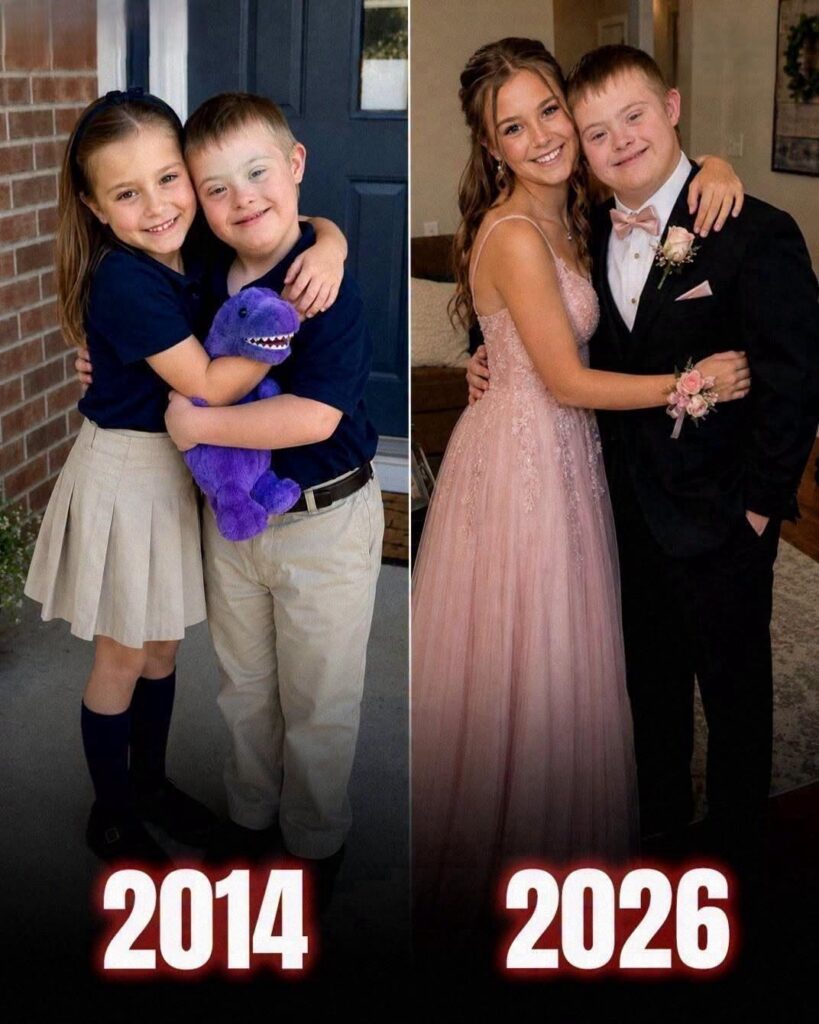
Twelve years later, he still remembered.
We became friends in first grade because we both hated raisins and loved dinosaurs.
Noah had Down syndrome, but our friendship was built around much more ordinary things.
He loved baseball.
I loved drawing.
He remembered statistics from games played years earlier and thought my drawings looked like “potatoes with arms.”
We argued.
Laughed.
Shared snacks.
And somehow became inseparable.
One afternoon, our teacher announced she was getting married.
Noah declared that his own wedding would have chocolate cake and absolutely no slow songs.
A boy across the table laughed.
“Who’s going to marry you? Nobody will.”
Noah’s smile disappeared.
I became furious.
“That’s stupid. Somebody will love Noah.”
He looked at me.
“Would you?”
I considered the question with all the seriousness a six-year-old could manage.
“Maybe. But first we have to go to prom.”
“What’s prom?”
“A dance when we’re almost grown-ups.”
He held out his pinkie.
“Promise?”
“Promise.”
Over the years, our friendship changed, but it never disappeared.
We weren’t always in the same classes.
We developed different interests.
I had other friends, and so did Noah.
But we kept finding our way back to each other.
When my parents divorced, he noticed I had stopped talking as much.
He didn’t demand explanations.
He invited me to baseball games.
Brought me ridiculous jokes.
And occasionally sat beside me without saying anything.
Years later, when my first boyfriend broke my heart, Noah arrived with ice cream.
“I told you he was an idiot,” he announced.
I laughed so hard I nearly spilled it.
He looked pleased.
“See? I’m usually right.”
“You are not.”
“About baseball, I am.”
That was Noah.
He didn’t always know what to say.
Neither did I.
But we knew how to be friends.
When senior prom approached, I didn’t need to think about whom I wanted to go with.
Noah asked me first.
“Remember our promise?”
I smiled.
“Obviously.”
He grinned.
“I was making sure you didn’t forget.”
We chose our outfits together.
He insisted on a navy suit.
I helped him find a bow tie.
He gave very strong opinions about my dress, most of which I ignored.
Everything felt wonderfully ordinary.
Until prom night.
Noah arrived holding my corsage.
He looked proud and nervous.
My mother opened the front door.
The moment she saw him, her expression changed.
She stared at him for several seconds.
Then she smiled and said I would be downstairs soon.
A minute later, she entered my bedroom.
“Can we talk?”
I was fastening my earrings.
“About what?”
She closed the door.
“You can go with Noah tonight,” she said, “but there’s something I need to tell you first.”
I turned toward her.
“Mom, what’s wrong?”
Her eyes filled with tears.
“It’s about something that happened when your father left.”
I remembered that year.
I had been twelve.
My parents’ divorce had changed everything.
I stopped eating lunch at school.
I didn’t want to talk when Mom asked what was wrong.
I was angry at Dad.
Angry at her.
Angry that our family had fallen apart while everyone expected me to continue behaving normally.
Mom told me that one afternoon, she’d been crying in the school parking lot.
Noah had noticed.
He approached her and asked whether I was all right.
She admitted she was worried about me.
Then Noah said something she had never forgotten.
“I don’t know how to fix people. I just know how to stay.”
Mom began crying again as she repeated it.
“I asked him to look after you,” she said.
“And he told me he would.”
I sat quietly.
For years, I had never known about that conversation.
But I remembered Noah inviting me outside when I wanted to stay in my room.
I remembered him sitting with me during lunch.
I remembered how he never acted offended when I didn’t feel like talking.
“Why didn’t you tell me?” I asked.
Mom wiped her eyes.
“Because I didn’t want you to feel you owed him something.”
I frowned.
“What do you mean?”
She sat beside me.
“I was afraid that you’d spent years being his friend because you felt responsible for him. And perhaps he’d been looking after you because I asked him to.”
I looked at her.
“Mom, Noah isn’t a responsibility.”
“I know.”
“He’s my best friend.”
She nodded.
“I understand that now.”
I thought about the little boy downstairs.
The one who had promised me a dance twelve years earlier.
He hadn’t spent those years following instructions from my mother.
He had his own life.
His own opinions.
His own stubbornness.
Sometimes he needed my help.
Sometimes I needed his.
And sometimes we annoyed each other so much that we didn’t speak for an afternoon.
That’s what friendship looked like.
Not a permanent rescue mission.
Not a childhood promise that neither of us was allowed to outgrow.
Just two people who kept choosing each other’s company.
“Mom,” I said gently, “I’m going with Noah because I want to.”
She smiled through her tears.
“I know, sweetheart.”
Then she hugged me.
“Go have a wonderful time.”
When I came downstairs, Noah stood by the window examining his bow tie in the reflection.
He turned.
“Finally!”
I laughed.
“You’ve been here ten minutes.”
“Eleven.”
He held out the corsage.
“You look nice.”
“Thank you. So do you.”
He straightened his jacket.
“I know.”
Mom burst out laughing behind us.
We took photographs on the porch.
Noah insisted on one serious picture and another where we made dinosaur faces.
At prom, he danced enthusiastically.
He complained when the DJ played slow music.
He drank too much lemonade and spent twenty minutes debating baseball with our history teacher.
Near the end of the evening, a slower song began.
Noah looked at me.
“Want to dance?”
“Didn’t you say slow songs were boring?”
He shrugged.
“I changed my mind.”
So we danced.
Not because we were fulfilling a duty.
Not because we had to prove anything to anyone.
Because it was prom night.
And we were happy.
Later, as we walked outside, Noah looked up at the stars.
“We kept our promise,” he said.
“We did.”
He smiled.
“Pretty good for two six-year-olds.”
I laughed.
Then I thought about what Mom had told me.
For years, she had carried gratitude for a boy who had been kind to her daughter during a difficult time.
But Noah had never asked to be treated as a hero.
He had simply been a friend.
And I had been his.
I didn’t know where life would take us after graduation.
We might attend different colleges.
Find different careers.
Build lives in different cities.
Perhaps our friendship would change, as friendships sometimes do.
But I was grateful for every year we’d shared.
Because the most beautiful part of our childhood promise wasn’t that we had kept it.
It was that, twelve years later, we were both still free to choose—and we chose to go together.
{"post":116588,"page":2,"next":[{"id":116584,"title":"Cruel Mother Refuses To Walk Daughter Down The Aisle Before Truth Surfaces","url":"https:\/\/new24.info\/116584"},{"id":116581,"title":"Bride\u0027s Mother Told the Groom He \u0027Wouldn\u0027t Last a Year\u0027 \u2013 Five Years Later, He Sent Her a Package on Their Anniversary","url":"https:\/\/new24.info\/116581"},{"id":116574,"title":"The world is mourning a heartbreaking loss today. A familiar face who touched so many people has died far too soon at just 46","url":"https:\/\/new24.info\/116574"},{"id":116570,"title":"It is with heavy hearts that we announce the passing of this beloved and pioneering actor at just 34","url":"https:\/\/new24.info\/116570"},{"id":116566,"title":"Exhausted Mother Finds Second Refrigerator And Executes Brilliant Legal Eviction Plan","url":"https:\/\/new24.info\/116566"},{"id":116518,"title":"Secret Inheritance Reveals Ultimate Betrayal And Destroys A Greedy Family Forever","url":"https:\/\/new24.info\/116518"},{"id":116560,"title":"My Dad Charged Me $250 a Month for Five Years\u2014After His Funeral, His Best Friend Gave Me a Box That Changed Everything","url":"https:\/\/new24.info\/116560"},{"id":116522,"title":"Wynonna Judd\u0027s Tennessee Farm and Home: Aerial Views, the Gazebo Where She Married, and the Ranch Life She Shares with Her 4-Year-Old Granddaughter \u2014 30+ Photos","url":"https:\/\/new24.info\/116522"},{"id":116519,"title":"A Woman Let Her 11-Year-Old Son Walk Home from School Alone for the First Time \u2013 Twenty Minutes Later, Her Neighbor Called Her Crying, \u0027Come Outside. You Need to See What Your Son Did\u0027","url":"https:\/\/new24.info\/116519"},{"id":116514,"title":"Apologizing Seven Years After Divorce Uncovered A Son With My Exact Eyes","url":"https:\/\/new24.info\/116514"},{"id":116511,"title":"Kelly Clarkson Says a Brooklyn Store Made Her Feel Like Julia Roberts in \u0027Pretty Woman\u0027 \u2014 Here\u0027s Where the Drama Went Next","url":"https:\/\/new24.info\/116511"},{"id":116506,"title":"My Husband Ignored Seven Emergency Calls While His Corporate Betrayal Unraveled","url":"https:\/\/new24.info\/116506"},{"id":116502,"title":"My Husband Told Me To Take My Mess Somewhere Else. So I Took My Bottles, My Career, And My Self-Respect\u2014and Left Him Behind.","url":"https:\/\/new24.info\/116502"},{"id":116499,"title":"They Tried To Dine And Dash\u2014But My Boss Had A Plan I Never Saw Coming","url":"https:\/\/new24.info\/116499"},{"id":116496,"title":"My Ex-Husband Trashed My House After Our Divorce \u2013 My Father Dealt with Him During the Proceedings","url":"https:\/\/new24.info\/116496"},{"id":116491,"title":"I donated bl00d to save my boyfriend after his friends told me he had been in a serious ac:cid:ent. As I was leaving the hospital, I heard someone behind a door say, \u201cI can\u2019t believe she fell for it again.\u201d","url":"https:\/\/new24.info\/116491"},{"id":116487,"title":"My husband\u2019s family waited until after my mother was gone before deciding her $8 million estate should belong to them.","url":"https:\/\/new24.info\/116487"},{"id":116484,"title":"Man Returned from a Three-Day Fishing Trip with a Wedding Ring Mark \u2013 He Hadn\u0027t Worn One in 12 Years","url":"https:\/\/new24.info\/116484"},{"id":116481,"title":"A Man Kept Manspreading Into a Woman\u0027s Plane Seat for Hours \u2013 When He Returned From the Restroom, He Shouted, \u0027What the Hell Did You Do?!\u0027","url":"https:\/\/new24.info\/116481"},{"id":116478,"title":"My 78 Year Old Boss Took Me to a Park and Said As of Today You No Longer Work for Me I Froze Thinking He Was Firing Me After Years of Loyalty Then He Offered to Keep Me Only on One Condition What He Said Made Me Walk Away in Tears","url":"https:\/\/new24.info\/116478"}]}