Behind her, my sisters Paige and Lauren exchanged glances.
My father stood near the door.
“Don’t make this difficult,” he said. “Your mother has her reasons.”
I looked at the four of them.
For twenty-nine years, I had been trying to understand what made me so difficult to love.
Apparently, even on my wedding day, they couldn’t let me stop wondering.
My mother had proudly accompanied both my sisters during their weddings.
She had paid for their celebrations, praised their choices, and reminded everyone how fortunate she was to have such wonderful daughters.
With me, things had always been different.
As a child, I slept in a small attic bedroom while my sisters had spacious rooms downstairs.
They received expensive gifts and overseas holidays.
I learned not to ask for much.
Whenever I questioned the differences, my parents called me ungrateful.
As I grew older, I began asking harder questions.
What happened to the educational trust my grandparents had established for me?
Why had Grandpa Arthur stopped visiting?
Why did my mother become angry whenever I mentioned Grandma’s estate?
Those questions made me the family’s troublemaker.
So I studied accounting.
Eventually, I became a forensic accountant.
I built a life that didn’t depend on my parents’ approval.
And then I met Daniel.
He was the first person who made love feel uncomplicated.
That morning, Daniel stood beside me in the bridal room.
He had heard everything.
“Margaret,” he said, struggling to remain calm, “you can’t speak to her that way.”
My mother folded her arms.
“This is a family matter.”
Then a voice came from the doorway.
“She’s right. It is.”
We turned.
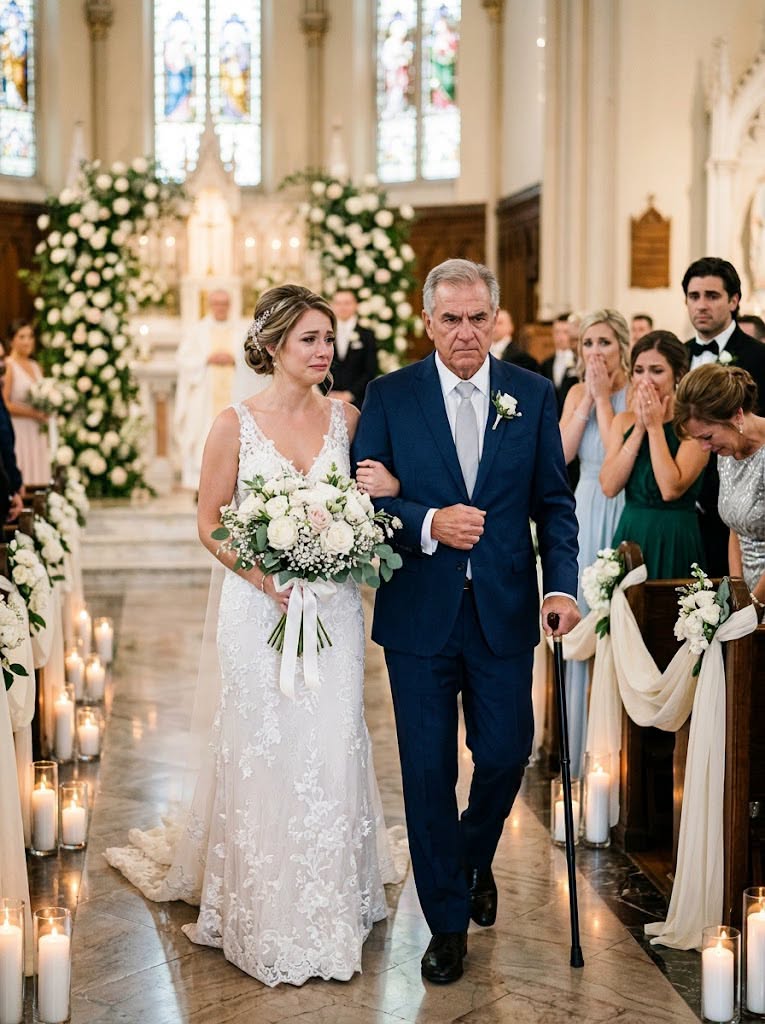
My grandfather Arthur stood there in a navy suit, leaning on his cane.
At eighty-one, he walked slowly.
But his voice was steady.
“Margaret, did you just call your daughter your greatest regret?”
My mother looked uncomfortable.
“Dad, please stay out of this.”
He ignored her.
Instead, he approached me and took my hand.
“Would you allow me to walk beside you?”
I started crying.
“Grandpa, you don’t have to.”
“I know.”
He smiled gently.
“I want to.”
Eighteen months earlier, Grandpa Arthur and I had begun examining old family financial records.
I had discovered inconsistencies in the educational trust established for me.
Money appeared to have been diverted into accounts associated with my parents and the Stone Family Foundation.
Some transfers coincided with expensive purchases made for my sisters.
The findings were troubling.
But they were not something I intended to settle through accusations at my wedding.
With Arthur’s support, I had engaged an independent attorney.
We preserved records, requested formal accounting, and began pursuing the matter through the appropriate legal channels.
My parents had been notified of the dispute.
They had refused to cooperate.
I knew there would be difficult proceedings ahead.
But I had made one decision.
My wedding would not become another day controlled by my parents’ behavior.
The organ began playing.
Grandpa offered his arm.
We walked slowly down the aisle.
Halfway toward the altar, I noticed my mother sitting in the front pew.
She looked away.
A familiar sadness rose in my chest.
For a moment, I was eight years old again, standing outside her bedroom after being told I wasn’t welcome inside.
Grandpa felt my hand tighten.
He stopped briefly.
“Are you all right?” he whispered.
I nodded.
Then he said something I will never forget.
“You don’t have to earn your place here.”
I looked toward Daniel.
He was waiting for me.
His eyes were wet.
And suddenly I understood.
I wasn’t walking toward another person I needed to convince to love me.
I was walking toward someone who already had.
We continued.
Our ceremony was simple.
Daniel and I exchanged vows.
We promised to speak honestly, to treat each other with kindness, and to remember that love required more than affection when life was easy.
When we kissed, Grandpa applauded louder than anyone.
I laughed through my tears.
For the first time that morning, I felt happy without checking whether my mother approved.
After the wedding, my parents approached me.
My father wanted to discuss the legal documents.
He said I was embarrassing the family.
“Today isn’t the day,” I replied.
“Your accusations could destroy the foundation.”
“If the records are accurate, the foundation deserves to know what happened.”
My mother shook her head.
“After everything we’ve done for you.”
I looked at her.
For years, that sentence had ended every disagreement.
I had always responded by defending myself.
Listing my achievements.
Explaining my needs.
Trying to prove I was grateful enough.
This time, I didn’t.
“I hope one day you understand how much your words have hurt me,” I said.
“But I won’t discuss this at my wedding.”
Then I returned to Daniel.
The financial investigation continued over the following months.
Independent reviews confirmed that substantial funds intended for my education had been improperly redirected.
The foundation’s board examined related transactions and removed my parents from leadership while the matter proceeded.
Civil proceedings sought recovery of the misused assets.
Separate financial misconduct allegations were referred to investigators.
Not every question had an immediate answer.
Some records were incomplete.
There were disputes about authorization and responsibility.
And certain concerns surrounding my grandmother’s final illness remained too uncertain to treat as established wrongdoing.
I refused to turn suspicion into certainty simply because I had reason to distrust my parents.
I wanted the truth.
Not the most damaging version of it.
Eventually, portions of the financial claims were resolved through legal proceedings and restitution arrangements.
My parents faced consequences for their actions.
The foundation continued its work under new oversight.
My sisters were forced to reconsider privileges they had long assumed were simply gifts from our parents.
I didn’t enjoy seeing their lives become difficult.
But I also didn’t apologize for seeking the return of what had been taken from me.
That spring, Grandpa began spending more time with us.
He loved sitting in the garden while Daniel worked on small projects around the house.
One afternoon, he handed me a velvet box.
Inside was Grandma’s gold locket.
“She wanted you to have this,” he said.
I held it carefully.
For years, I had wondered why my grandparents seemed so distant.
Now I understood that family stories could be shaped by the people who controlled the communication.
I had lost time with Grandpa because of that distance.
I couldn’t recover those years.
But I could be present for the ones we still had.
I sat beside him.
“Why didn’t you stop Mom when I was little?”
He looked down.
It took him a long time to answer.
“I should have done more.”
There was no excuse.
No attempt to make the past sound better.
Just an elderly man acknowledging something painful.
I leaned against his shoulder.
“I’m glad you’re here now.”
He nodded.
“So am I.”
Months after the wedding, Daniel and I looked through our photographs.
There was one of my mother refusing to smile.
Another of my sisters standing stiffly beside the flowers.
I almost laughed at how much effort I had once spent trying to make them happy.
Then Daniel showed me another picture.
Grandpa and I were walking down the aisle.
His cane was in one hand.
My hand was in the other.
We were both smiling.
I stared at it for a long time.
For twenty-nine years, I had believed something must be wrong with me because my mother found me difficult to love.
I thought that if I became successful enough, obedient enough, or generous enough, she would finally treat me like my sisters.
But that day, her rejection hadn’t changed who I was.
It had only revealed what she was unwilling to give.
Grandpa couldn’t repair my childhood with one act of kindness.
Daniel couldn’t make those losses disappear by loving me.
And recovering the trust money wouldn’t replace the years I had spent feeling unwanted.
But I could stop measuring my worth by what my parents refused to offer.
I placed the photograph in a frame.
Not because Grandpa had rescued me from my family.
But because he had stood beside me when I needed someone.
And because, on the day I married Daniel, I finally understood something I wished I’d known as a little girl.
Being denied love by someone who should have given it freely does not mean you were ever undeserving of it.
{"post":116584,"page":2,"next":[{"id":116581,"title":"Bride\u0027s Mother Told the Groom He \u0027Wouldn\u0027t Last a Year\u0027 \u2013 Five Years Later, He Sent Her a Package on Their Anniversary","url":"https:\/\/new24.info\/116581"},{"id":116574,"title":"The world is mourning a heartbreaking loss today. A familiar face who touched so many people has died far too soon at just 46","url":"https:\/\/new24.info\/116574"},{"id":116570,"title":"It is with heavy hearts that we announce the passing of this beloved and pioneering actor at just 34","url":"https:\/\/new24.info\/116570"},{"id":116566,"title":"Exhausted Mother Finds Second Refrigerator And Executes Brilliant Legal Eviction Plan","url":"https:\/\/new24.info\/116566"},{"id":116518,"title":"Secret Inheritance Reveals Ultimate Betrayal And Destroys A Greedy Family Forever","url":"https:\/\/new24.info\/116518"},{"id":116560,"title":"My Dad Charged Me $250 a Month for Five Years\u2014After His Funeral, His Best Friend Gave Me a Box That Changed Everything","url":"https:\/\/new24.info\/116560"},{"id":116522,"title":"Wynonna Judd\u0027s Tennessee Farm and Home: Aerial Views, the Gazebo Where She Married, and the Ranch Life She Shares with Her 4-Year-Old Granddaughter \u2014 30+ Photos","url":"https:\/\/new24.info\/116522"},{"id":116519,"title":"A Woman Let Her 11-Year-Old Son Walk Home from School Alone for the First Time \u2013 Twenty Minutes Later, Her Neighbor Called Her Crying, \u0027Come Outside. You Need to See What Your Son Did\u0027","url":"https:\/\/new24.info\/116519"},{"id":116514,"title":"Apologizing Seven Years After Divorce Uncovered A Son With My Exact Eyes","url":"https:\/\/new24.info\/116514"},{"id":116511,"title":"Kelly Clarkson Says a Brooklyn Store Made Her Feel Like Julia Roberts in \u0027Pretty Woman\u0027 \u2014 Here\u0027s Where the Drama Went Next","url":"https:\/\/new24.info\/116511"},{"id":116506,"title":"My Husband Ignored Seven Emergency Calls While His Corporate Betrayal Unraveled","url":"https:\/\/new24.info\/116506"},{"id":116502,"title":"My Husband Told Me To Take My Mess Somewhere Else. So I Took My Bottles, My Career, And My Self-Respect\u2014and Left Him Behind.","url":"https:\/\/new24.info\/116502"},{"id":116499,"title":"They Tried To Dine And Dash\u2014But My Boss Had A Plan I Never Saw Coming","url":"https:\/\/new24.info\/116499"},{"id":116496,"title":"My Ex-Husband Trashed My House After Our Divorce \u2013 My Father Dealt with Him During the Proceedings","url":"https:\/\/new24.info\/116496"},{"id":116491,"title":"I donated bl00d to save my boyfriend after his friends told me he had been in a serious ac:cid:ent. As I was leaving the hospital, I heard someone behind a door say, \u201cI can\u2019t believe she fell for it again.\u201d","url":"https:\/\/new24.info\/116491"},{"id":116487,"title":"My husband\u2019s family waited until after my mother was gone before deciding her $8 million estate should belong to them.","url":"https:\/\/new24.info\/116487"},{"id":116484,"title":"Man Returned from a Three-Day Fishing Trip with a Wedding Ring Mark \u2013 He Hadn\u0027t Worn One in 12 Years","url":"https:\/\/new24.info\/116484"},{"id":116481,"title":"A Man Kept Manspreading Into a Woman\u0027s Plane Seat for Hours \u2013 When He Returned From the Restroom, He Shouted, \u0027What the Hell Did You Do?!\u0027","url":"https:\/\/new24.info\/116481"},{"id":116478,"title":"My 78 Year Old Boss Took Me to a Park and Said As of Today You No Longer Work for Me I Froze Thinking He Was Firing Me After Years of Loyalty Then He Offered to Keep Me Only on One Condition What He Said Made Me Walk Away in Tears","url":"https:\/\/new24.info\/116478"},{"id":116475,"title":"My Father Made Me Pay Rent And I Never Understood Why Until That Final Day","url":"https:\/\/new24.info\/116475"}]}