My mother picked up the crying newborn, pushed her into my arms, and said:
“Take her.”
Then she looked at me.
“You’re the one we can afford to lose.”
I was twenty-four.
Still in school.
Almost no savings.
No home of my own.
By sunrise, I was on a bus heading west with a newborn against my chest and a garbage bag of clothes beside me.
My family had already decided what everyone else would hear.
Betty had disgraced herself.
Betty had disappeared.
Betty had broken the family.
I stayed quiet.
And I raised Clara.
For most of her childhood, Clara simply knew me as Mom.
When she turned twelve, I told her the truth.
Biologically, I was her aunt.
She stared at me.
“So you’re my aunt?”
“I’m your mom.”
Then I smiled.
“I’m also your aunt. Only one of those is a job.”
At fourteen, she asked to take a DNA test.
The result showed a parent match.
Cole.
Her biological father.
When I contacted him, he answered almost immediately.
That’s impossible.
Then:
Vanessa told me the baby died.
Cole had spent fifteen years believing his daughter had never survived.
I remembered him coming to our family home shortly after Clara was born.
My mother had met him at the door.
He left carrying nothing.
But he had brought something.
A pair of tiny yellow booties his mother had knitted.
Mom threw them away.
I pulled them from the trash.
Fifteen years later, when Cole came to Spokane and met Clara, I returned them.
He cried.
From then on, he called Clara every Sunday.
Months later, he invited her to stand beside him at his wedding.
As his daughter.
That was when the past finally began moving.
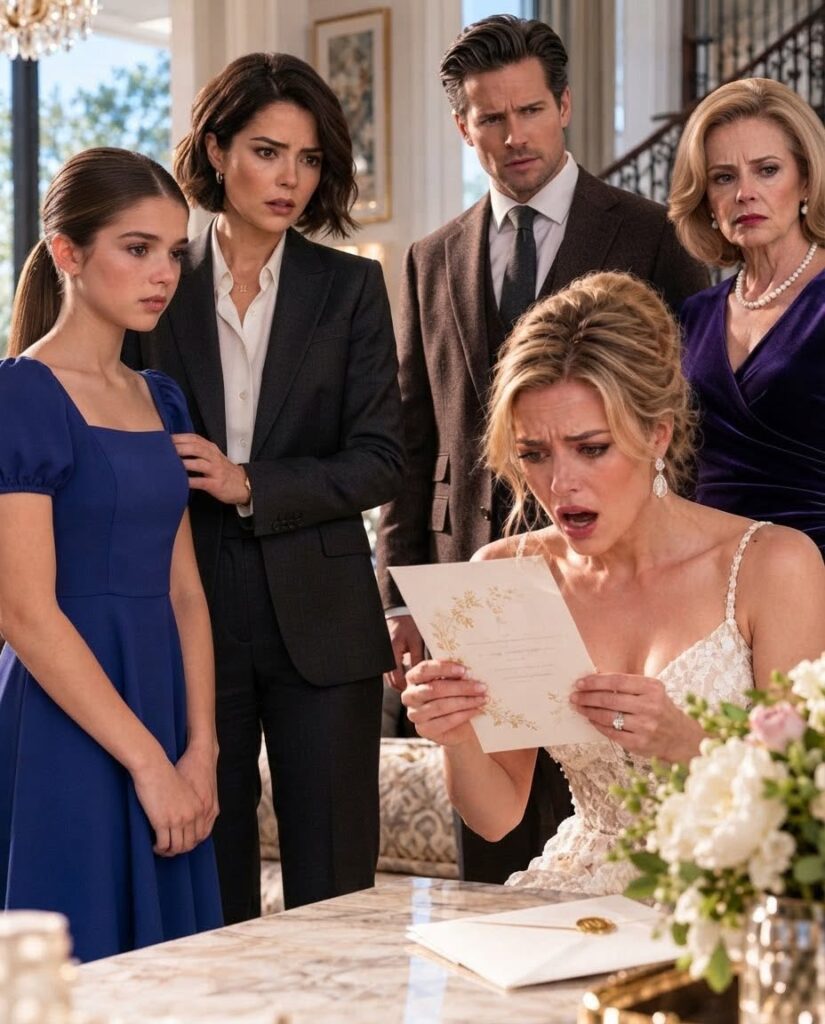
Someone sent Vanessa a wedding invitation.
Across it were the words:
Together with their daughter Clara…
Vanessa called me screaming.
“What did you do?”
I hadn’t sent it.
Clara had asked Cole to.
When I confronted her, she said:
“I’m tired of being a secret.”
Her eyes filled.
“She gets to have a husband, children, a business, a whole public life.”
Then:
“And she gets to pretend I never existed.”
I understood the anger.
But I also knew something Clara did not yet understand.
Truth can become another weapon if we use it only to wound.
Cole admitted the invitation had partly been for him too.
“For fifteen years, I thought my daughter was dead.”
“I wanted Vanessa to know that I know.”
I told him:
“That was for you.”
He went quiet.
“Not for Clara.”
“I know.”
Then my mother called.
Vanessa wanted to pay me twenty thousand dollars.
“For what?”
“Consider it compensation.”
My stomach turned.
“You don’t get to pay me for Clara.”
A few days later, Vanessa posted a tearful video online.
She claimed that fifteen years earlier, while she was vulnerable, I had taken her daughter and disappeared.
Clara watched it beside me.
Then she asked:
“Did you take me?”
That question hurt more than anything Vanessa could have said.
I did not ask Clara to trust me.
I went to my closet.
Inside an old box were envelopes I had mailed to Vanessa over the years.
Pictures of Clara.
Every envelope had been returned.
Across the front:
REFUSED. RETURN TO SENDER.
Then I showed Clara an old message from my mother:
Nobody can ever know she is Vanessa’s. You keep her or leave her somewhere else, but you do not bring her back here.
Clara sat quietly.
Then she told me something else.
She had already spoken privately with Vanessa.
Vanessa cried during their calls.
Said she wanted to reconnect.
But she never asked about volleyball.
School.
Friends.
What Clara liked.
Instead, she wanted Clara to come to Columbus secretly so their reunion could be filmed.
“She told me what colors would look better on camera,” Clara whispered.
That was when Clara understood something painful.
Vanessa might have wanted redemption.
She might have wanted sympathy.
She might even have felt grief.
But she still had not learned to see Clara as a person instead of part of her own story.
Clara sent one final message:
I’m not making a video. You can talk to me at the wedding. No camera.
Then my father called.
We had barely spoken in fifteen years.
He had found the letters I sent him.
Still sealed.
Hidden in the attic by my mother.
He also found an old letter from Cole asking where his daughter had been buried because he wanted to bring flowers.
Dad cried.
“I didn’t know.”
For the first time, I believed him.
Not because ignorance erased anything.
But because this time he was willing to face what had happened instead of defending the family story.
Then Vanessa’s former assistant sent me something else.
An unedited recording from the day the wedding invitation arrived.
Vanessa could be heard shouting:
“She was supposed to stay gone!”
Then:
“Mom promised she’d stay gone!”
There was no need for interpretation.
The truth had finally become difficult to rearrange.
Clara and I flew to Ohio for Cole’s wedding.
She made one condition.
Vanessa could attend.
But there would be no cameras.
At the ceremony, Cole stood in front of Clara.
“I missed your first fifteen years.”
His voice broke.
“I’m asking for the rest.”
Later, a car arrived.
Vanessa stepped out.
So did my mother.
And behind them was a cameraman.
Already recording.
Vanessa hurried toward Clara with tears streaming down her face.
“My baby!”
Clara did not move.
She asked:
“Can he stop filming?”
Vanessa kept smiling.
“It’s for us.”
“No.”
Clara’s voice stayed calm.
“It’s my life.”
The camera finally lowered.
And almost instantly, Vanessa’s performance changed.
She blamed me.
My mother accused me of stealing Clara.
I did not shout.
I simply said:
“She was given to me.”
Then my father stood.
He held the letters my mother had hidden.
Cole stepped forward.
“You told me my daughter was dead.”
Vanessa’s husband had also seen the old messages and the unedited recording.
One by one, the story Vanessa and my mother had protected for fifteen years stopped holding together.
Then Clara asked Vanessa the only question that mattered.
“Did you ever look for me?”
Vanessa said yes.
Clara shook her head.
“No.”
“She sent you pictures.”
“You refused them.”
Then:
“I know your handwriting.”
For a few seconds, Vanessa said nothing.
Finally:
“I didn’t want to be found.”
The lawn went silent.
“I wanted a life where you didn’t exist.”
Clara absorbed that.
Then nodded slowly.
“Okay.”
Her voice did not shake.
“I’m not your content.”
“I’m not your secret.”
“I’m Clara.”
Then she turned around and walked toward me.
Several guests lifted phones.
I stepped forward.
“She is fifteen.”
The phones began lowering.
“Please don’t record this.”
“This belongs to her.”
That mattered more to me than exposing anyone.
For fifteen years, adults had treated Clara’s life as something they were entitled to hide, explain, reshape, or use.
I would not let truth become one more way of taking ownership away from her.
After the wedding, I made one public statement.
No videos.
No private messages.
No pictures of Clara.
I posted only the returned envelopes.
Then I stepped away.
I did not need to destroy Vanessa.
The truth was enough.
My father began rebuilding a relationship with us.
Cole remained part of Clara’s life.
And for the first time in fifteen years, nobody required me to carry a lie simply because telling the truth would make them uncomfortable.
A few weeks later, Clara placed the wedding invitation on our refrigerator.
She stared at her name for a long time.
Then she smiled.
“It’s the first time my name has ever been printed beside the word ‘daughter.’”
She looked at me.
“And nobody had to lie.”
Then she went upstairs.
I stayed in the kitchen.
Fifteen years earlier, my mother placed a newborn in my arms and called her my problem.
She was wrong.
Clara was never a problem to solve.
She was a person to protect.
A child to raise.
And eventually, a young woman entitled to decide for herself what parts of her story the world was allowed to see.
She was my daughter.
Not because someone surrendered her to me.
Because I stayed.