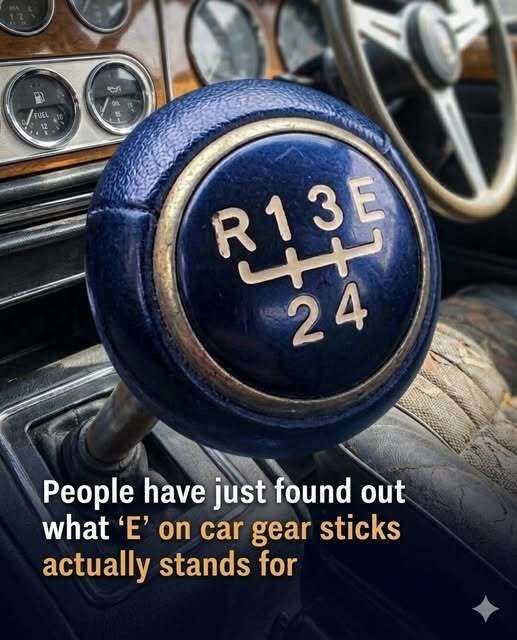
So what exactly did it mean?
In many vehicles produced during the 1980s and 1990s, the “E” stood for Economy.
It appeared during a period when fuel efficiency was becoming increasingly important to both manufacturers and drivers. Gasoline prices, changing regulations, and growing interest in better fuel economy pushed automakers to find simple ways to help vehicles use less fuel.
Selecting “E” altered the way the automatic transmission behaved.
Instead of holding lower gears for longer periods, the transmission would typically shift into higher gears sooner. This allowed the engine to operate at lower revolutions per minute, or RPM, during normal driving.
Lower engine speeds generally meant less fuel consumption, reduced engine noise, and a smoother driving experience under suitable conditions.
Economy mode was not designed for maximum performance.
If a driver pressed the accelerator aggressively, some systems were less eager to immediately drop into a lower gear. The response could feel slower compared with a sportier transmission setting.
That was intentional.
The idea was to encourage calmer acceleration and reduce unnecessary high-RPM driving. Drivers who used the “E” setting were essentially telling the vehicle that fuel efficiency mattered more than quick acceleration.
For many people, this created a noticeably more relaxed driving experience.
The engine remained quieter.
Gear changes often happened sooner.
The vehicle felt less eager to race through the rev range.
In an era before advanced electronic transmission management became common, that simple letter gave drivers an easy way to influence how their car behaved.
Older cars also provided a very different connection between the driver and the machine.
Today, many driving decisions are handled automatically by computers. Modern transmissions constantly analyze throttle position, speed, engine load, road conditions, and numerous other factors before choosing the most efficient gear.
Older vehicles were often much more straightforward.
Moving the gear lever into “E” was a physical decision.
The driver was deliberately choosing economy over performance.
There were no complicated touchscreen menus, customizable digital profiles, or constantly adapting software systems. A simple movement of the gear selector could noticeably change the personality of the car.
As automotive technology improved, the dedicated “E” position gradually disappeared.
Modern engines became more efficient.
Electronic fuel injection replaced older fuel-delivery systems.
Automatic transmissions gained additional gears and increasingly sophisticated computer controls.
Aerodynamics improved.
Tires were developed with lower rolling resistance.
All of these changes meant manufacturers could build fuel-saving behavior directly into the vehicle rather than asking the driver to select a separate economy position.
But the basic idea behind the old “E” never really disappeared.
Today, many vehicles offer an Eco mode.
Pressing an Eco button can change throttle sensitivity, transmission shift points, air-conditioning behavior, and other systems to reduce energy consumption.
Some cars perform many of these adjustments automatically without the driver noticing.
In other words, the same goal that once required moving a mechanical gear lever can now be handled silently by software.
The meaning of the letter “E” has also changed dramatically with the rise of electric vehicles.
Today, “E” may immediately make people think of electric propulsion, electronic systems, regenerative braking, or features such as one-pedal driving.
Instead of helping a gasoline engine burn slightly less fuel, modern energy-saving systems can now recover electricity while the vehicle slows down and return that energy to the battery.
That makes the old “E” position an interesting reminder of how quickly automotive technology has evolved.
What once represented a basic Economy setting eventually became part of a much larger movement toward computerized efficiency and electrification.
The physical lever may have disappeared from most vehicles, but the principle behind it remains very much alive.
Drivers still want cars that can travel farther while consuming less energy.
Manufacturers still search for ways to improve efficiency without sacrificing comfort or everyday usability.
Only the technology has changed.
So if you ever see an old automatic gear selector with an unfamiliar “E” beside the usual letters, it is more than just a forgotten transmission setting.
It is a small piece of automotive history—a reminder of the time when saving fuel could begin with something as simple as moving the gear lever one position farther.