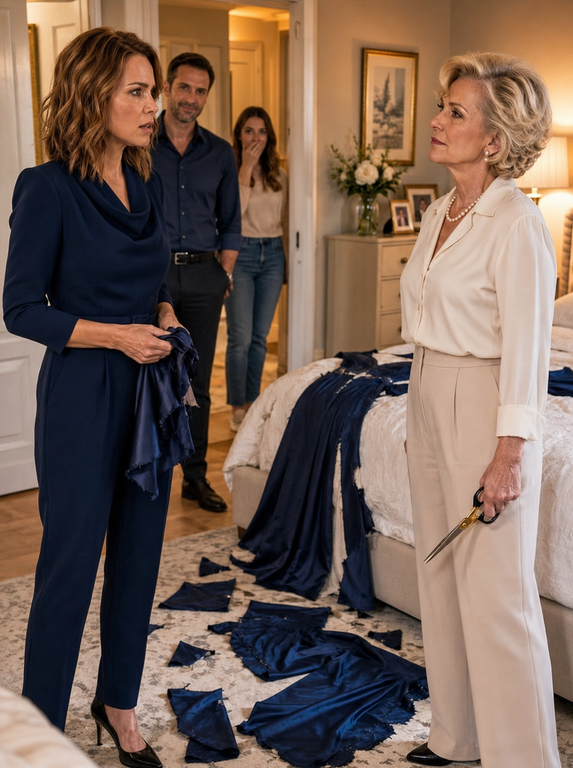
“Who else is going to serve dinner tomorrow?” Patricia said, arms folded, as if the answer to Clare’s outrage should have been obvious. Patricia had invited twelve guests for the same night as Clare’s ceremony, and in her mind, Clare’s absence was simply a problem to be solved with scissors. When Mark saw the shredded fabric, he only smirked. “You’re a wife, not a celebrity,” he told her. “Act like one.”
The Gown
Clare had debated buying that dress for three weeks before finally spending the money on herself. It was meant to mark fourteen years of building Second Chapter House, the nonprofit she’d started in two rented church-basement rooms, back when Mark still called it their dream instead of her “little project.”
Over those fourteen years, more than 3,000 women had come through the organization’s doors, starting with Denise Parker, who insisted she had no skills until Clare helped her see the budgeting, caregiving, and scheduling she’d been doing all along. Another of those women had been Margaret Bell, though Clare didn’t yet know how much that name would matter.
The next morning, Patricia handed Clare a grocery list — pot roast, carrots, green beans, dinner rolls, cheesecake — as if nothing had happened. Clare looked at it, then at her. “You cut up my dress, and now you’re giving me groceries?” she asked. She refused to cook. Later, she learned that Mark’s daughter, Melissa, had known days earlier that Patricia was planning something, but had said nothing to warn her.
With no time to repair the gown, Clare nearly gave up on attending at all. Then Denise arrived with a black dress she’d worn to her daughter’s wedding and a blunt pep talk about who had been driving Clare’s life for the last twenty-three years. It was enough to get her in the car.
An Unexpected Presenter
Backstage at the Ohio Theater, an event producer told Clare her presenter had asked to meet her privately and specifically requested not to be named in advance. When the dressing room door opened, Clare recognized the woman inside immediately: actress and humanitarian Evelyn Grant.
Evelyn explained that her late sister, Margaret Bell, had once been one of the frightened, newly divorced women Clare had helped find work after decades out of the job market. Margaret had died eighteen months earlier, but she had never forgotten the woman who waited outside her interview so she wouldn’t have to face the outcome alone.
Onstage, Evelyn told Margaret’s story to the full theater before turning to the audience with a line Clare would carry with her long after: there is a difference between being needed and being respected. She then announced that Second Chapter House had been awarded a $250,000 expansion grant.
After the Applause
Across town, Mark, Patricia, and Melissa were watching the broadcast. Melissa later said that once Mark saw the grant figure on Clare’s phone, he abruptly stopped complaining about the takeout dinner Patricia’s guests had been forced to order.
When Clare came home, no one offered congratulations. Mark demanded to know how the speech had “looked,” as though Evelyn’s words had exposed the family rather than honored Clare’s work. His closest attempt at an apology — “I didn’t know it meant that much to you” — collapsed seconds later into a complaint that Clare “could have handled Mom better.”
He also asked, almost immediately, whether the grant money could go toward the mortgage or a new truck.
It was Melissa who finally admitted she’d known Patricia intended to do something to keep Clare home, though she hadn’t known scissors would be involved. Patricia, for her part, seemed most upset that no one had told her the ceremony involved that much money.
In the weeks that followed, Clare stopped managing the family’s obligations. She stepped back from scheduling Patricia’s appointments, hosting holidays, and covering last-minute childcare for Melissa. She and Mark began counseling, and for a while, real change seemed possible — he did his own laundry, asked real questions about the nonprofit, even planned a quiet dinner just for the two of them.
That fragile progress broke one evening when Patricia called about a malfunctioning TV remote. Mark left their candlelit dinner “for twenty minutes” and didn’t return until the food was cold. Six months after the ceremony, Clare asked for a separation. There was no shouting, only the quiet recognition that Mark had grown guilty enough to apologize, but never enough to choose differently.
What I Kept
About a month after Mark moved out, Melissa brought Clare a paper bag containing the salvaged scraps of the blue gown, pulled from the trash. She admitted she had stood in the room and watched Patricia begin cutting before Clare ever came home — and had done nothing to stop her.
Patricia’s eventual apology amounted to regret that “the whole thing got so out of hand,” and several of Mark’s relatives quietly decided Clare was the one who had ended a twenty-three-year marriage over a dress.
At the following spring’s fundraiser, Clare wore a midnight blue jacket with a small patch sewn from the only salvageable piece of her gown. Evelyn Grant attended as honorary chair. Mark did not come.
For years, Clare had confused being needed with being loved. People had needed her cooking, her memory, her patience, her forgiveness — but needing isn’t the same as valuing. She is grateful, in the end, that the disrespect finally became too obvious to explain away, because it taught her that dignity isn’t only something others give you. Sometimes it’s something you have to protect yourself.