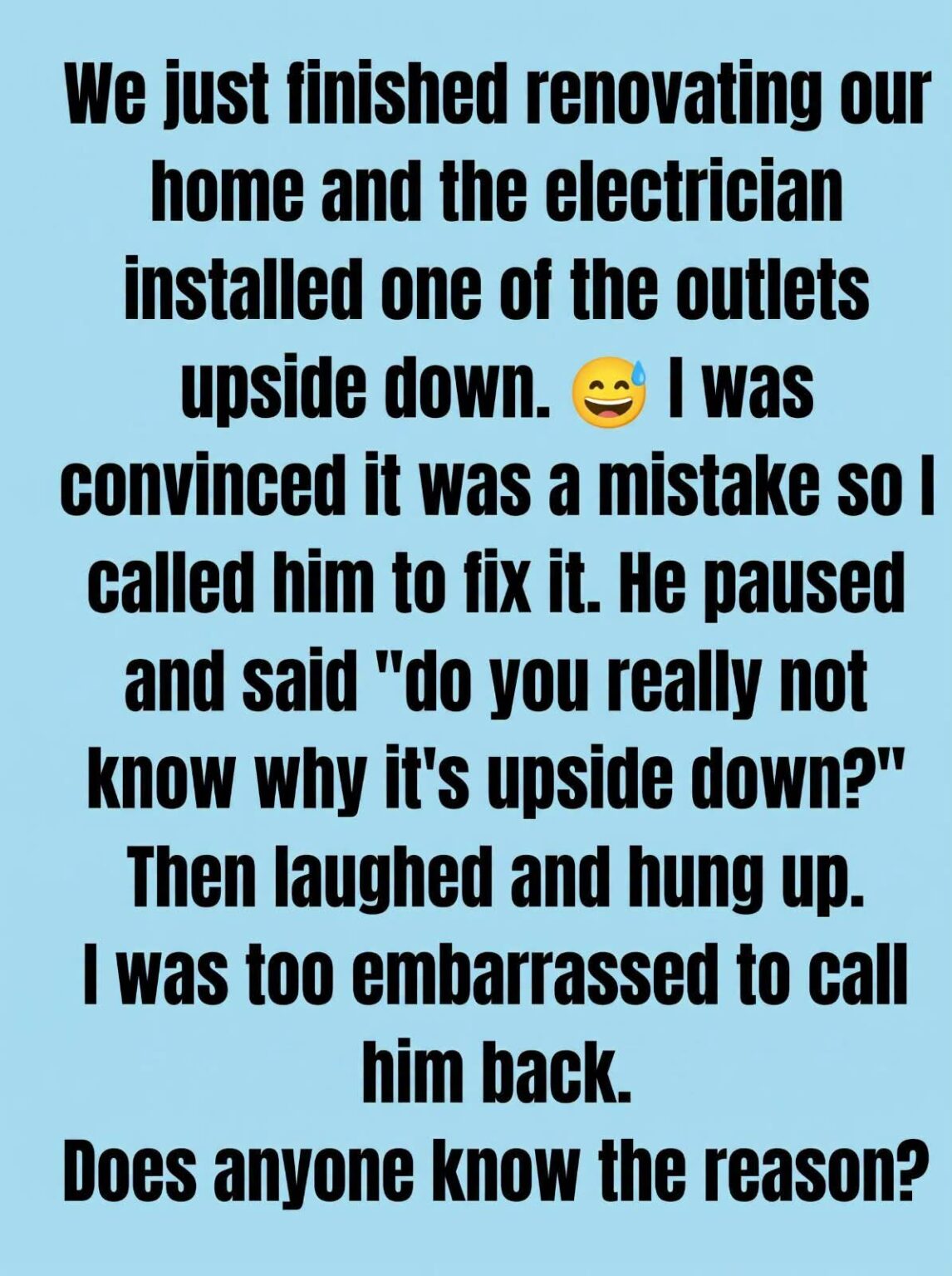
One possible reason is surprisingly simple: to make a particular outlet stand out.
In some buildings, an electrician or facility may use a different orientation to distinguish certain receptacles—for example, an outlet connected to a switched or otherwise particular circuit.
That doesn’t mean every ground-up outlet has a special function. There is no universal rule saying an upside-down outlet identifies a particular type of circuit. It’s simply one convention that may be used in some installations.
Some Electricians Simply Prefer Ground-Up
Sometimes there isn’t a hidden meaning at all.
Electricians have different installation practices, and both ground-up and ground-down receptacles can be found in homes and commercial buildings.
A single outlet may also face differently because it was replaced years after the surrounding receptacles.
In other words, the explanation may simply be: that’s how it was installed.
Is Ground-Up Safer?
There’s a practical argument behind the ground-up orientation.
Imagine a three-prong plug that has partially pulled away from the receptacle. If a conductive object were to fall into the gap, the orientation of the plug affects which exposed components it could contact.
Supporters of ground-up installation argue that having the grounding pin above the energized blades may provide an advantage in certain circumstances.
However, that doesn’t establish that every ground-up receptacle is safer than every ground-down one. The plug, receptacle, equipment, wiring and circumstances all matter.
Proper installation is far more important than which direction the round opening faces.
Does an Upside-Down Outlet Mean It’s Wired Wrong?
No—not by itself.
Physical orientation doesn’t tell you whether the conductors behind the receptacle are connected correctly.
A ground-up receptacle can be wired perfectly.
A completely ordinary-looking ground-down receptacle can be wired incorrectly.
That’s why appearance alone isn’t a reliable electrical safety test.
Does Turning the Outlet Change How It Works?
Simply rotating a properly installed receptacle 180 degrees doesn’t reverse its electrical function.
The hot conductor remains connected to the hot contact, neutral to neutral and ground to the grounding contact.
You’re changing the device’s orientation, not how electricity fundamentally moves through the circuit.
Why Do You See Them in Hospitals and Commercial Buildings?
Hospitals, workshops, offices and industrial buildings may follow electrical practices that differ from those typically seen in homes.
Orientation can sometimes be standardized within a facility or used alongside labels, colors and other markings to distinguish circuits or equipment.
So an unusual-looking receptacle in a specialized building may very well have been installed that way deliberately.
What Actually Makes an Outlet Concerning?
Instead of focusing on whether the ground opening points up or down, watch for genuine warning signs.
An outlet deserves attention if it is:
- Loose or moving in the wall
- Cracked or visibly damaged
- Warm or hot
- Discolored
- Buzzing or sizzling
- Producing sparks
- Giving off a burning smell
- Repeatedly associated with tripped breakers
- No longer holding plugs securely
Those problems are much more meaningful than orientation. If you notice them, stop treating the outlet as a household curiosity and have the electrical installation inspected.
What About GFCI and Tamper-Resistant Outlets?
Orientation shouldn’t be confused with other electrical safety features.
GFCI receptacles, recognizable by their TEST and RESET buttons, monitor current and interrupt power when certain ground-fault conditions occur. Their protective function comes from the device itself, not whether it’s installed ground-up or ground-down.
Tamper-resistant receptacles contain internal shutters designed to reduce the chance of objects being inserted into the energized slots. Again, simply turning an ordinary outlet upside down doesn’t provide that protection.
Should You Turn Your Outlets Around?
There’s generally no reason to start rotating perfectly functional outlets just because you’ve learned about ground-up installation.
Reorienting a receptacle requires working with electrical wiring. Mistakes can create shock and fire hazards, so electrical work should be performed according to applicable requirements by someone qualified to do it.
If your only concern is that an outlet “looks upside down,” orientation alone isn’t a reason to replace it.
The Bottom Line
An outlet with its grounding opening on top isn’t necessarily upside down at all.
It may have been deliberately oriented that way for identification. An electrician may prefer that orientation. Someone may have replaced the receptacle differently from the others. Or the installer may have chosen ground-up because of the potential advantage it offers in certain partially disconnected-plug scenarios.
What matters much more is whether the outlet is properly wired, grounded, securely installed and in good condition.
So the next time someone points at a receptacle and says, “That outlet is upside down,” the most accurate answer might be:
Maybe—but that doesn’t mean anything is wrong with it.