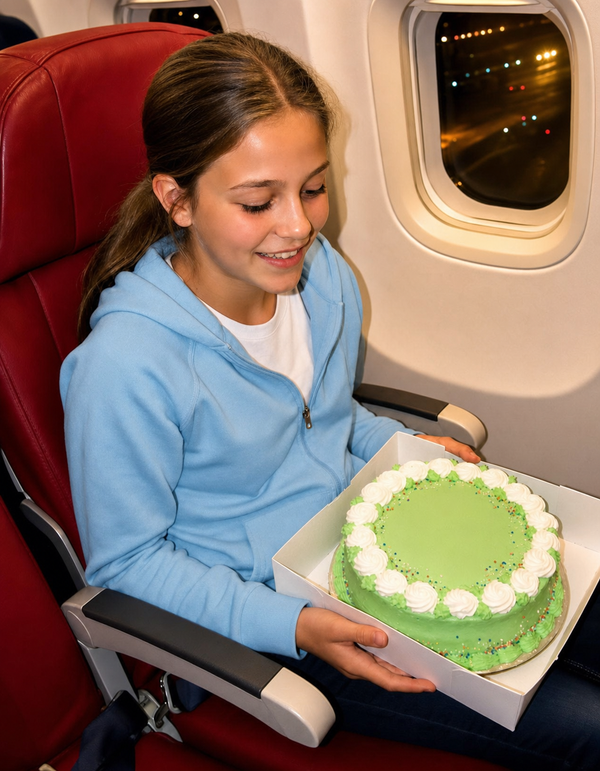
“You shouldn’t be on this flight,” she whispered, and before I could ask why, the cockpit door opened and William stepped out, his face draining of color the moment he saw us standing in the aisle.
The Secret Flight
William had spent nearly twenty years as a commercial pilot. Sophie, twelve, had idolized his work since she was small, tracking his flights and collecting the plastic wings crew members gave her. She’d never actually flown with him operating the plane, so when she found his Boston birthday flight on the schedule, she begged until I gave in.
We bought regular tickets, careful not to connect them to his employee account. That morning William left for work believing we had nothing more planned than dinner later that night. Two hours after he walked out the door, Sophie and I boarded with the cake tucked under my arm.
Everything felt perfect until the flight attendant, Karen, heard Sophie proudly announce that her father was flying that day. Karen’s smile vanished. She pulled me aside, asked if Captain Harris knew we were there, and told me we needed to leave before he saw us. Before I could respond, the cockpit door swung open.
A Truth Revealed Mid-Air
William looked terrified, not surprised. He asked for five minutes alone with me, and once Sophie was settled with the cake, he finally spoke. “This is my last flight,” he said. I laughed because it made no sense—he was forty-seven, healthy, always talking about flying until retirement.
Then he told me: two months earlier, he’d failed part of his medical exam. He’d been losing hearing in his left ear for eight months, something he’d blamed on wax buildup before ringing started. Doctors found a tumor on the nerve controlling hearing and balance. Not cancer, he insisted, but he’d known for six weeks and said nothing.
Six weeks. We had slept beside each other for forty-two nights while he carried that alone. I learned Karen already knew, because months earlier in Chicago he’d gotten dizzy in the terminal and lost his balance; she’d caught him before he fell. That incident was what finally pushed him to get checked.
Another pilot, David, appeared then. William introduced him as the captain actually operating our flight. William wasn’t flying at all—he was riding along in uniform because the airline had arranged this trip as an unofficial goodbye, a farewell tour on a route he’d flown for years, with colleagues waiting to meet him in Boston. There was a real chance he’d never fly commercially again.
He admitted he’d planned to tell us only after his coworkers got their chance to say goodbye. When I asked why he hadn’t told Sophie, his voice cracked: he didn’t know how to tell her he might be finished flying. I told him those were two different things—being a pilot and being her dad—but to him, apparently, they’d blurred into one.
Learning to Be Dad Again
We agreed to continue to Boston as a family, but I insisted he tell Sophie before takeoff. He knelt beside her and explained, carefully, that doctors had found a problem affecting his hearing and balance, and that he might not be allowed to fly professionally again. Her face crumpled. “But you’re a pilot,” she said.
Then she looked at him and said, “You can still be my dad.” William covered his face. Sophie wrapped her arms around his neck, and I finally understood what I’d been trying to tell him all along—she had never needed Captain Harris. She needed her father.
Midflight, David made an announcement thanking a longtime member of their airline family for nearly twenty years of service, without ever mentioning the tumor. Passengers applauded. Sophie stood and clapped loudest of all, shouting, “That’s my dad!” William laughed and cried at the same time.
When we landed, about thirty people—pilots, flight attendants, ground crew—were waiting near the gate to honor him. One older pilot hugged him and said he’d always be one of them. That night, after Sophie fell asleep, William and I sat by the hotel window and finally talked it through.
He apologized. I told him I understood his fear, but six weeks was too long, and that he didn’t get to decide I was better off not knowing. He admitted he’d been trying to keep home feeling normal. I told him home hadn’t been normal—I’d just been suffering quietly inside it without knowing why.
Finding a New Identity
William had surgery four months later. It went well, though he permanently lost most of the hearing in his left ear; his balance slowly improved with therapy. He never returned to commercial flying. The loss showed up in small ways—he stopped checking aviation weather, stopped watching takeoff videos Sophie sent him, left his flight bag untouched in the closet.
One night I found him on the bedroom floor holding his old headset. “I don’t know who I am without it,” he said. Eventually a former colleague connected him to a flight simulator training center, and William started teaching. It wasn’t the same, he insisted—but months later I watched him coach a nervous student through an emergency procedure, and his old focus was back, just changed.
Sophie never wavered. If anything, William’s diagnosis made her more determined, and she began asking him detailed questions about medical certificates and hearing requirements she’d never thought to ask before. For her thirteenth birthday, he took her to the simulator center, sat beside her as she took the controls, and asked, “Ready, Captain?” She grinned. “Ready.”
A few weeks ago, William found the old cake box from that flight. Across the side, in marker, Sophie had written: “SURPRISE, CAPTAIN DAD!” He showed it to me and said quietly, “I couldn’t even fly that day.” I pointed to the last word. She hadn’t written Pilot. She’d written Dad. This time, he understood the difference.