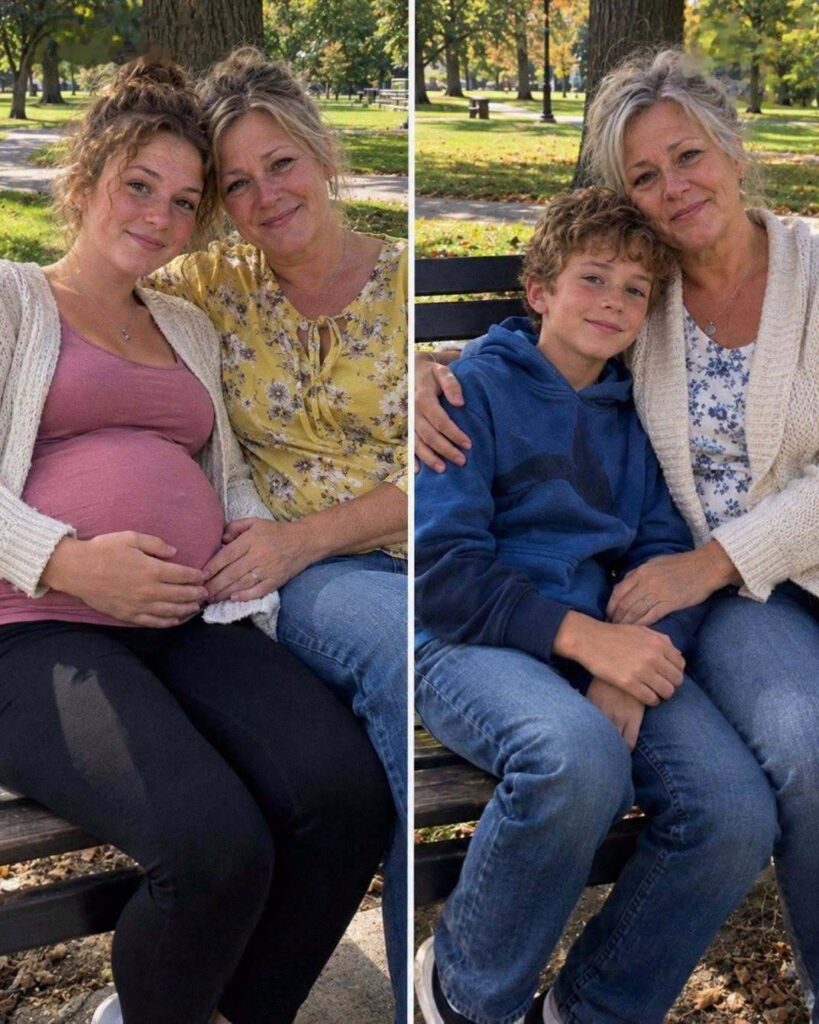
Then, on the tenth anniversary of her death, a stranger approached me at Teagan’s grave carrying a sealed envelope.
She looked at Lucas.
Then at me.
And said something that changed everything I thought I knew.
“Your daughter gave me this the day Lucas was born.”
I stared at the envelope.
“What?”
“She told me to give it to you if something ever happened to her…”
The woman hesitated.
“…and his father didn’t come back.”
I felt Lucas’s hand tighten around mine.
He was ten years old then.
Tall for his age.
Skinny knees.
Always asking questions.
And he had Teagan’s eyes.
Those eyes were looking directly at the envelope.
“Grandma?”
I squeezed his hand.
“It’s okay.”
But I had no idea whether it was.
The woman’s name was Trudy.
I vaguely remembered her from years earlier.
She and Teagan had worked together for a while.
I’d seen her at the hospital when Lucas was born, although back then she’d had long brown hair instead of the short silver-gray cut she wore now.
“Why have you waited ten years?” I asked.
Trudy looked toward Teagan’s headstone.
“Because those were her instructions.”
“That doesn’t make sense.”
“She said you’d know when Lucas was old enough.”
“Old enough for what?”
Trudy looked at him.
Then back at me.
“The truth.”
I didn’t open the envelope at the cemetery.
Something stopped me.
Maybe fear.
Maybe instinct.
Whatever Teagan had written had waited ten years.
It could wait another hour.
That evening, after Lucas went upstairs, I sat alone at my kitchen table.
The envelope lay in front of me.
My name was written across it.
Mom.
Teagan’s handwriting.
Seeing it almost broke me.
There are strange things grief does to you.
You forget someone’s voice before you forget their handwriting.
You forget exactly how their perfume smelled.
You forget the sound of their footsteps coming down the stairs.
But one glimpse of their handwriting can bring them back so suddenly that your chest hurts.
I ran my finger over the word.
Then I opened it.
A photograph fell onto the table.
Teagan was seventeen or eighteen.
Beside her stood a teenage boy.
His arm was around her waist.
They were both laughing.
I recognized him.
Not immediately.
But eventually.
He’d come to our house several times when Teagan was younger.
Quiet boy.
Polite.
Dark hair.
Always looked slightly uncomfortable when adults spoke to him.
I couldn’t remember his name.
Then I unfolded the letter.
Mom,
If you’re reading this, something happened that I hoped never would.
I stopped.
Read the sentence again.
Then continued.
Teagan explained that Lucas’s father knew about the pregnancy.
He had always known.
That alone shocked me.
I’d assumed he’d disappeared before learning she was pregnant.
But Teagan wrote that she’d told him herself.
He’d panicked.
His family had panicked even more.
They had plans for him.
College.
A career.
A future that apparently had no room for a baby.
According to Teagan, he kept saying he loved her.
Kept saying he wanted to do the right thing.
But every time doing the right thing required an actual decision, fear won.
Then I reached a paragraph that made me stop.
His name is Nathan.
I remembered him.
Nathan Cole.
The boy from the photograph.
Teagan continued:
Nathan knows about Lucas. I told him he can be part of our son’s life, but I won’t chase him. I won’t beg someone to love our baby. If he comes back, I need it to be because he chose Lucas himself.
I covered my mouth.
For years, I’d been angry at a faceless man.
Now he had a name.
A face.
And apparently, a choice he’d failed to make.
The final paragraph was worse.
If something happens to me, please don’t teach Lucas to hate his father for me.
Tell him the truth when he’s ready.
I don’t know whether Nathan will ever become brave enough to come back.
But Lucas shouldn’t inherit my anger.
I folded the letter.
Then unfolded it.
Then read it again.
I barely slept.
The next morning, I called Trudy.
“There are things you didn’t tell me.”
“I know.”
“Did Nathan ever come back?”
Silence.
“Trudy?”
“Yes.”
My heart jumped.
“When?”
“The day Lucas was born.”
I stood up so quickly my chair scraped across the floor.
“He was at the hospital?”
“Yes.”
“I never saw him.”
“He saw you.”
I stopped.
“What?”
Trudy took a breath.
“He came late that afternoon.”
Suddenly, I was back there.
Ten years earlier.
Teagan exhausted but smiling.
Lucas wrapped in a blue blanket.
Me walking through the hospital corridor carrying flowers, crying because I had just become a grandmother.
“He saw you leaving the maternity floor with Lucas.”
“What happened?”
“He froze.”
“That’s it?”
“He stood there watching you.”
“And?”
“Then he left.”
Anger rushed through me.
“He walked away?”
“He was eighteen.”
“So was Teagan.”
“I know.”
“She didn’t get to walk away.”
“I know.”
My voice broke.
“She had to become a mother whether she was frightened or not.”
Trudy didn’t argue.
After a moment, she said:
“That’s why Teagan never made excuses for him.”
That stopped me.
“She understood that he was scared. But understanding wasn’t the same as excusing it.”
I looked down at the photograph.
“Why didn’t you tell me?”
“Because Teagan asked me not to.”
“For ten years?”
“She wanted Nathan to make the first move.”
“He didn’t.”
“No.”
“And then she died.”
Trudy became quiet.
“She thought there would be more time.”
That sentence stayed with me.
There is almost always something grief leaves unfinished because everyone assumes there will be more time.
I spent the next week deciding whether I should look for Nathan.
Part of me thought I shouldn’t.
He’d had ten years.
Ten birthdays.
Ten Christmases.
Ten first days of school.
He’d missed Lucas losing his first tooth.
Learning to ride a bicycle.
Breaking his wrist jumping from the backyard fence after I’d specifically told him not to.
Nathan hadn’t been there for any of it.
Why should I go searching for him now?
Then I kept returning to Teagan’s letter.
Lucas shouldn’t inherit my anger.
So I searched.
It took less time than I expected.
Nathan lived less than three hours away.
He was thirty.
Worked for an engineering company.
No wife.
No children.
I stared at his photograph online for a long time.
Then I sent one message.
My name is Margaret. I’m Teagan’s mother. I think we need to talk about Lucas.
He replied eleven minutes later.
I know who you are.
Then:
I’ve been waiting for this message for ten years.
That made me furious.
I called him.
He answered immediately.
“If you’ve been waiting ten years, Nathan, you had my address.”
Silence.
“You could’ve sent the message yourself.”
“I know.”
“You knew where we lived?”
“Yes.”
“You knew Lucas was with me?”
“Yes.”
Every answer made me angrier.
“Then explain something to me. Why?”
Nathan took a long time to respond.
“Because I was a coward.”
I hadn’t expected that.
No excuses.
No elaborate explanation.
Just four words.
We agreed to meet at a coffee shop halfway between our towns.
I arrived twenty minutes early.
Nathan was already there.
The teenage boy from Teagan’s photograph had disappeared.
But I recognized him immediately.
Same eyes.
Same nervous way of rubbing his thumb against the side of his hand.
He stood when I approached.
“Mrs. Bennett.”
“Margaret.”
“Right.”
Neither of us hugged.
He pulled out a chair.
I sat.
Then I placed Teagan’s photograph between us.
Nathan looked at it.
His face changed.
“I haven’t seen that picture in years.”
“I’ve only seen it for a week.”
He looked at me.
“She kept it?”
“Yes.”
Nathan’s eyes filled, but I wasn’t there to comfort him.
“You knew she was pregnant.”
“Yes.”
“You knew Lucas was yours.”
“Yes.”
“You came to the hospital.”
His eyes dropped.
“Yes.”
“And you left.”
“Yes.”
“Why?”
Nathan stared at the photograph.
“My parents.”
I waited.
“They thought my life was over.”
“Teagan’s parents weren’t thrilled either.”
“I know.”
“She still raised him.”
“I know.”
Nathan swallowed.
“My father had everything planned. University. Graduate school. Job with his company. When I told them about Teagan, my mother cried for three days.”
“And that frightened you?”
“Everything frightened me.”
He rubbed his face.
“I was eighteen and stupid enough to think being scared meant I wasn’t ready.”
“Nobody was ready.”
“I know that now.”
He told me his parents hadn’t physically forced him to stay away.
They hadn’t threatened him.
They’d done something quieter.
They’d convinced him that leaving was responsible.
That Teagan would be better off.
That Lucas would eventually have a stepfather who actually wanted family life.
That paying child support later would be enough.
“And you believed them?”
“I wanted to.”
That answer, at least, was truthful.
“Because it made leaving easier?”
“Yes.”
“What happened at the hospital?”
Nathan stared toward the window.
“I came because I wanted to see him.”
“Why didn’t you?”
“I saw you first.”
“Carrying Lucas?”
He nodded.
“You were standing near the elevators.”
I remembered that exact moment.
Lucas had been asleep against my chest.
“I could see part of his face.”
Nathan’s voice shook.
“And suddenly he wasn’t an idea anymore.”
He paused.
“He was my son.”
I said nothing.
“I panicked.”
“So you left.”
“Yes.”
“Did Teagan know you came?”
“Yes.”
That surprised me.
“How?”
“I called her from the parking lot.”
“What did she say?”
Nathan looked down.
“She told me I could come back upstairs.”
“And?”
“I told her I couldn’t.”
I closed my eyes.
“What did she say then?”
“She said, ‘Then don’t come back until you can stay.’”
That sounded exactly like my daughter.
“So you waited ten years.”
“At first, I thought I’d come back in a week.”
Nathan gave a bitter laugh.
“Then a month.”
He looked at me.
“Then Lucas turned one.”
“Then two.”
He nodded.
“Every year made it harder.”
“Because?”
“Because every year added another question I couldn’t answer.”
Why weren’t you there?
Why didn’t you call?
Why didn’t you send a birthday card?
Why didn’t you come when Mom died?
Nathan didn’t need to say them.
I could hear them myself.
“I followed from a distance,” he admitted.
My expression hardened.
“What does that mean?”
“I found your social media. School pictures sometimes. Community baseball.”
“You watched him?”
“Online. Never in person.”
I wasn’t sure whether that made me feel better or worse.
“He likes baseball,” Nathan said quietly.
“I know what my grandson likes.”
He nodded immediately.
“Sorry.”
For the first time, I noticed something important.
Nathan wasn’t asking me to make him Lucas’s father.
He wasn’t demanding access.
He wasn’t telling me that biology entitled him to anything.
So I asked:
“What do you want?”
His answer came immediately.
“For Lucas to know I didn’t stay away because there was something wrong with him.”
That hit me.
Nathan looked directly at me.
“I don’t expect him to forgive me.”
He swallowed.
“I don’t even expect him to meet me.”
“Then what?”
“I want him to know the truth.”
I thought about Teagan.
Tell him the truth when he’s ready.
I reached into my handbag.
Pulled out a notebook.
Placed it in front of Nathan.
“Write him a letter.”
He stared at it.
“What?”
“You’ve had ten years to think about what you’d say.”
Nathan looked terrified.
Good.
Some things should frighten you.
“Don’t tell him your parents made you do it.”
“I won’t.”
“Don’t blame Teagan.”
“Never.”
“Don’t tell him you stayed away for his own good.”
Nathan nodded.
“And don’t ask him to forgive you.”
“I won’t.”
“Tell him what happened.”
Nathan took the notebook.
His hand shook.
“And tell him the choice is his now.”
He wrote the letter that night.
It was six pages long.
I read it before giving it to Lucas.
Nathan didn’t excuse himself.
He admitted he’d known about Lucas from the beginning.
He admitted he’d gone to the hospital.
He admitted he’d been afraid.
And he wrote:
I kept thinking I’d come back when I was brave enough to answer for what I’d done. I didn’t understand that courage doesn’t usually arrive first. Sometimes you have to do the frightening thing before you become brave.
He ended with:
I am your biological father, but I know that doesn’t automatically make me your dad. You don’t owe me a relationship. If you ever want to know me, I’ll be here. If you don’t, I will respect that too.
I kept the letter for three days.
Then Lucas asked me why I’d been acting strange.
Children always know.
“Sit with me.”
He sat beside me on the couch.
I showed him Teagan’s photograph first.
“That’s Mom?”
“Yes.”
“Who’s the guy?”
I took a breath.
“Your father.”
Lucas stared at me.
“My dad?”
“Yes.”
He looked at the photograph again.
“Is he alive?”
“Yes.”
“Did you know?”
“Not everything.”
Then I told him.
Not every adult detail.
Not my anger.
Not the things Nathan’s parents had said.
Just the truth Lucas was old enough to carry.
“Your dad was very young when you were born.”
“So was Mom.”
I smiled sadly.
“Yes.”
“He got scared?”
“Yes.”
“And left?”
“Yes.”
Lucas was quiet.
Then came the question I’d dreaded.
“Didn’t he want me?”
I moved closer.
“No.”
Lucas looked at me.
“No?”
“He was afraid of being your father. That’s different from there being anything wrong with you.”
“But he still left.”
“Yes.”
I wasn’t going to soften that.
“He made a bad decision. Then he kept making it because he became more ashamed as time passed.”
Lucas looked at the photograph.
“Does he want to see me?”
“He said the decision belongs to you.”
“Do I have to?”
“No.”
“Will you be mad if I don’t?”
“Never.”
“Will Mom?”
My throat tightened.
“No.”
“How do you know?”
“Because she left me a letter too.”
I handed him Nathan’s letter.
Lucas read slowly.
Twice.
Then he folded it.
“I don’t want to meet him.”
“Okay.”
Three days later, he changed his mind.
“I want to see what he looks like.”
I showed him a current photograph.
“He looks old.”
I laughed.
“He’s thirty.”
“That’s old.”
A week later:
“Does he still like baseball?”
“I don’t know.”
Another week:
“Could I meet him somewhere that’s not here?”
“Yes.”
“Not a restaurant.”
“Okay.”
“Somewhere I can leave if it’s weird.”
“Absolutely.”
We chose a baseball field.
Saturday morning.
Ten o’clock.
Nathan was already there when we arrived.
He was sitting alone on the bleachers with a baseball glove beside him.
When he saw Lucas, he stood.
Then seemed to realize standing might feel intimidating and sat down again.
Lucas stopped beside me.
Nathan didn’t approach.
“Hi, Lucas.”
“Hi.”
Silence.
Nathan looked at me.
I gave him nothing.
This wasn’t my conversation.
Finally, Lucas asked:
“Did you really come to the hospital?”
Nathan nodded.
“Yes.”
“And leave?”
“Yes.”
“Why didn’t you just come upstairs?”
Nathan took a breath.
“Because I was scared.”
Lucas frowned.
“Of a baby?”
Nathan almost smiled.
“Not of you.”
“Then what?”
“Of being responsible for somebody.”
Lucas considered that.
“My mom did it.”
“Yes.”
Nathan’s voice softened.
“She was braver than I was.”
Another silence.
Then Lucas noticed the glove.
“You play?”
“I used to.”
“Are you good?”
“No.”
Lucas looked skeptical.
“How bad?”
“Embarrassingly bad.”
That earned the smallest smile.
Nathan picked up the baseball.
“Want to find out?”
Lucas looked at me.
I shrugged.
“Your choice.”
He took the ball.
Their first throw was terrible.
Nathan threw too gently.
Lucas threw too hard.
The second nearly went over Nathan’s head.
By the fifth, they were talking.
Not about abandonment.
Not about Teagan.
About baseball.
Nathan asked what position Lucas played.
“Shortstop.”
“I played second.”
“That’s easier.”
Nathan laughed.
“Apparently humility isn’t genetic.”
Lucas smiled.
I sat on the bleachers and watched them.
Something inside me hurt.
Because Teagan should’ve been there.
She should’ve seen her son.
She should’ve seen Nathan finally standing where he’d been too frightened to stand ten years earlier.
But another part of me felt something I hadn’t expected.
Peace.
Not forgiveness.
Not yet.
Maybe not ever in the way people imagine it.
But possibility.
Their first meeting didn’t transform Nathan into Lucas’s father.
He didn’t suddenly start attending every baseball game.
Lucas didn’t run into his arms.
Nobody pretended ten years hadn’t happened.
They met again two weeks later.
Then Nathan attended a game.
He sat several rows behind me because Lucas hadn’t decided what to call him yet.
Eventually, Lucas started texting him.
Mostly baseball questions.
Then school things.
Slowly, carefully, they built something.
Not the relationship they should have had.
That one was gone.
This was something different.
Something beginning at ten instead of birth.
Months later, Lucas asked me:
“Do you forgive him?”
I thought about it.
“Some days.”
He laughed.
“That’s not an answer.”
“It’s the most truthful answer I have.”
“Do I have to forgive him?”
“No.”
“Ever?”
“No.”
He looked relieved.
“Then maybe I will someday.”
That was when I finally understood what Teagan had been trying to tell me.
For years, I’d believed protecting Lucas meant protecting him from pain.
From his father’s choices.
From uncomfortable truths.
From knowing he’d been left.
But children eventually grow old enough to notice the blank spaces in their own stories.
And if you don’t fill those spaces with truth, they’ll often fill them themselves.
Sometimes with something much worse.
Lucas didn’t need me to decide whether Nathan deserved forgiveness.
He didn’t need me to turn his father into a monster.
And he certainly didn’t need me to turn him into a misunderstood hero.
Nathan was simply a frightened eighteen-year-old who made a terrible choice and then spent ten years being too ashamed to correct it.
Understanding that didn’t erase what he’d done.
It simply made the truth complete.
I still visit Teagan’s grave.
Sometimes Lucas comes.
Sometimes I go alone.
The last time I went, I brought the photograph she’d left in the envelope.
I sat beside her headstone for a long time.
“You were right,” I whispered.
The wind moved through the grass.
“He needed to choose.”
Nathan finally had.
Far too late.
But he had.
And now Lucas was choosing too.
That was the part I hadn’t understood when Trudy first placed that envelope in my hands.
Teagan hadn’t left me instructions about whether Nathan deserved another chance.
She had left something far more important.
She had made sure that one day, when Lucas was old enough, he would have the truth.
What he did with it would belong to him.
Because protecting a child doesn’t always mean shielding them from every painful part of their story.
Sometimes it means standing beside them while they learn it.
Telling them what happened without deciding how they’re supposed to feel.
And then loving them enough to let them choose what comes next.