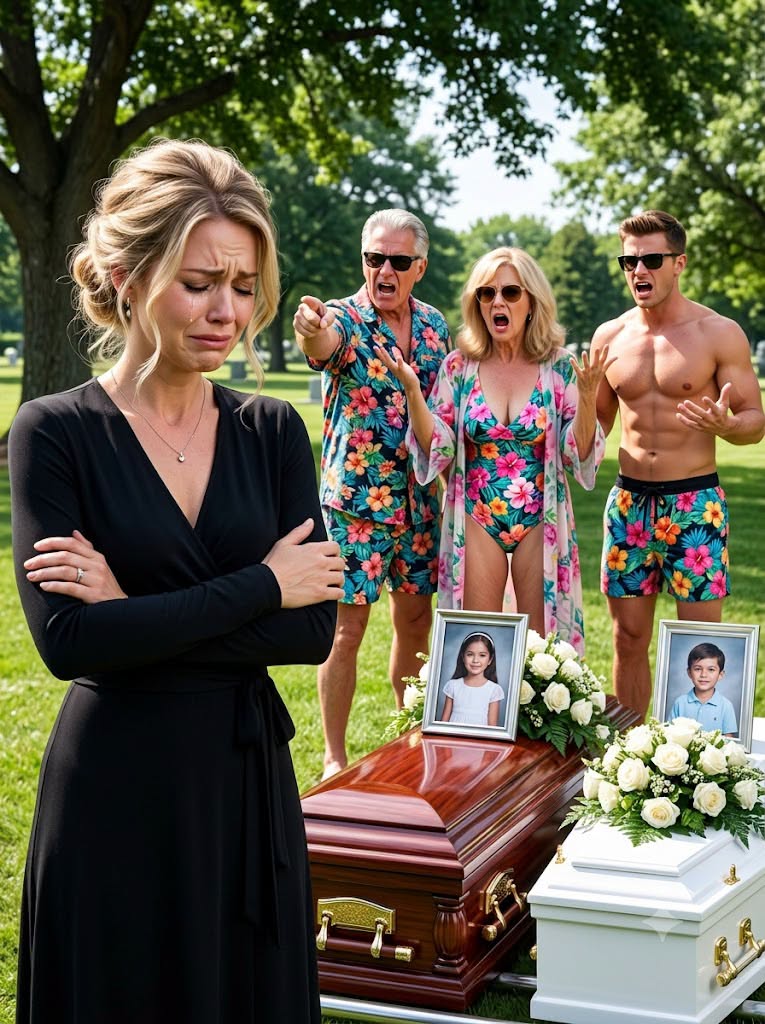
Then I opened social media and saw the three of them smiling on a beach beneath a caption about enjoying precious family time.
I stopped looking after that.
The people who actually carried me through those first days weren’t related to me. Johnny’s colleagues filled the funeral home. My neighbor Mrs. Forbes brought food because she noticed I wasn’t eating. My pastor sat with me without trying to explain why a husband and a seven-year-old child could disappear from someone’s life in a single car accident.
My family had always called me strong. It took me years to understand that they mostly meant useful.
Jared had spent his adult life moving from one failed business to another. My parents rescued him repeatedly, usually with money they didn’t have. When their own finances collapsed, they came to me. I paid bills, covered emergencies and helped Jared more times than I could count.
Johnny hated watching it.
“They don’t ask whether you’re okay,” he once told me. “They ask whether you’re available.”
Three days after the funeral, someone knocked on my door.
My parents and Jared stood outside, freshly returned from Aruba.
My mother hugged me briefly. My father asked how I was holding up. Jared barely mentioned Johnny or Gemma before explaining why they’d actually come.
His restaurant was in serious financial trouble. There were overdue tax obligations and debts he couldn’t cover.
They needed $40,000.
I stared at them, still wearing black, while Gemma’s glitter-covered backpack hung from the hook beside the door.
My mother told me this was an emergency.
I almost laughed.
Instead, I picked up the navy folder sitting on my entryway table.
“Come inside.”
The folder existed because several months before the accident, Johnny and I had received a rejection letter for a commercial loan.
The problem was that neither of us had applied for one.
Johnny was a corporate insurance attorney, so he immediately recognized that something was wrong. We pulled our credit reports, contacted the lender and began disputing accounts and applications we didn’t recognize.
The trail led somewhere neither of us wanted it to lead.
My family.
Documents connected to Jared’s restaurant contained my personal information and signatures I hadn’t provided. Other accounts appeared to have been opened or used without my authorization. Johnny also discovered documents bearing what purported to be his signature on financing he insisted he’d never guaranteed.
He hired an attorney experienced in financial fraud and brought in a forensic accountant to help reconstruct the transactions.
The deeper they looked, the worse it became.
Johnny had been assembling everything when he and Gemma died.
After the funeral, his attorney contacted me because the investigation had not disappeared with him. There were lender records, account statements, disputed applications and communications that still needed to be turned over to the appropriate institutions and investigators.
Then another incident occurred.
Shortly before the funeral, someone using my name contacted Johnny’s law firm about financial matters connected to his death. The message suggested I was too emotionally unstable to manage things myself and attempted to obtain information about money that might become payable to me.
The firm did not release it.
When I confronted my mother about the message, she stopped looking at me.
I opened the folder and placed copies of the disputed financial documents on the table.
Jared’s face changed first.
My father demanded to know where I’d gotten them.
“Johnny found them.”
For the first time since they arrived, nobody mentioned the $40,000.
I told them the lenders had already been notified, the fraudulent accounts disputed and the evidence preserved. Attorneys were handling Johnny’s estate, and information concerning suspected identity theft and forgery had been provided to investigators.
My father reached toward the folder.
I pulled it away.
“These are copies.”
That was when my mother began crying.
Not about Johnny.
Not about Gemma.
About what might happen to Jared.
Then another part of the investigation surfaced: money my grandmother Rosemary had left years earlier for educational purposes.
I had always been told the fund had been smaller than expected and largely exhausted by legitimate family expenses. Records suggested otherwise. Significant withdrawals had been made over the years, including transactions that appeared connected to my parents and Jared.
That issue required its own legal review. Some money was difficult to trace, some transactions were disputed, and recovering funds was far more complicated than simply proving that they had once existed.
But the pattern mattered.
For most of my life, I had believed my family was simply irresponsible with money.
I was beginning to understand that irresponsibility wasn’t the whole story.
The investigation took months.
Lenders produced records. Signatures and electronic communications were examined. Bank transactions were traced. My parents and Jared hired their own attorneys and offered explanations for some of the transfers and accounts.
Not every accusation resulted in a criminal charge, and not every dollar was recovered.
But enough evidence remained.
Eventually, prosecutors pursued charges connected to fraudulent financial activity that could be supported by the records. I testified about which accounts and applications I had authorized and which I had not. Other witnesses and financial records supplied the rest.
Watching my family face consequences brought me no satisfaction.
They were still my parents.
Jared was still my brother.
But grief had stripped away my ability to confuse love with unlimited access.
For years, I’d believed being a good daughter meant rescuing them whenever they created another disaster. Johnny had tried to teach me that helping someone and allowing them to use you were not the same thing.
It took losing him to finally understand.
Some money connected to the disputed accounts and my grandmother’s fund was eventually recovered through the various proceedings. Combined with money of my own, it became the beginning of something I wanted Gemma’s name attached to.
I established a small memorial scholarship fund for local children who had lost a parent or primary caregiver.
It wasn’t enormous at first.
That didn’t matter.
The first time we awarded a scholarship, I kept imagining Gemma sitting beside me, swinging her legs under the chair because she was too small for her feet to reach the floor.
Months later, on a warm spring morning, I visited the cemetery carrying blueberry pancakes.
They had been Gemma’s favorite.
I sat between two granite headstones and told Johnny about the scholarship. I told Gemma about the children we’d helped. Then I told them something I wished I’d understood while they were alive.
I wasn’t going to spend the rest of my life being strong for people who only appeared when they needed something from me.
My family had missed the worst day of my life because their vacation mattered more.
Three days later, they showed up because they needed $40,000.
They thought they were knocking on the same door they’d knocked on for years.
They weren’t.
The woman who had always opened it and solved their problems had finally learned how to say no.