Physical touch often communicates some degree of connection or comfort, but its meaning depends heavily on who’s doing it and what’s happening at the time.
A touch on the arm is relatively common and may emphasize a point, show friendliness, offer reassurance or signal familiarity.
A hand on the shoulder can communicate encouragement, support or affection. Depending on the relationship, it can also simply be a casual social gesture.
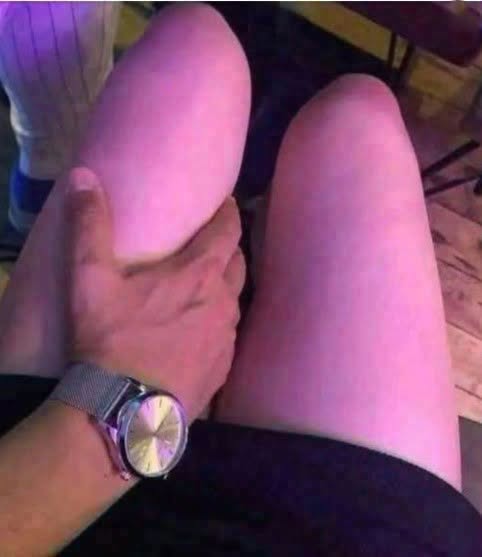
Touching someone’s knee is generally more personal because it enters a more intimate area of personal space. In some situations it may suggest flirtation or attraction—but even that isn’t proof on its own.
The important question isn’t simply:
“Where did they touch me?”
It’s:
“What else was happening?”
Attraction Is About Patterns, Not One Gesture
Suppose someone briefly touches your arm while laughing.
That alone tells you very little.
But imagine that the same person consistently seeks you out, sits close to you, maintains unusually sustained eye contact, initiates physical contact primarily with you and appears to create opportunities to spend time together.
Now you have a broader pattern.
Even then, body language isn’t a mind-reading device.
But multiple behaviors occurring consistently can provide more information than one isolated movement.
The opposite is equally important.
Someone who casually touches everyone while talking may simply have a naturally expressive communication style.
Touch Can Also Mean Comfort or Support
Not every meaningful touch is romantic.
Imagine someone has just received upsetting news.
A friend places a hand on their shoulder.
The gesture might simply communicate:
I’m here.
The same applies when people hug after difficult experiences, squeeze someone’s hand before an important moment or briefly touch an arm while offering reassurance.
Sometimes physical contact communicates support more naturally than words can.
Personality Makes a Huge Difference
Some people are naturally tactile.
They hug friends.
Touch someone’s arm while laughing.
Stand close during conversations.
Others can know someone for twenty years and barely make physical contact outside a handshake.
Neither style necessarily tells you how deeply they care.
That’s why comparing someone’s behavior with you versus their normal behavior with everyone else can be more informative than interpreting the gesture in isolation.
Culture Matters Too
Personal-space expectations differ considerably between cultures and communities.
A level of physical closeness that feels completely ordinary in one social environment may feel unusually intimate in another.
Family background matters as well.
Someone raised in a physically affectionate household may naturally communicate through hugs and touch, while another person may have learned to express affection with words or actions instead.
There is no universal body-language dictionary where:
Arm touch = attraction.
Shoulder touch = friendship.
Knee touch = romantic interest.
Human beings aren’t that predictable.
What About Eye Contact and Body Position?
Touch becomes more interesting when considered alongside other behavior.
Someone who is interested in another person may sometimes:
- Orient their body toward them
- Seek frequent eye contact
- Move physically closer
- Smile more during interaction
- Initiate conversations
- Remember small details
- Find reasons to continue spending time together
But every one of these behaviors can also occur without romantic attraction.
A good friend can do all of them.
So can an outgoing person who simply enjoys talking to you.
Body language provides clues—not verdicts.
Social Media Often Gets This Wrong
Viral posts love certainty.
“If someone does THIS, they’re secretly attracted to you.”
“If they touch you HERE, they want more than friendship.”
“If their feet point toward you, they’re in love.”
Those claims are appealing because they turn complicated relationships into simple puzzles.
Real communication doesn’t work that way.
Behavior changes with personality, mood, culture, stress, environment, relationship history and countless other factors.
Trying to decode every movement can actually make social interaction harder rather than easier.
Boundaries Matter More Than Interpretation
There’s another side to physical touch that’s more important than figuring out what someone “meant.”
How did it make you feel?
A gesture can be completely innocent and still make another person uncomfortable.
Healthy interaction requires awareness of personal boundaries.
If someone repeatedly touches you in ways you don’t like, you don’t need to determine whether they’re flirting, being friendly or simply naturally tactile before establishing a boundary.
Likewise, if you’re unsure whether another person is comfortable with physical contact, respecting their space is better than assuming.
So What Does That Touch Actually Mean?
Possibly attraction.
Possibly affection.
Possibly reassurance.
Possibly friendliness.
Possibly emphasis during conversation.
Or possibly almost nothing.
The most reliable interpretation comes from combining the gesture with the relationship, setting, personality, cultural context and broader pattern of behavior.
And when knowing someone’s feelings actually matters, direct communication will usually tell you more than analyzing the angle of their shoulders or counting how many seconds they maintained eye contact.
Body language can reveal things people haven’t put into words.
But it isn’t a secret code.
Sometimes a hand on your arm is a subtle expression of closeness.
And sometimes it’s simply a hand on your arm.
The difference is usually found in everything happening around that moment—not the gesture alone.