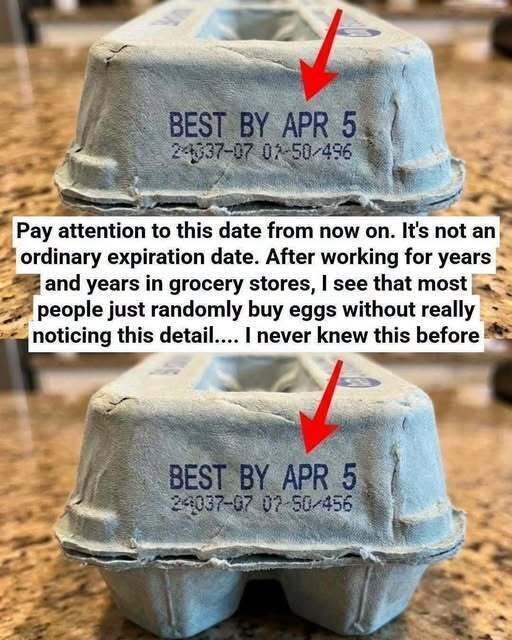
The system runs from 001 through 365, with 001 representing January 1.
So, for example, 032 corresponds to February 1, while 198 represents July 17 in a non-leap year.
Knowing how to read this code can be useful when comparing cartons at the store or deciding which eggs in your refrigerator should be used first.
But there is an important distinction.
The pack date does not tell you by itself whether an egg is safe to eat.
It mainly tells you when the eggs were packaged.
Some cartons may also include a code beginning with the letter “P.”
That number identifies the processing or grading facility where the eggs were handled.
Then there are the more familiar labels such as “Sell By,” “Best By” and “Best Before.”
Those markings have different purposes.
A sell-by date is primarily intended to help retailers manage stock and determine how long a carton should remain on store shelves.
Best-by or best-before dates are generally more closely connected to expected quality rather than serving as an absolute food-safety cutoff.
What matters just as much as the printed date is how the eggs have been stored.
According to USDA guidance, raw shell eggs can generally remain refrigerated for around three to five weeks.
They should be kept at 40°F, or about 4°C, or colder.
Storage location matters too.
Keeping eggs on an interior refrigerator shelf is generally better than storing them in the refrigerator door, where temperatures can fluctuate every time the door is opened.
Leaving them in their original carton also helps protect them from damage and reduces moisture loss and odor absorption.
One of the biggest misconceptions surrounding eggs is that freshness and safety are the same thing.
They are not.
An older egg may still be safe if it has been stored properly, while an egg that looks perfectly normal could potentially contain harmful bacteria.
Salmonella is one of the main concerns.
That is also why the popular float test should not be treated as a reliable food-safety test.
In the test, an egg is placed in water.
Fresh eggs generally sink, while older eggs may tilt upward or float.
The reason has to do with the air cell inside the shell.
As an egg ages, moisture and gases gradually move through the porous shell, causing the air pocket inside to become larger.
A larger air cell makes the egg more buoyant.
So a floating egg is usually an indication of age.
It does not automatically mean the egg is spoiled, and it certainly cannot tell you whether harmful bacteria are present.
Safe handling therefore matters far more than any kitchen trick.
Eggs with badly cracked shells should generally be avoided because cracks can create an easier pathway for contamination.
Heavily soiled or otherwise compromised eggs should also be handled cautiously.
After touching raw eggs, wash your hands thoroughly.
Utensils, countertops, cutting boards and other surfaces that have come into contact with raw egg should also be cleaned to reduce the risk of cross-contamination.
Cooking is another important part of egg safety.
FDA guidance recommends cooking eggs until both the whites and yolks are firm.
Recipes that use eggs but leave them raw or undercooked require extra caution, especially for people who may be more vulnerable to foodborne illness.
Once eggs have been cooked, storage rules change again.
Most cooked egg dishes can generally be kept in the refrigerator for about three to four days.
Hard-cooked eggs typically keep for about one week when refrigerated properly.
Leftovers should be refrigerated promptly rather than left sitting at room temperature for extended periods.
Ultimately, the different numbers and dates on an egg carton are useful pieces of information, but none should be treated as a single definitive safety test.
The three-digit code tells you when the eggs were packed.
A sell-by date helps stores manage inventory.
A best-by date is more closely related to expected quality.
And a float test mostly reveals how large the egg’s internal air cell has become.
What protects you most is proper handling.
Keep eggs refrigerated.
Store them in their original carton.
Avoid badly cracked or contaminated shells.
Wash your hands and kitchen surfaces after handling raw eggs.
Cook eggs thoroughly when appropriate.
And refrigerate cooked dishes and leftovers promptly.
If an egg has been badly damaged, contaminated or left at unsafe temperatures for too long, throwing it away is the safest choice.
The carton can give you useful clues.
But when it comes to egg safety, good storage and handling habits matter much more than any single printed number.
{"post":111707,"page":2,"next":[{"id":111706,"title":"Entitled Neighbor Claims My Driveway Until Thirty Classic Cars Teach Respect","url":"https:\/\/new24.info\/111706"},{"id":111702,"title":"Husband Summons Unexpected Guest After His Mother Throws Away My Delivery Dinner","url":"https:\/\/new24.info\/111702"},{"id":111698,"title":"My Parents Gave My Brother Everything Until My Hidden Lien Surfaced","url":"https:\/\/new24.info\/111698"},{"id":111693,"title":"A Rich Couple Refused to Pay My Grandpa $6,200 for Their Renovation \u2013 He Looked Around, Smiled, and Said, \u0027Okay\u0027","url":"https:\/\/new24.info\/111693"},{"id":111690,"title":"Why One Tiny Silver Key Destroyed My Husband And Saved My Life","url":"https:\/\/new24.info\/111690"},{"id":111686,"title":"Cruel Family Dinner Ambush Unintentionally Exposes Decades Of Massive Corporate Financial..","url":"https:\/\/new24.info\/111686"},{"id":111672,"title":"She was \u0027madly\u0027 in love with her co-star Robert Redford until his death \u2013 who is this legendary actress, now brokenhearted?","url":"https:\/\/new24.info\/111672"},{"id":111669,"title":"A Mother Cancels the Grocery Fund After a Cruel Remark About Her Starving Child","url":"https:\/\/new24.info\/111669"},{"id":111666,"title":"A Granddaughter Drives Nine Hours and Uncovers a Cruel Secret Hidden Inside a Nursing Home","url":"https:\/\/new24.info\/111666"},{"id":111663,"title":"I Broke My Arm and Asked My Husband to Help with Our 5-Month-Old Twins, but He Said, \u0027Moms Don\u0027t Get Sick Days\u0027 \u2013 So I Taught Him a Lesson He\u0027d Never Forget","url":"https:\/\/new24.info\/111663"},{"id":111660,"title":"My MIL Ordered Me a Dress Four Sizes Too Small for Her Party, Saying, \u0027It\u0027s Time for You to Lose Weight\u0027 \u2013 Karma Didn\u0027t Take Long to Catch up with Her","url":"https:\/\/new24.info\/111660"},{"id":111656,"title":"My Son Came Home Acting Strange Until I Realized Something Was Wrong","url":"https:\/\/new24.info\/111656"},{"id":111654,"title":"Dolly Parton Is Alive and Well as Her Hollywood Walk of Fame Star Undergoes Professional Restoration","url":"https:\/\/new24.info\/111654"},{"id":111651,"title":"A Childhood Vow Kept: The Deep Bond Between Two Friends on a Night to Remember","url":"https:\/\/new24.info\/111651"},{"id":111648,"title":"Bunny Levine, the Librarian Who Became a Late-Blooming Actress, Dies at 97","url":"https:\/\/new24.info\/111648"},{"id":111642,"title":"\u2018Grey\u2019s Anatomy\u2019 Star Eric Dane Dies at 53 After Courageous Battle With ALS","url":"https:\/\/new24.info\/111642"},{"id":111638,"title":"Most Folks Don\u2019t Recognize This Item Anymore","url":"https:\/\/new24.info\/111638"},{"id":111634,"title":"A Legendary Hollywood Career Comes to an End\u2014Fans Remember an Icon","url":"https:\/\/new24.info\/111634"},{"id":111630,"title":"Dolly Parton Dies at 80: Doctor Shares Cancer Warning Signs You Shouldn\u2019t Ignore","url":"https:\/\/new24.info\/111630"},{"id":111626,"title":"My 13-Year-Old Son Took a Dishwashing Job Without Telling Me \u2013 Then His Boss Called and Asked, \u0027Do You Know What He Does with Every Paycheck?\u0027","url":"https:\/\/new24.info\/111626"}]}