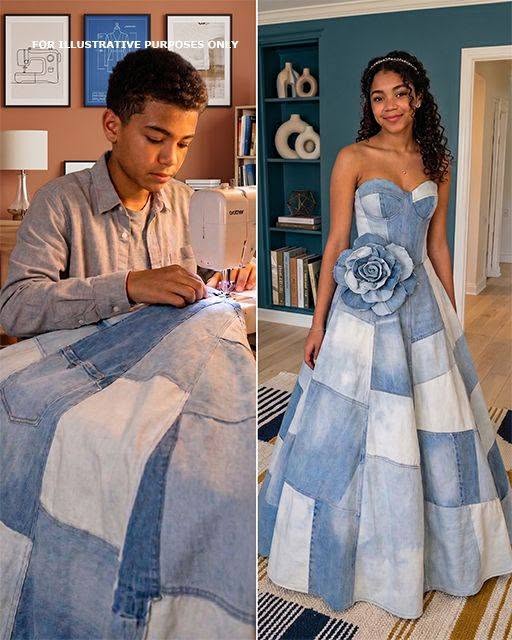
The rejection stung, but it was the sight of her designer handbag—purchased with funds meant for our education—that finally snapped the tether of my compliance. My brother Eli, only fifteen and burdened by the same grief that had haunted us since our parents’ deaths, saw the devastation in my eyes. He didn’t offer empty platitudes. Instead, he retreated to his room and returned with a stack of our late mother’s jeans, their denim faded by years of love, labor, and the simple, beautiful rhythm of a life once shared. He possessed a quiet, steady resolve, and as he began to measure and cut, he transformed those worn fabrics into a garment that carried the weight of our history. For three weeks, the kitchen became a sanctuary of sewing needles and whispered memories, a place where we reclaimed the pieces of our mother that Vanessa had tried to bury under her own selfish ambitions. When the dress was finished, it was more than just clothing; it was a testament to a bond she could never break and a resilience she could never comprehend.
The process of creating the dress was an act of profound healing. Eli spent hours hunched over the sewing machine, his brow furrowed in concentration as he aligned the different shades of blue. We spent those evenings talking about Mom, recounting stories of her laugh, her favorite songs, and the way she used to tuck us into bed. For the first time in years, the silence of our house didn’t feel oppressive; it felt filled with her presence. Eli’s skill was remarkable, as he treated the fabric with a reverence that spoke volumes about his love for our family. He preserved the original seams and the tiny embroidered flower, ensuring that the dress was not just a piece of fashion, but a living archive of our mother’s life. When I finally slipped into the finished garment, the fit was surprisingly elegant. It felt like a protective layer, a suit of armor fashioned from the very fabric of our shared past.
The night of the school showcase, Vanessa arrived with her phone held high, clearly anticipating a spectacle of embarrassment. She wanted the world to see us as charity cases, to mock the denim panels that Eli had so carefully stitched together. She stood near the back of the gymnasium, her posture rigid with expectation, ready to document what she believed would be our social ruin. But as I walked into the gymnasium, the atmosphere shifted. The dress was not a joke; it was a revelation. Students and teachers gathered, not to laugh, but to admire the craftsmanship and the profound story woven into every seam. The contrast between the simple, honest beauty of the dress and the artificiality of the surrounding prom preparations was striking. People were genuinely moved by the sight of us, and the warmth of their reception caught Vanessa completely off guard.
When we were called to the stage, the truth spilled out—not as an accusation, but as a tribute to our mother and the brother who had refused to let her memory fade. I spoke into the microphone, my voice steady, explaining that the dress was made from our mother’s jeans, a way to keep her close during a milestone she would have loved to witness. The audience broke into sustained, heartfelt applause. Vanessa, unable to contain her bitterness, pushed her way forward and began to shout, her voice cracking with the realization that her narrative of control was unraveling in front of a live audience. She accused us of making her look like a monster, oblivious to the fact that her public outburst was the final piece of evidence we needed, exposing the cruelty she had hidden behind closed doors for years. The principal and teachers stepped in, their protective presence shielding us from her vitriol as the livestream captured every word of her unhinged performance.
The aftermath was swift and necessary. The school, having witnessed her behavior, became the catalyst for our rescue. Our aunt Julia, whom we had been led to believe wanted nothing to do with us, arrived within the hour, her embrace a stark contrast to the cold isolation Vanessa had enforced. The legal proceedings that followed were exhaustive but just. We discovered the extent of the financial abuse—the vacations, the debts, and the personal luxuries funded by money meant for our care. The court acted decisively, removing Vanessa as trustee and appointing a professional to manage the remaining assets. She was ordered to repay the stolen funds, a judgment that stood as a final, formal recognition of her betrayal. We moved into a new life with Aunt Julia, one defined by safety and the freedom to remember our parents without the shadow of manipulation. Eli’s talent, once mocked, was recognized by professional designers, and I kept the dress, not as a reminder of the pain, but as a symbol of the night we finally stood up for ourselves.
We had walked into that gymnasium carrying the weight of our past, but we walked out knowing that our future was finally, unequivocally, our own. The court’s decision to remove Vanessa as trustee provided more than just financial relief; it restored our dignity and validated the years of hardship we had endured in silence. With Aunt Julia’s guidance, we began the slow process of healing, finding solace in the knowledge that the truth had finally surfaced. Eli’s design career flourished, and I found peace in the quiet moments of our new life, knowing the cycle of abuse had been broken for good. We had reclaimed our story, and in doing so, we had finally found our way home.