Neighbors walked the roads.
Police asked questions.
Our parents called relatives, hospitals, friends, anyone who might know something.
For months, every unfamiliar car slowing near the house made my heart jump.
Every phone call after dark felt important.
Every knock at the door made me run.
But eventually, the calls became less frequent.
The searches stopped.
People returned to their normal lives.
I didn’t.
Neither did my family, although we learned how to pretend.
My mother kept Laura’s room almost exactly as she had left it.
My father stopped talking about her almost entirely.
And I spent years wondering whether my sister was alive somewhere, whether she had been hurt, whether she had left willingly, or whether something terrible had happened to her.
The not knowing was the worst part.
Death, as unbearable as it is, at least gives you something definite to grieve.
Laura left us with a question mark.
I carried that question into adulthood.
Into marriage.
Into motherhood.
Then grandmotherhood.
I learned to live around it.
But I never really stopped waiting.
Even decades later, whenever I saw a woman with Laura’s hair or heard a familiar laugh in a crowded store, some part of me still turned.
Then one ordinary afternoon, my granddaughter Sophie walked into my kitchen and brought the past with her.
She was sixteen then.
Almost exactly the age Laura and I had been when everything changed.
“Grandma?”
I looked up from the counter.
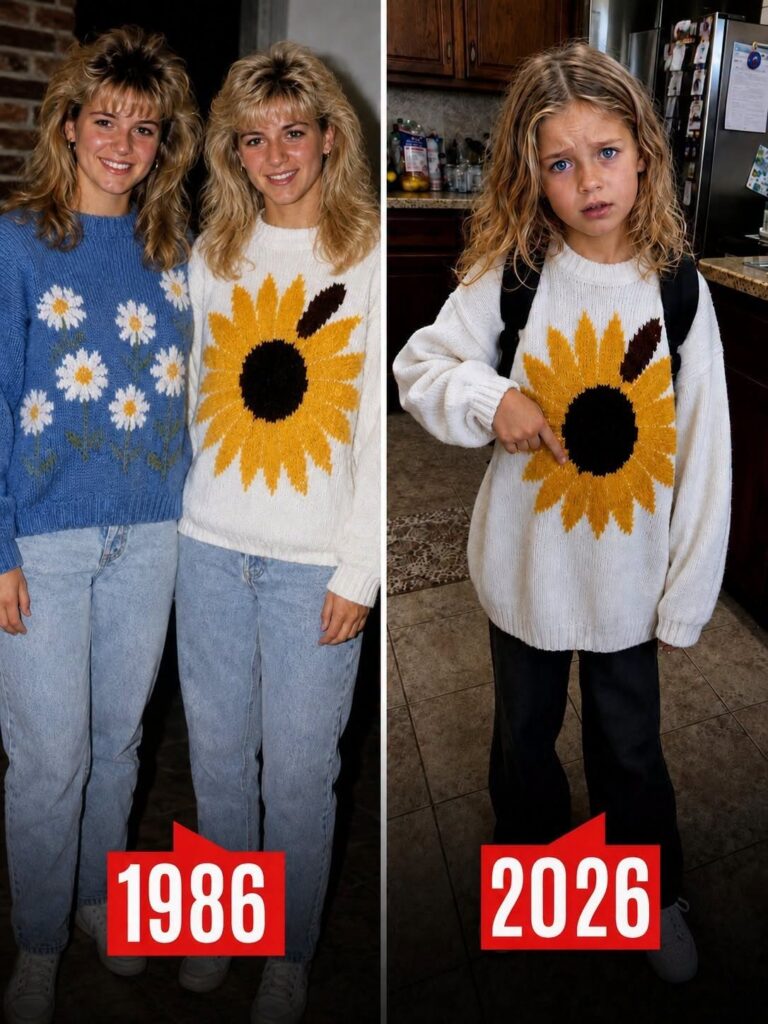
Sophie was wearing a cream-colored sweater.
There was a large yellow sunflower stitched across the front.
The bowl I was holding slipped from my hands and hit the counter.
Sophie jumped.
“What?”
I couldn’t answer.
I stared at the sweater.
The cream wool.
The slightly oversized sleeves.
The sunflower.
I knew that sweater.
I had known it before Sophie was born.
Before her mother was born.
Before I had wrinkles or gray hair or grandchildren.
Laura had worn it on our sixteenth birthday.
The last night I ever saw her.
“Sophie.”
My voice barely came out.
“Where did you get that?”
She looked down at herself.
“This?”
“Yes.”
I stepped closer.
“Where did you get it?”
Her smile disappeared.
“One of the cleaners at school gave it to me.”
I stared at her.
“What cleaner?”
“A woman named Dolly.”
“Why would a school cleaner give you a sweater?”
Sophie shrugged.
“She said she thought I’d like it.”
I reached for the sleeve.
My hands were shaking.
The wool was older now.
Softer.
There were tiny repairs near one cuff.
But I knew it.
I turned the neckline inside out.
There, sewn into the fabric in faded thread, were two letters.
L.W.
Laura Whitmore.
My knees almost gave out.
“Sophie.”
She looked frightened now.
“What’s wrong?”
“This belonged to my sister.”
“Laura?”
I nodded.
Sophie knew the story.
Everyone in the family knew the story.
Laura was the ghost at the edge of every old photograph.
The missing girl nobody fully understood.
Sophie stared at the initials.
“That’s impossible.”
“I know.”
Then her expression changed.
“Wait.”
“What?”
“She told me something else.”
My stomach tightened.
“Who?”
“Dolly.”
Sophie touched the sunflower.
“She said if I ever wondered why she gave it to me, I should look under the flower.”
I stared at her.
“Under it?”
She nodded.
We laid the sweater on the kitchen table.
At first, I saw nothing unusual.
Then I ran my fingers around the edge of the embroidered sunflower.
One section lifted slightly.
There was a tiny hidden pocket sewn beneath it.
My breath caught.
I slipped two fingers inside.
Something hard was tucked into the fabric.
I pulled it out.
And the room disappeared around me.
It was a small wooden sunflower.
Simple.
Hand-carved.
One petal slightly larger than the others.
A tiny crack along the stem.
Our father had made it.
He carved one for each of us when we were children.
Mine had been a little wooden moon.
Laura’s was the sunflower.
She carried it everywhere for years.
And the night she disappeared, it disappeared with her.
I sat down.
Sophie stood beside me silently.
For nearly forty years, I had wondered whether Laura had walked out of our lives carrying that little sunflower.
Now I was holding it again.
The past wasn’t gone.
It had just walked into my kitchen wearing my granddaughter.
“I need to meet Dolly.”
Sophie swallowed.
“I figured you were going to say that.”
The next afternoon, I went to Sophie’s school.
My hands shook the entire drive.
I had imagined finding Laura thousands of times.
In some versions, she was alive and happy.
In others, she had been injured and couldn’t come home.
Sometimes I imagined discovering that she had spent years trying to find us too.
But I had never imagined meeting a stranger wearing a janitor’s badge who somehow possessed the sweater my sister wore the night she disappeared.
Sophie led me toward a hallway near the gym.
A woman was pushing a cleaning cart.
She looked to be in her late thirties.
Dark hair.
Brown eyes.
Something about her face made me stop.
Not because she looked exactly like Laura.
She didn’t.
But there was something in the shape of her mouth.
The way she tilted her head.
A familiarity I couldn’t place.
Sophie called out.
“Dolly?”
The woman turned.
She saw me.
And froze.
Then she whispered my name.
“Margaret.”
I stopped breathing.
I had never met this woman.
I had never told Sophie to mention my name to her.
Yet she knew it.
“How do you know who I am?”
Dolly looked toward Sophie.
Then back at me.
Her eyes filled.
“Because my mother told me about you my whole life.”
I gripped the edge of a nearby table.
“Your mother?”
Dolly nodded.
“My mother is Laura.”
For several seconds, I genuinely couldn’t understand the words.
I heard them.
But my mind rejected them.
“Laura?”
“Yes.”
“My Laura?”
Dolly started crying.
“She’s my mom.”
I sat down because my legs would no longer hold me.
Alive.
Laura was alive.
After nearly forty years of wondering whether my twin sister was buried somewhere unknown, she was alive.
I should have felt only relief.
Instead, the first thing I felt was anger.
“Where is she?”
Dolly wiped her face.
“She doesn’t live here.”
“Where?”
“I can tell you.”
“Why didn’t she come herself?”
Dolly looked down.
“Because she’s afraid you hate her.”
I laughed bitterly.
“Hate her?”
“She thought you did.”
“She disappeared!”
“I know.”
“No. You don’t know.”
My voice cracked.
“I spent my entire life wondering whether she was dead.”
Dolly flinched.
I immediately regretted my tone.
None of this was her fault.
I sat back down.
“Tell me what happened.”
Dolly took a long breath.
Then she told me the story that had been hidden from me for almost forty years.
Laura hadn’t been kidnapped.
She hadn’t been killed.
She had run away.
There was a boy.
His name was Nathan.
I remembered him vaguely.
He was eighteen.
My father hated him.
Laura had been furious at home for months before our birthday.
Dad was strict.
Laura was stubborn.
Their arguments had become constant.
I knew some of that.
What I didn’t know was how far things had gone.
On the night we turned sixteen, Laura left with Nathan.
She believed they were going to start a life together.
She believed love would solve everything.
It didn’t.
Within a few years, Nathan was gone.
Laura was left raising Dolly alone.
“She wanted to come home,” Dolly said.
My heart pounded.
“When?”
“When I was about three.”
I calculated automatically.
That meant Laura had returned less than seven years after disappearing.
“She came here?”
Dolly nodded.
“With me.”
The room seemed to tilt.
“And nobody told me?”
Dolly hesitated.
“My grandfather met her.”
My father.
I stared at her.
“What did he do?”
Dolly’s eyes filled again.
“He told her not to come back.”
I stopped breathing.
“No.”
“She told me he said the family had finally started healing.”
“No.”
“He said your mother was fragile.”
“Stop.”
“He said seeing Laura again would destroy everything.”
I stood.
“No.”
I wasn’t arguing with Dolly.
I was arguing with reality.
My father had spent decades watching me wonder what happened to Laura.
He had watched my mother cry.
He had watched me celebrate birthdays with one empty chair in my mind.
And he knew.
He knew she was alive.
That evening, I drove to my father’s house.
He was eighty-seven by then.
Slower.
Thinner.
But still mentally sharp.
When I walked inside holding the wooden sunflower, he took one look at it and went completely still.
I didn’t say hello.
I placed it on the table.
“Tell me.”
His face changed.
“Margaret.”
“Tell me the truth.”
He looked at the sunflower.
Then closed his eyes.
That was enough.
I started crying.
“You knew.”
He didn’t deny it.
“You knew she was alive.”
“I did.”
The words hurt more than I expected.
“How long?”
His voice was barely audible.
“Thirty-two years.”
I stared at him.
“Thirty-two years?”
He nodded.
I had imagined so many monsters over the decades.
Kidnappers.
Strangers.
Accidents.
Bad luck.
I had never imagined my own father standing between me and the truth.
“She came back?”
“Yes.”
“With a little girl?”
“Yes.”
“And you sent her away?”
His face crumpled.
“I thought I was protecting everyone.”
I laughed through tears.
“That sentence has destroyed more families than people realize.”
He looked down.
“Your mother had barely started sleeping again.”
“So you lied to her too?”
“Yes.”
“Did Mom die believing Laura was still missing?”
He covered his face.
“Yes.”
That nearly broke me.
My mother had died twelve years earlier.
Until the end, she kept Laura’s photograph beside her bed.
“She waited for her.”
“I know.”
“You let her wait.”
“I know.”
“Why?”
Dad cried then.
I had almost never seen him cry.
“Because I was ashamed.”
I stared at him.
“When Laura left, I blamed myself.”
He wiped his face.
“When she came back, she had a child. She was struggling. She was angry. I thought if I let her back in, every wound would open again.”
“So you decided for all of us.”
“Yes.”
“You decided I didn’t deserve my sister.”
“No.”
“That Mom didn’t deserve her daughter.”
“No.”
“That Dolly didn’t deserve grandparents.”
“Margaret…”
“That is exactly what you decided.”
He couldn’t argue.
He had been afraid.
Afraid of conflict.
Afraid of reopening grief.
Afraid that Laura would disappear again.
And because of that fear, he created another disappearance.
This time deliberately.
I left his house furious.
But underneath the anger was something else.
Relief.
Laura was alive.
The sentence repeated in my mind all night.
Laura is alive.
Laura is alive.
Laura is alive.
Dolly and I began talking regularly after that.
She showed me photographs.
Laura at twenty-five.
Laura holding baby Dolly.
Laura at forty.
Laura with streaks of gray in her hair.
Laura standing on a beach.
Laura laughing at a birthday table.
I cried over almost every picture.
Not because she looked unhappy.
Because she had lived an entire life without me.
And I had lived one without her.
Dolly told me Laura had married again eventually.
That she worked for years at a florist.
That she still loved sunflowers.
That she asked about me more often than she admitted.
“Why didn’t she contact me herself?” I asked.
Dolly hesitated.
“She thought Grandpa told you she had come back.”
I closed my eyes.
Of course.
Another lie created by silence.
Laura believed I had known and chosen not to see her.
I believed Laura had vanished.
For decades, both of us had been hurt by something that wasn’t true.
“Does she know you found Sophie?”
“Yes.”
“What did she say?”
“She cried.”
I smiled sadly.
“That sounds familiar.”
Months passed before I received the first letter.
No return address.
My hands shook when I recognized the handwriting.
It had changed.
Of course it had.
But some shapes were still the same.
Especially the L.
I opened it slowly.
Laura didn’t ask for forgiveness.
She didn’t offer excuses.
She told me she had been sixteen, angry, frightened, and certain she knew more about life than everyone around her.
She said leaving had been her decision.
Staying away had not always been.
She wrote that when Dad turned her away, she believed I had agreed.
That hurt most of all.
She had spent decades thinking her twin sister didn’t want her.
I wrote back.
I told her the truth.
I had never known.
I had never stopped wondering.
I had never stopped loving her.
We began exchanging letters.
Then phone calls.
The first time I heard Laura’s voice after nearly forty years, neither of us spoke for almost a minute.
Finally, she whispered, “You still breathe loudly when you cry.”
I laughed.
Then cried harder.
“You still say rude things when you’re nervous.”
“That too.”
We didn’t repair forty years in one conversation.
We couldn’t.
There were too many birthdays.
Too many funerals.
Too many children born.
Too many ordinary Tuesdays we should have shared.
Our mother was gone.
Nothing could change that.
Nothing could return the years.
And I eventually understood that reconciliation is not a time machine.
It doesn’t erase what happened.
It simply gives you somewhere different to go next.
My father and I never completely repaired what his decision had done.
But before he died, he apologized to Laura directly.
She listened.
She didn’t absolve him instantly.
I respected her for that.
Some wounds deserve honesty before forgiveness.
Sophie still has the cream sweater.
We had it professionally cleaned and repaired, though the sunflower remains exactly where it always was.
The little hidden pocket is still there.
The wooden sunflower now sits on my bookshelf beside an old photograph of Laura and me when we were fifteen.
Two girls.
Same face.
Same smile.
Neither knowing what the next year would take from us.
For most of my life, I thought peace would come from solving the mystery.
I imagined one perfect answer that would make everything hurt less.
There wasn’t one.
The truth was messy.
Laura had made mistakes.
My father had made a terrible choice.
Silence had multiplied the damage.
People who loved each other had spent decades believing things that were never true.
But eventually I learned that peace doesn’t mean fixing the past.
Some things cannot be fixed.
Peace means finally understanding what happened and refusing to let what happened control everything that comes afterward.
I still hope Laura will walk through my front door someday.
Maybe she will.
Maybe she won’t.
But I no longer stand metaphorically at that door waiting for the sixteen-year-old girl who disappeared.
That girl is gone.
So is the girl I was.
We are older now.
We have children.
Grandchildren.
Regrets.
Stories the other never heard.
And, somehow, we still have time.
For nearly forty years, Laura’s disappearance was the unfinished sentence of my life.
Now I finally know how that sentence ended.
And for the first time since I was sixteen, I’m not waiting for an answer.
I’m living with the truth.
{"post":111127,"page":2,"next":[{"id":111120,"title":"Brigitte Bardot blamed her son for not giving her the maternal instinct \u2013 cut all contact for decades","url":"https:\/\/new24.info\/111120"},{"id":111117,"title":"The Hidden Costs of Deception: Why Supermarket Meat Labels Are Failing to Tell the Truth","url":"https:\/\/new24.info\/111117"},{"id":111114,"title":"Test Your Sharp Eyes With This Cozy Bedroom Hidden Object Challenge","url":"https:\/\/new24.info\/111114"},{"id":111111,"title":"Clarifying the Truth Regarding Dolly Parton and Her Recent Public Appearances","url":"https:\/\/new24.info\/111111"},{"id":111107,"title":"After Four Months Without Work, My Husband Finally Got a Job \u2013 Just Hours Into His First Day, He Came Home Pale and Refused to Tell Me What Happened","url":"https:\/\/new24.info\/111107"},{"id":111104,"title":"My 16-Year-Old Daughter Saved $4,000 All Summer for Her First Car \u2013 Then She Told Me Who She\u0027d Given It All To, and I Couldn\u0027t Say a Word","url":"https:\/\/new24.info\/111104"},{"id":111101,"title":"My Neighbor Covered My Car in Concrete for \u0027Blocking Her Lake View\u0027 \u2013 Then My 8-Year-Old Daughter Wiped the Smile off Her Face","url":"https:\/\/new24.info\/111101"},{"id":111098,"title":"Which Shoes Match This Dress Best? \u2013 Wake Up Your Mind","url":"https:\/\/new24.info\/111098"},{"id":111096,"title":"The Cream Envelope In My Purse That Revealed Which Daughter Had Been Erasing The Other","url":"https:\/\/new24.info\/111096"},{"id":111090,"title":"Before her death, Dolly Parton revealed the name she had chosen for her unborn daughter","url":"https:\/\/new24.info\/111090"},{"id":111086,"title":"Dolly Parton fans blown away by her real hair after years of seeing her in wigs","url":"https:\/\/new24.info\/111086"},{"id":111084,"title":"What Your Choice of Footwear Reveals About Your Inner Personality and Personal Style","url":"https:\/\/new24.info\/111084"},{"id":111081,"title":"Building Bridges: How to Foster Open Communication and Prevent Your Child from Facing Hidden Digital Pressures","url":"https:\/\/new24.info\/111081"},{"id":111078,"title":"The Secret Contract That Redefined My Sister\u2019s Life and My Family\u2019s Future","url":"https:\/\/new24.info\/111078"},{"id":111068,"title":"Dolly Parton\u0027s Tribute Responses Leave Fans Divided \u2014 One Touched Hearts, Another Sparked Outrage","url":"https:\/\/new24.info\/111068"},{"id":111066,"title":"Reflecting on the Final Public Appearances and Enduring Legacy of the Beloved Icon Dolly Parton","url":"https:\/\/new24.info\/111066"},{"id":111061,"title":"My 8-Year-Old Son Gave Up His Lunch Money to Buy a Little Girl with Down Syndrome a Red Birthday Dress \u2013 The Next Morning, Our Lawn Was Covered with Lunchboxes, but What Was Inside the Biggest One Made Him Go Pale","url":"https:\/\/new24.info\/111061"},{"id":111058,"title":"Every Graduate\u0027s Sibling Had to Make Them a Gift for Prom \u2013 I Worried About My Brother with Down Syndrome Until I Saw What He\u0027d Made Me","url":"https:\/\/new24.info\/111058"},{"id":111053,"title":"Remembering Peter Cullen: The Iconic Voice Behind Optimus Prime and Eeyore","url":"https:\/\/new24.info\/111053"},{"id":111050,"title":"A little girl called 911 crying: \u201cDaddy\u2019s snake is so big it hurts!\u201d\u2026","url":"https:\/\/new24.info\/111050"}]}