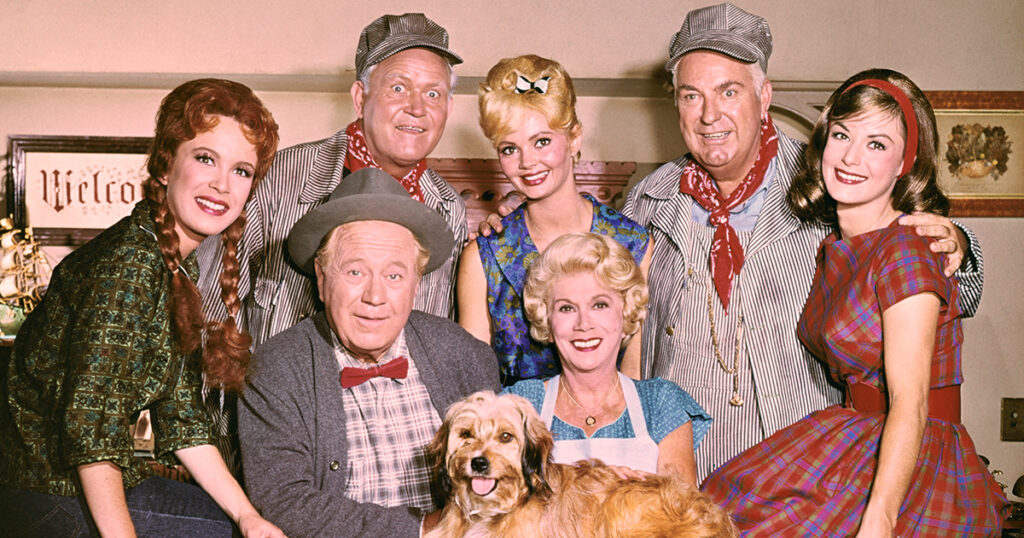
But beneath that wholesome image were casting surprises, continuity mistakes, real-life romance and heartbreaking circumstances viewers watching at home knew almost nothing about.
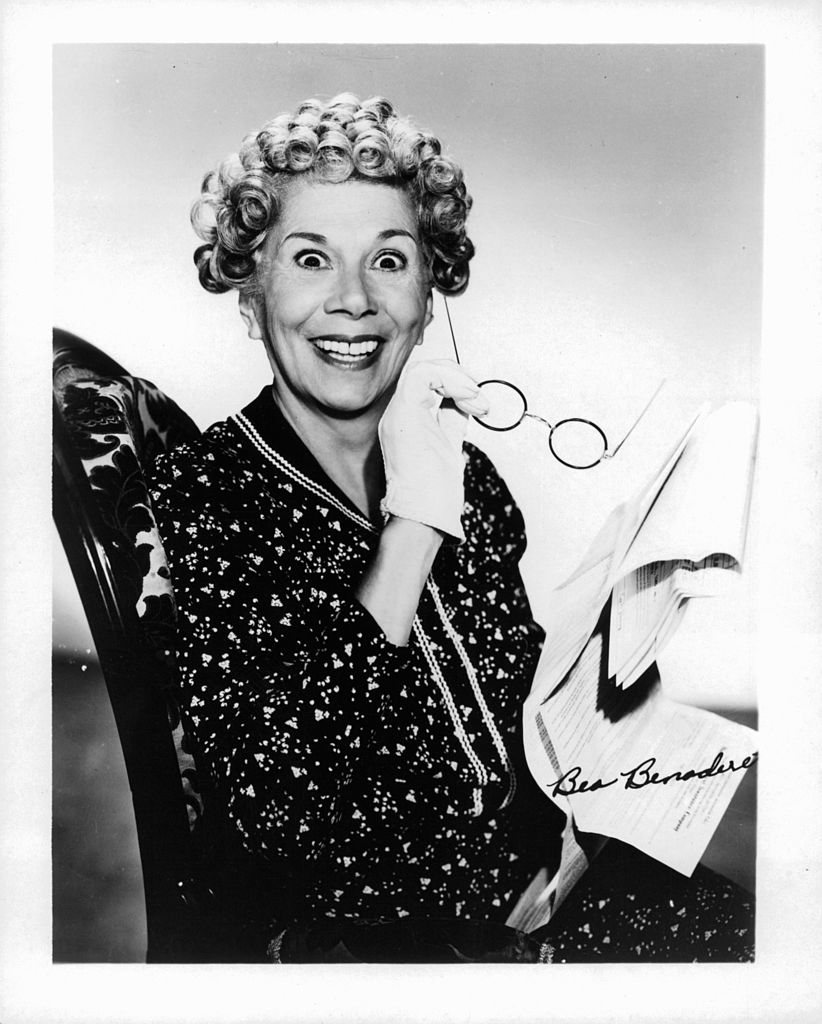
Set in the fictional community of Hooterville, *Petticoat Junction* followed widowed mother Kate Bradley, played by Bea Benaderet, as she ran the Shady Rest Hotel while raising her three daughters.
Then there was Edgar Buchanan’s hilariously lazy Uncle Joe Carson, who was always nearby — although whether he was actually helping was another question entirely.
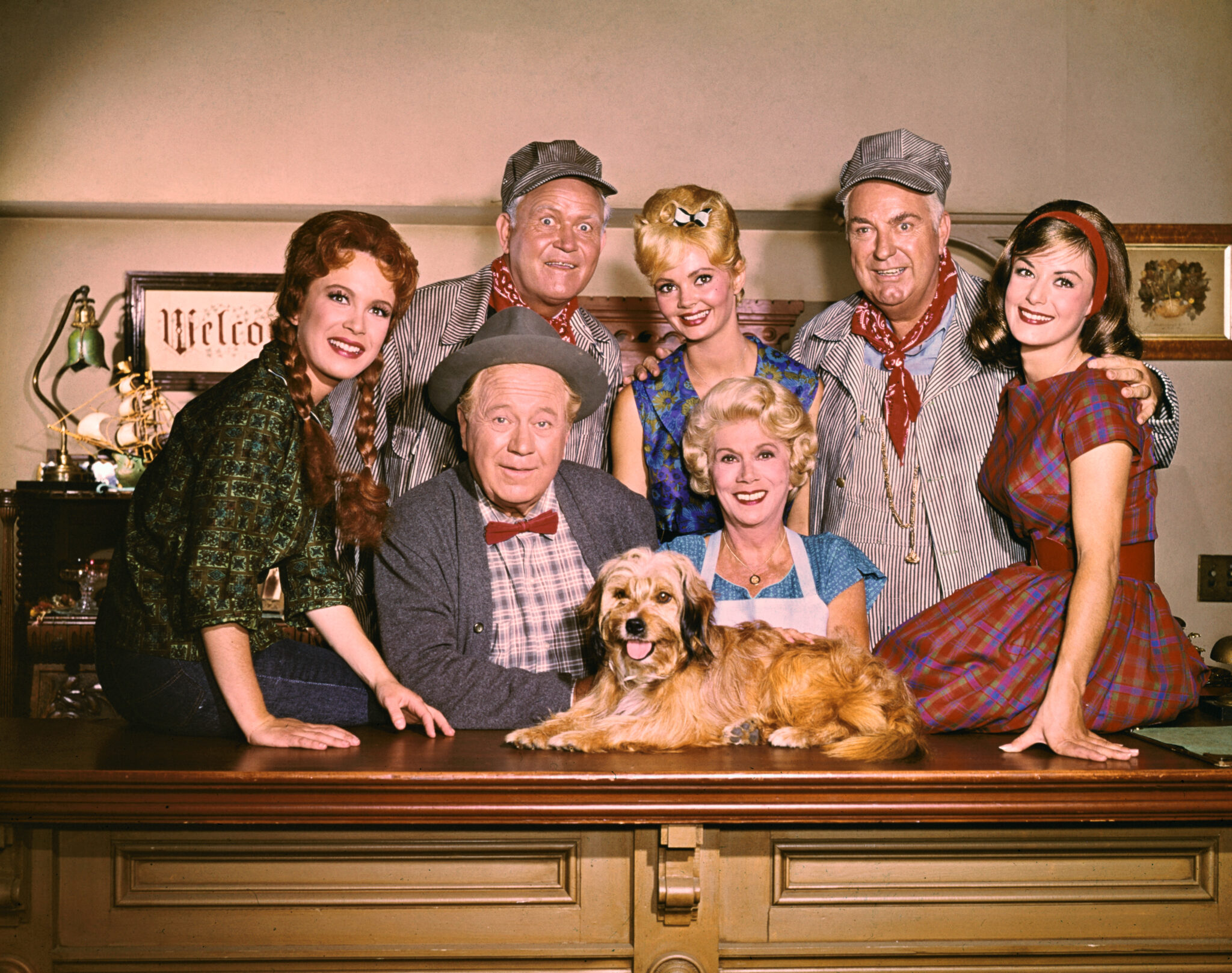
Kate’s daughters became equally recognizable.
Linda Kaye Henning played redheaded Betty Jo, while Bobbie Jo was originally portrayed by Pat Woodell before Lori Saunders assumed the role. Billie Jo changed actresses several times, with Jeannine Riley, Gunilla Hutton and eventually Meredith MacRae playing the blonde Bradley sister.
Together, the characters carried the series through seven seasons and 222 episodes.
Yet even longtime fans may have missed some surprisingly obvious mistakes.
Despite the show’s title, for example, the Shady Rest wasn’t technically sitting at a traditional railroad junction.
It was located near a water stop along an isolated branch line. The name “Petticoat Junction” was connected to the Bradley sisters’ habit of swimming in the railroad water tower and leaving their petticoats hanging over its side.
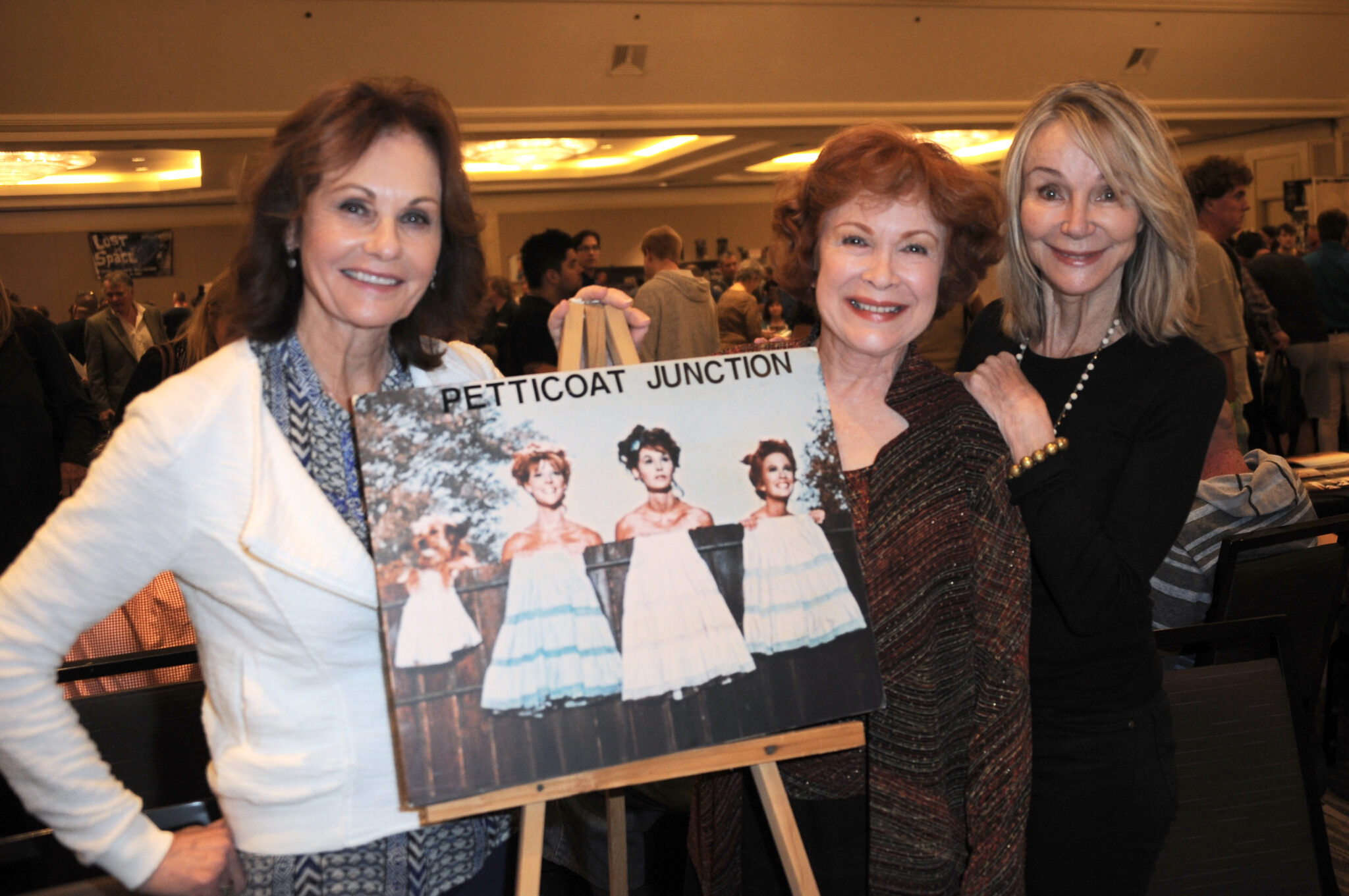
And yes, the famous opening deliberately played with the audience’s imagination.
But that opening sequence also contained one of the show’s funniest continuity problems.
When Meredith MacRae replaced Gunilla Hutton as Billie Jo beginning with the 1966–67 season, viewers might have expected the opening credits to change accordingly.
They didn’t — at least not completely.
In the distant shot showing the Bradley sisters climbing down from the water tower, Hutton reportedly remained visible for years after MacRae had already taken over the character.
In other words, Billie Jo had technically been replaced everywhere except the water tower.
There were other subtle changes.
During the first two seasons, the sisters appeared in the credits in the order Billie Jo, Bobbie Jo and Betty Jo. Beginning with Season 3, the sequence shifted to Betty Jo, Bobbie Jo and Billie Jo.
Finding the right Bradley sisters hadn’t been easy either.
Series creator Paul Henning reportedly considered an enormous number of young women before settling on the actresses who would become the faces of the Shady Rest.
One of them had an especially close connection to him.
Linda Kaye Henning was Paul’s daughter.
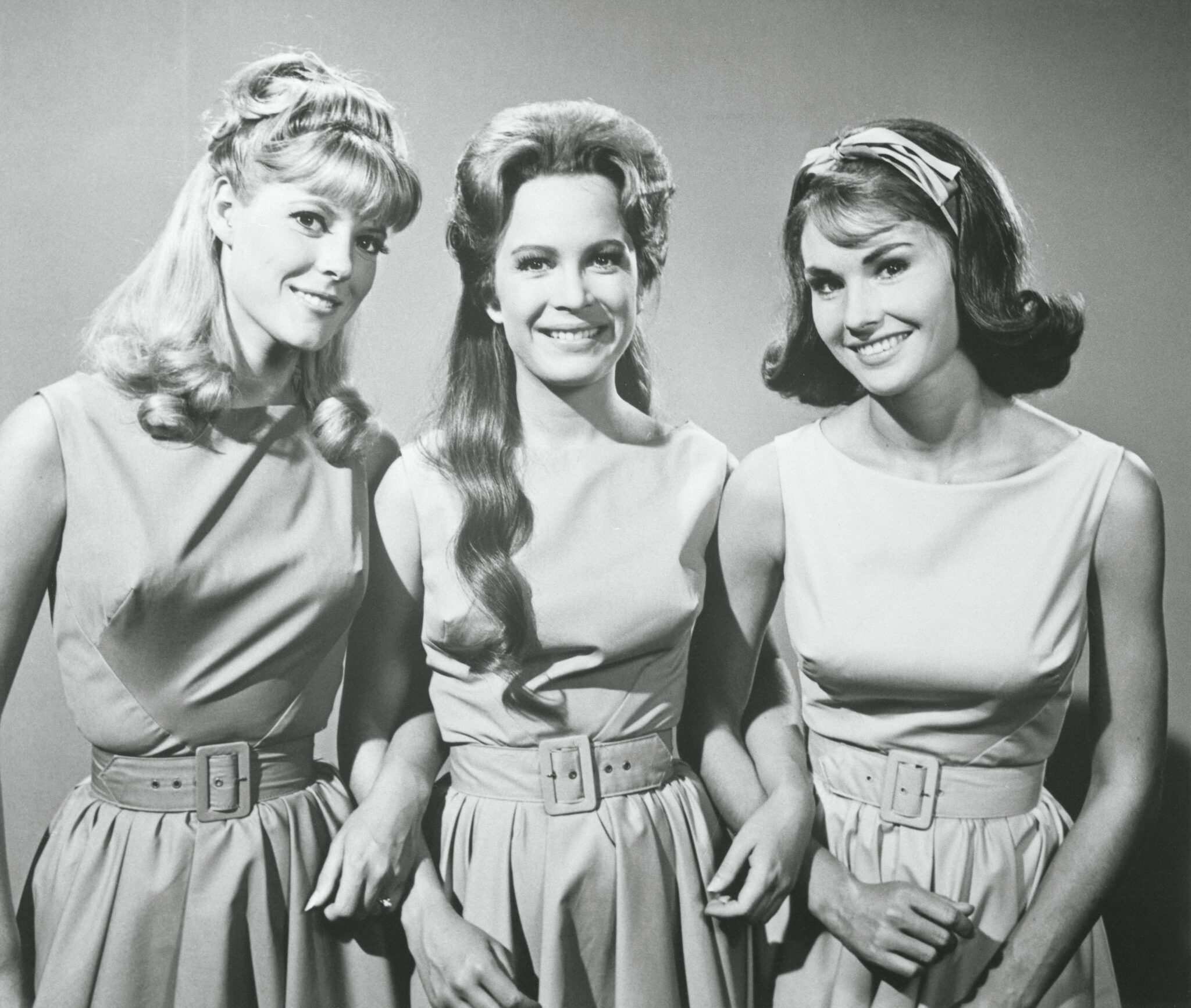
Bea Benaderet reportedly encouraged the idea of casting Linda as Betty Jo, helping launch a role that would become inseparable from the actress.
The Hooterville Cannonball created another collection of amusing inconsistencies.
According to the show’s premise, the train was essentially the primary way to reach the isolated Shady Rest Hotel. The nearest usable road wasn’t exactly supposed to provide convenient transportation.
But as the seasons continued, that isolation became remarkably flexible.
Characters would occasionally appear at the hotel despite apparently never arriving on the Cannonball. Someone might enter shortly after the train had departed, while another guest could already be at the hotel moments before the Cannonball supposedly delivered visitors.
Apparently, the Hooterville Cannonball ran according to whatever schedule that week’s script required.
Then there was the smoke.
The locomotive was presented as a wood-burning engine, and viewers could clearly see chopped firewood piled aboard.
But it frequently produced thick black smoke more characteristic of another type of fuel.
The series even offered a convenient explanation early on: the Cannonball was supposedly burning old railroad ties.
The locomotive itself wasn’t always consistent either.
Different filming circumstances meant viewers weren’t necessarily seeing precisely the same train in every shot, with production techniques and mock-ups helping create the illusion.
Even the Cannonball’s number mysteriously changed.
During the black-and-white seasons, viewers could spot the number “3” on the locomotive.
When *Petticoat Junction* transitioned to color in its third season, the locomotive became No. 8.
No elaborate explanation was necessary.
This was Hooterville, after all.
One of the sweetest stories surrounding the series happened away from the cameras.
Linda Kaye Henning’s Betty Jo eventually fell in love with Steve Elliott, played by Mike Minor.
Their characters married on the show in 1967.
Then fiction became reality.
Approximately 10 months later, Henning and Minor married in real life.
There was even an especially romantic connection between the two ceremonies: Henning reportedly wore the same wedding gown for her real wedding that Betty Jo had worn when marrying Steve on television.
Another future Hollywood star nearly became part of the Bradley family.
Before *Petticoat Junction* premiered, Sharon Tate was considered for the role of Billie Jo and participated in early promotional work connected with the production.
She ultimately didn’t become one of the show’s regular Bradley sisters, and Jeannine Riley took the role when the series began.
Meanwhile, Edgar Buchanan became indispensable as Uncle Joe.
His character was famous for avoiding work whenever possible, constantly searching for shortcuts and schemes while moving at his own famously relaxed pace.
Ironically, Buchanan himself achieved something no other performer on the series did.
He appeared in all 222 episodes.
The supposedly laziest man in Hooterville was actually the show’s most consistently employed resident.
Even the theme song contained a little mischief.
The famous reference to “lots of curves” could easily describe the railroad.
But audiences weren’t necessarily expected to think only about the tracks.
For an early-1960s family sitcom, *Petticoat Junction* knew exactly how to slip a playful double meaning past viewers.
Then there was Higgins.
Fans knew the lovable canine simply as “Dog,” although Higgins was the animal actor’s actual name.
He became an important part of the series and appeared in more than 150 episodes.
One of the show’s recurring jokes involved Dog’s rivalry with Uncle Joe.
Behind the scenes, things were apparently very different.
Higgins reportedly had a particularly good relationship with Edgar Buchanan and could even be found sitting comfortably in his lap during publicity sessions.
The dog’s career didn’t end in Hooterville either.
Higgins later became famous as the title character in the 1974 movie *Benji*.
But among all the amusing mistakes and charming behind-the-scenes stories surrounding *Petticoat Junction*, one chapter remains far more painful.
Bea Benaderet was the emotional center of the series.
As Kate Bradley, she was the warm, sensible mother holding together not only her family but seemingly the entire Shady Rest Hotel.
What viewers couldn’t see was that Benaderet eventually began fighting a devastating illness while continuing her work.
Doctors had discovered a suspicious spot on one of her lungs during a medical examination years earlier. Although it initially appeared to disappear, the problem later returned.
While *Petticoat Junction* was in its fifth season, Benaderet underwent exploratory surgery in November 1967.
Doctors discovered a tumor that could not be surgically removed.
She had lung cancer.
Benaderet underwent radiation treatment and was forced to miss multiple episodes while recovering.
Instead of permanently removing Kate from the story, the writers explained her temporary absence by saying she was visiting her sister.
Other performers were brought in to provide a maternal presence around the Shady Rest while everyone hoped Benaderet would recover.
And for a brief period, that hope appeared justified.
She returned for the fifth-season finale, appropriately titled “Kate’s Homecoming.”
For viewers who loved Kate Bradley, seeing her return must have felt reassuring.
Unfortunately, the improvement didn’t last.
Within months, Benaderet’s condition deteriorated again.
She eventually became too ill to continue appearing normally on camera.
Her final involvement with *Petticoat Junction* came during the sixth-season episode “The Valley Has a Baby.”
By then, Benaderet’s health had deteriorated so severely that her participation had to be significantly limited.
It became a heartbreaking ending for an actress whose character had been the heart of Hooterville from the beginning.
On October 13, 1968, Bea Benaderet died in Los Angeles.
She was 62.
The loss fundamentally changed *Petticoat Junction*.
June Lockhart later joined the cast as Dr. Janet Craig, providing another strong female presence around the Shady Rest.
But for many viewers, nobody could truly replace Kate Bradley.
The tragedy surrounding Benaderet’s death became even more devastating only days later.
Her husband, Eugene Twombly, died from a heart attack just four days after losing his wife.
He was only 54.
He was laid to rest beside her.
Despite losing its beloved leading lady, *Petticoat Junction* continued until 1970.
But by then, American television itself was changing.
Advertisers were becoming increasingly focused not simply on how many people watched a program, but exactly which demographic groups were watching.
That mattered enormously.
A series could have a substantial and devoted audience and still find itself vulnerable if advertisers believed too many viewers fell outside their preferred age range.
*Petticoat Junction* experienced those shifting commercial pressures firsthand as sponsors and scheduling decisions influenced the show’s future.
And eventually, an even larger change swept through television.
At the beginning of the 1970s, networks began moving aggressively away from the rural comedies that had dominated schedules throughout the previous decade.
The phenomenon became famously known as television’s “rural purge.”
Shows centered around small towns, farms and country life suddenly found themselves disappearing, sometimes despite continuing popularity.
*Green Acres*, *Mayberry R.F.D.* and other rural favorites were swept up in the transformation.
*Petticoat Junction* became part of that disappearing television era as well.
After seven seasons and 222 episodes, the doors of the Shady Rest finally closed.
But more than half a century later, Hooterville hasn’t completely disappeared.
Fans still remember the Cannonball pulling into the station.
They remember Uncle Joe’s schemes.
They remember Betty Jo, Bobbie Jo and Billie Jo.
They remember Dog.
And perhaps most of all, they remember Bea Benaderet standing at the center of it all as Kate Bradley.
The mistakes, changing actresses, mysterious locomotive numbers and continuity problems are fun to spot now.
But they’re also part of the charm.
*Petticoat Junction* came from an era when television didn’t need to be perfect to become unforgettable.
Sometimes all it needed was a little hotel beside the railroad tracks, three sisters, one extremely lazy uncle, a dog and a train that somehow always arrived exactly when the story needed it.
And for viewers who grew up watching them, one glimpse of the Shady Rest can still feel a little like coming home.
{"post":110757,"page":2,"next":[{"id":110743,"title":"Dolly Parton, Who Never Had Kids, Treated Miley Cyrus Like Her Own \u2014 Here Is How Her Grandkids Would Look via AI","url":"https:\/\/new24.info\/110743"},{"id":110736,"title":"Missing Pregnant Paramedic Astounds Rescuers With Unconventional Survival And Emotional Reunion","url":"https:\/\/new24.info\/110736"},{"id":110732,"title":"Ritz Cracker Party Sandwiches: The Perfect Bite-Sized Appetizer","url":"https:\/\/new24.info\/110732"},{"id":110728,"title":"Missing For Ten Years My Twin Sister Suddenly Called For Help","url":"https:\/\/new24.info\/110728"},{"id":110723,"title":"Slow Cooker Brown Sugar Pork Chops: An Easy Sweet and Savory Dinner","url":"https:\/\/new24.info\/110723"},{"id":110713,"title":"Dolly Parton\u0027s Last Instagram Post, Published 10 Days Before Her Death, Takes on a Heartbreaking New Meaning","url":"https:\/\/new24.info\/110713"},{"id":110706,"title":"Before her death, Dolly Parton revealed why she never had children","url":"https:\/\/new24.info\/110706"},{"id":110704,"title":"Dolly Parton, Beloved Country Music Icon and Philanthropist, Passes Away at Age 80","url":"https:\/\/new24.info\/110704"},{"id":110694,"title":"Dolly Parton, 80, Spent Her Final Days Out of the Public Eye \u2014 and a Source Close to Her Family Has Now Revealed Why","url":"https:\/\/new24.info\/110694"},{"id":110691,"title":"Dolly Parton\u2019s last public appearance has everyone saying the same thing","url":"https:\/\/new24.info\/110691"},{"id":110687,"title":"Dolly Parton chose the song she wanted at her funeral years before her death","url":"https:\/\/new24.info\/110687"},{"id":110685,"title":"A Mother\u0027s Secret, A Daughter\u0027s Flight, and the Long Road to Rebuilding Trust After a Year","url":"https:\/\/new24.info\/110685"},{"id":110682,"title":"The Enduring Legacy of Dolly Parton and the Mystery of Her Dollywood Time Capsule","url":"https:\/\/new24.info\/110682"},{"id":110679,"title":"A Young Student\u2019s Quiet Sacrifice Sparks a Wave of Compassion Throughout Her Entire School Community","url":"https:\/\/new24.info\/110679"},{"id":110673,"title":"3-Ingredient Slow Cooker Whole Chicken","url":"https:\/\/new24.info\/110673"},{"id":110669,"title":"Garden Vegetable Spread","url":"https:\/\/new24.info\/110669"},{"id":110667,"title":"The Hidden Letter Beneath the Roses That Changed Everything for My Ex-Husband\u2019s New Life","url":"https:\/\/new24.info\/110667"},{"id":110662,"title":"New Details Emerge About Dolly Parton\u2019s Secret Hospital Visit Just Days Before Her Death","url":"https:\/\/new24.info\/110662"},{"id":110656,"title":"Dolly Parton Dies at 80 \u2014 Inside Her Heartbreaking Final Days, Last Health Update and Family\u2019s Emotional Goodbye","url":"https:\/\/new24.info\/110656"},{"id":110653,"title":"The Ring You Pick Will Reveal Your Truest Trait","url":"https:\/\/new24.info\/110653"}]}