She never really stopped writing after that.
Parton, the country music legend whose songs, unmistakable voice, larger-than-life appearance and warm personality made her one of the world’s most recognizable entertainers, has died at the age of 80, according to a statement from her family.
Across a career spanning nearly six decades, Parton became far more than a country singer. She was a songwriter, actress, businesswoman, philanthropist and cultural icon whose appeal extended well beyond Nashville.
She won 11 Grammy Awards, including a Lifetime Achievement Award, and sold more than 100 million records worldwide. Songs including “Jolene,” “Coat of Many Colors” and “I Will Always Love You” became classics, while generations of other artists continued recording her compositions.
But behind the towering blond hair, rhinestones and elaborate costumes was a woman whose beginnings could hardly have been further removed from Hollywood glamour.
Dolly Rebecca Parton was born January 19, 1946, in Tennessee and grew up in a one-room cabin in Locust Ridge. She was one of 12 children born to Robert Lee and Avie Lee Parton.
The family had very little money, and Parton later described her upbringing as “dirt-poor.” Those experiences became an important source for her songwriting, giving songs such as “Coat of Many Colors” an authenticity that listeners immediately understood.
Music was everywhere in the Parton household.
Her mother regularly sang traditional songs with roots in England, Ireland and Wales, often using music to tell stories.
“Mama had this haunting voice, and Lord you would feel it.”
Parton received her first real guitar at eight. Her mother proudly encouraged her talent, sometimes asking visitors to listen to songs her young daughter had written.
Parton admitted that she loved the attention.
By 11, she was performing on local radio. At 13, she appeared at Nashville’s legendary Grand Ole Opry.
After graduating from high school, Parton headed for Nashville determined to build a music career. Her breakthrough eventually included a hugely successful partnership with Porter Wagoner, appearing regularly on his television program and recording numerous hit duets with him.
When Parton decided it was time to pursue her solo career, she expressed the complicated farewell in the way she understood best — through a song.
That song was “I Will Always Love You.”
Years later, Whitney Houston transformed it into an enormous global hit, introducing Parton’s songwriting to another generation.
Parton’s personal life also began changing almost immediately after she arrived in Nashville. On her first day in the city, she met Carl Dean, who worked in the asphalt business.
They married in 1966.
Unlike his internationally famous wife, Dean preferred privacy and largely stayed away from Hollywood events and concert tours. Yet their relationship became part of Parton’s creative world.
One of the most famous examples was “Jolene,” inspired in part by a red-haired bank teller whose apparent interest in Dean caught Parton’s attention.
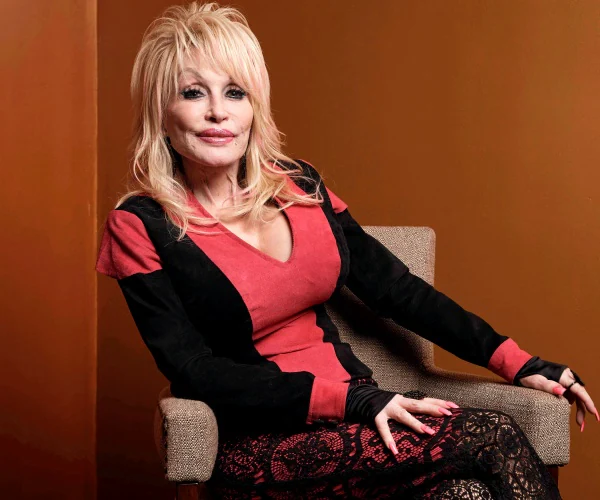
Her appearance, meanwhile, became nearly as recognizable as her music.
The enormous blond hairstyles, bright makeup, high heels and sparkling outfits weren’t accidental. Parton said her style had been inspired by a woman she remembered seeing around her Tennessee hometown.
Other people disparaged the woman’s appearance. Young Dolly saw something entirely different.
“I thought she was beautiful. But everybody said, ‘She’s trash!’ I laughed and said, ‘Well, if that’s trash, that’s what I want to be when I grow up!’”
Parton eventually learned to have fun with the enormous public fascination surrounding her appearance.
She joked about rumors involving her figure and treated “Dolly Parton” almost as a character she could dress, redesign and play with while keeping her private identity separate.
“I look one way and am another.”
She once explained that she thought about the public Dolly almost as a ventriloquist might think about a dummy, wondering what outrageous thing “she” could wear or say next.
Yet beneath that carefully constructed image was an extraordinarily serious songwriter.
Parton is estimated to have written thousands of songs during her lifetime. She loved lyrics that created pictures in the listener’s mind and approached songwriting with the sensibility of both a musician and poet.
“I like to make you see something visually, so I want to paint a picture. And I love to come up with clever lines, not just like a songwriter, but like a poet.”
Her songs crossed genres and generations.
“Jolene” alone was interpreted by performers ranging from The White Stripes to Beyoncé, while “I Will Always Love You” became inseparable from both Parton’s original recording and Houston’s powerhouse version.
Parton also shared a particularly close musical connection with her goddaughter Miley Cyrus and collaborated with Cyrus and her father, Billy Ray Cyrus.
Music, however, was only one part of her remarkable career.
In 1980, Parton made her major movie breakthrough alongside Jane Fonda and Lily Tomlin in 9 to 5. She also wrote and performed its famous title song, which earned her an Academy Award nomination.
Another Oscar nomination followed decades later for “Travelin’ Thru,” written for Transamerica.
Her film résumé also included The Best Little Whorehouse in Texas, Rhinestone, Steel Magnolias and Straight Talk.
Parton eventually became a major businesswoman as well.
Perhaps her most recognizable business venture was Dollywood, the Tennessee theme park that developed into one of the state’s best-known tourist attractions and provided employment and economic opportunities in the region where she grew up.
Her philanthropy became equally important to her public legacy.
Through the Imagination Library, Parton helped provide books to young children, with the literacy initiative eventually expanding far beyond Tennessee and into communities across the United States and several other countries.
She also supported scholarships for students in her home county.
During the COVID-19 pandemic, Parton donated $1 million to research at Vanderbilt University Medical Center, funding that contributed to work connected with Moderna’s COVID-19 vaccine.
Her hometown eventually honored her with a statue outside the courthouse.
But when another proposal emerged in 2021 to erect a statue of Parton in Nashville, she politely asked lawmakers to withdraw it.
“Given all that’s going on in the world, I don’t think putting me on a pedestal is appropriate at this time.”
That response reflected part of what made Parton unusual in an increasingly divided culture.
She generally avoided aligning herself publicly with partisan politics and managed to maintain affection among audiences with dramatically different political and cultural views.
Her ability to connect with people remained one of her greatest strengths.
Parton could look extravagantly glamorous while talking openly about poverty. She could make audiences laugh about her appearance and then devastate them with a song about heartbreak. She became extraordinarily wealthy without trying to erase the Appalachian childhood that had shaped her.
The awards accumulated along the way.
Twenty-five of her songs topped Billboard’s country charts. She entered the Songwriters Hall of Fame and received its prestigious Johnny Mercer Award in 2007. In 2022, she was inducted into the Rock and Roll Hall of Fame.
Her Grammy journey began decades earlier, with “Here You Come Again” earning her a Grammy in 1978. Numerous other honors followed.
Yet Parton repeatedly suggested that awards weren’t what she ultimately wanted people to remember.
Writing remained at the center of everything.
For her, songwriting was even connected to her spirituality.
“I feel like I’m closest to God when I write.”
Sometimes, she said, a particularly good lyric would seemingly arrive from nowhere, causing her to offer a quiet thank-you to God because she wasn’t convinced she had created it entirely by herself.
After the records sold, the movies ended, the rhinestones were packed away and the applause faded, Parton knew what she hoped would remain.
Not the hair.
Not the costumes.
Not even the celebrity.
The songs.
“At the end of the day, I hope that I will be remembered as a good songwriter. The songs are my legacy.”
From a little girl writing about a corncob doll in rural Tennessee to one of the most beloved entertainers in music history, Dolly Parton spent a lifetime turning experiences into stories and stories into songs.
And ultimately, she left behind exactly the legacy she said she wanted: music that will continue telling those stories long after the woman who wrote them has left the stage.
{"post":110628,"page":2,"next":[{"id":110625,"title":"The Letter Beneath The Roses That Undid My Ex-Husband\u2019s Wife The Very Next Day","url":"https:\/\/new24.info\/110625"},{"id":110623,"title":"Addressing False Reports Regarding the Well-Being of Country Music Icon Dolly Parton","url":"https:\/\/new24.info\/110623"},{"id":110620,"title":"Wheel of Fortune Contestant Delinda Rood Secures Significant Bonus Round Victory in Recent Appearance","url":"https:\/\/new24.info\/110620"},{"id":110617,"title":"Beyond the Ink: Understanding the Nuanced Reality of Three-Dot Tattoos","url":"https:\/\/new24.info\/110617"},{"id":110614,"title":"Clarifying the Truth Regarding the Health and Well-being of Country Music Icon Dolly Parton","url":"https:\/\/new24.info\/110614"},{"id":110611,"title":"I Tested the Avocado Skin Furniture Hack for 14 Days: Here Is the Truth","url":"https:\/\/new24.info\/110611"},{"id":110605,"title":"Do You Wake Up Between 3 and 5 in the Morning? \u0022It Could Be a Sign of Spiritual Awakening.\u0022","url":"https:\/\/new24.info\/110605"},{"id":110601,"title":"Devoted Mother Uncovers Husband Betraying Their Family Inside An Empty Apartment","url":"https:\/\/new24.info\/110601"},{"id":110597,"title":"My Husband Demanded Money For Europe So I Evicted Him Forever","url":"https:\/\/new24.info\/110597"},{"id":110593,"title":"Millionaire Discovers Massive Hotel Fraud Thanks To A Hungry Little Girl","url":"https:\/\/new24.info\/110593"},{"id":110589,"title":"Romanoff Noodles","url":"https:\/\/new24.info\/110589"},{"id":110585,"title":"Can You Spot All 4 Hidden Objects? Most People Miss at Least One","url":"https:\/\/new24.info\/110585"},{"id":110580,"title":"Husband Abandoned My Son To Take His Own Children On Vacation","url":"https:\/\/new24.info\/110580"},{"id":110577,"title":"My Husband Took Our Three Sons on a Fishing Trip, and None of Them Came Back \u2013 Six Years Later, My Oldest Daughter Found His Old Phone and Said, \u2018Mom, I Know What Really Happened Back Then\u2019","url":"https:\/\/new24.info\/110577"},{"id":110574,"title":"One year after the divorce, i ran into my ex-husband at the hospital. He smirked and said: Leaving you was the best decision i ever made. A useless woman can\u2019t have children. I\u2019m so lucky to have a one-year-old son with your best friend.","url":"https:\/\/new24.info\/110574"},{"id":110571,"title":"Just Weeks After I Gave Birth, My MIL Told Me to Step Out of the Family Photo, Saying, \u2018Otherwise, No One Else Will Fit in the Frame\u2019 \u2013 But 10 Minutes Later, She Rushed over in Panic Because of What I\u2019d Done","url":"https:\/\/new24.info\/110571"},{"id":110568,"title":"A Year After We Broke Up, I Learned My Ex-Boyfriend Had Put Me in His Will \u2013 Then His Lawyer Read His Letter, and Everything I Thought I Knew About Our Breakup Changed","url":"https:\/\/new24.info\/110568"},{"id":110565,"title":"Two Days Before Our Wedding, I Overheard My Fianc\u00e9\u2019s Plan \u2014 So I Made One Decision He Never Expected","url":"https:\/\/new24.info\/110565"},{"id":110563,"title":"The Grandparents Who Erased One Granddaughter Made A Threat That Was Recorded Word For Word2","url":"https:\/\/new24.info\/110563"},{"id":110560,"title":"Dirty Dancing star Jennifer Grey reveals surgeon\u2019s cruel comment before nose job that \u2018ruined her career\u2019","url":"https:\/\/new24.info\/110560"}]}