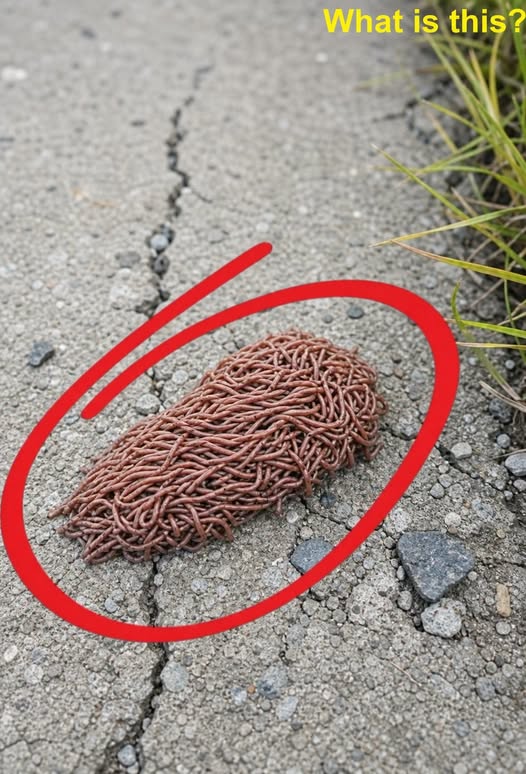
…and realized that my initial, dismissive assumption was entirely wrong. I had mentally categorized the object as discarded kitchen waste, a heap of overcooked spaghetti dumped carelessly by a neighbor or perhaps a stray animal. It looked sticky and wet, possessing that specific, unappealing sheen of starch left out in the rain. I prepared to step around it, my coffee cup steady in my hand, when the mass suddenly shifted. It did not merely twitch; it pulsed with a slow, rhythmic, and deeply unsettling vitality.
My breath hitched, and the coffee in my cup rippled in response to my sudden stillness. This was not inanimate refuse. It was a dense, writhing knot of hundreds of individual earthworms, a singular organism composed of countless smaller lives, all twisted into a frantic, suffocating sphere. The sheer density of the movement was hypnotic. They were not crawling away; they were locked in a desperate, tangled embrace. The sight was visceral, triggering a primal reaction that bypassed logic and went straight to the marrow of my bones.
I stood frozen, the steam from my coffee dissipating into the cool, damp air. My mind struggled to reconcile the mundane reality of my backyard with the alien spectacle before me. I found myself reaching for my phone, not to check messages, but to capture the evidence of this impossible knot. I zoomed in, the camera lens focusing on the glistening, translucent skin of the worms as they slid over one another, a constant, churning motion that felt like watching the earth itself trying to digest something it could not swallow. The texture was revoltingly smooth, yet the collective sound—a faint, dry rasping—seemed to vibrate through the soles of my shoes.
Later, from the safety of my kitchen, I sought answers. The scientific explanation was clinical and detached: the heavy rainfall had saturated the soil, flooding their tunnels and forcing them to the surface to avoid drowning. In their panic, they had sought the warmth and security of one another, forming a collective mass to survive the atmospheric shift. It was a biological imperative, a simple, evolutionary response to a hostile environment. Yet, knowing the mechanics of their survival did nothing to soothe the unease that had settled in my chest.
The knowledge that this was a natural occurrence made the experience feel more invasive, not less. It meant that this slow, silent struggle was happening beneath my feet every time I walked across the lawn. The earth was not a static foundation; it was a porous, breathing membrane, teeming with hidden life that only revealed itself when the conditions turned dire. The realization shattered the illusion of my dominion over the yard. I had always viewed the ground as a passive backdrop to my life, but now it felt like a thin veil stretched over a vast, subterranean world.
In the days that followed, the psychological shift became permanent. My morning routine, once a mindless transition between the indoors and the world, became an exercise in hyper-awareness. I found myself scanning the path before every step, my eyes darting to the damp shadows and the edges of the flowerbeds. I was no longer looking for spaghetti or trash; I was looking for the subtle signs of the life that pulsed just beneath the surface. Every patch of mud seemed to hold the potential for another eruption of writhing, desperate bodies. I felt as though the ground had eyes, or at least a consciousness I had previously failed to acknowledge.
This newfound vigilance felt like a burden. I began to notice the small, insignificant details I had ignored for years: the way the soil darkened in the low spots, the tiny holes that pockmarked the garden, and the faint, earthy smell that now carried a hint of warning. I felt like an intruder in a space I had once claimed as my own. The yard had become a theater of survival, and I was merely a clumsy, oblivious spectator who had finally been forced to pay attention to the performance.
I realized that my discomfort stemmed from the sudden collapse of distance between my world and theirs. We occupy the same space, separated only by a few inches of dirt, yet we exist in entirely different dimensions of time and necessity. My life is governed by schedules and screens, while theirs is governed by the saturation of the soil and the oxygen levels in the dark. The encounter with the knot of worms had bridged that gap, leaving me with a lingering, existential vertigo that I could not easily shake. It was a reminder that nature does not require my permission to exist, nor does it care for my comfort.
Eventually, the worms dispersed, returning to the depths or perishing in the sun, and the path returned to its familiar, empty state. But the memory of that living, breathing mass remained, a permanent fixture in my consciousness. I still walk the yard, but I do so with a measured, deliberate gait, acknowledging the silent, hidden pulse of the earth. I have accepted that my sense of normalcy was a fragile construct, easily undone by the simple, indifferent reality of the soil. I am no longer the master of my path, but a cautious guest, forever aware of the life that waits just beneath the surface, ready to rise when the rain begins to fall. The world is far more crowded than I ever dared to imagine.