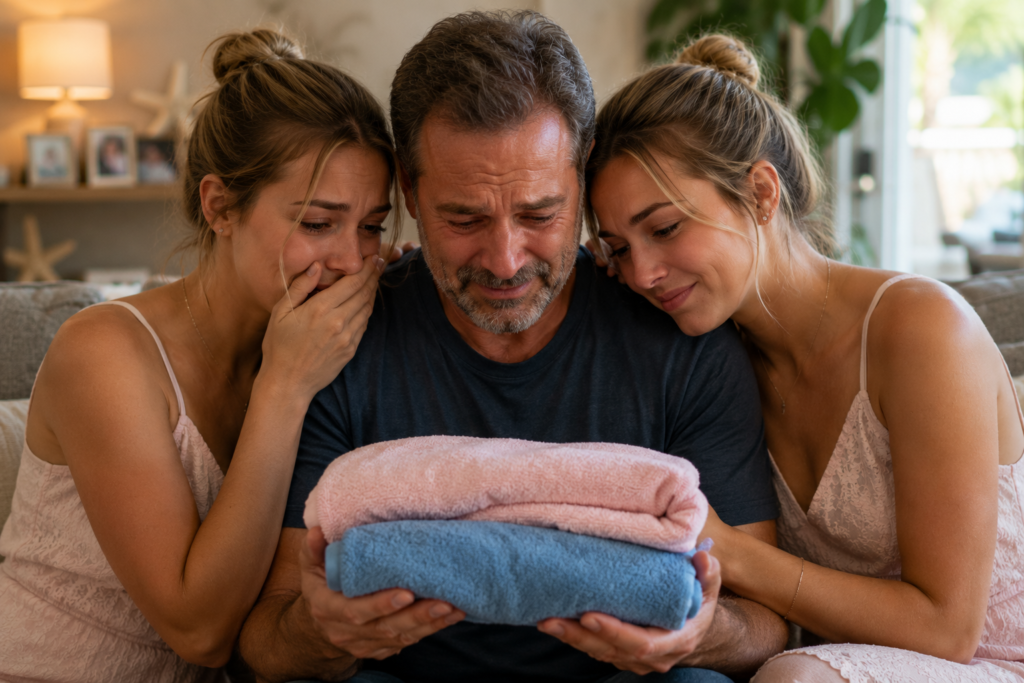
My hands started shaking the moment I saw those towels.
I knew every faded thread.
Eighteen years earlier, I had found two newborn girls wrapped in them inside a beach changing cubicle — one in white, the other in pink.
Now Emily and Grace stood across from me, both looking as if they were about to confess to something unforgivable.
“Dad,” Emily said softly, reaching for my hand.
Grace wiped at her cheek.
“We need to tell you the truth.”
“What truth?”
They exchanged a glance.
Then Grace pushed the white towel toward me.
“Open it.”
The second my fingers touched the fabric, I was no longer standing in my kitchen.
I was back on that beach, eighteen years younger, carrying a grief I was certain would kill me.
Before Emily and Grace, there had been Sarah and Ivy.
Sarah was my fiancée.
Ivy was our daughter.
She never took a breath, but she already had a name, a crib, and a drawer filled with little yellow onesies because Sarah believed babies should be surrounded by sunshine.
Then I lost them both.
After the funeral, I stopped living in any meaningful sense.
I stopped shaving.
Stopped returning calls.
Barely ate.
Most days, I sat inside the nursery staring at the pale yellow walls.
There was one uneven corner Sarah had teased me about, so I kept repainting it.
Again and again.
As though getting the color exactly right might somehow bring them home.
Three weeks later, my best friend Chris appeared in the doorway.
He looked at me, the untouched food, and the closed curtains.
“No.”
I blinked.
“No what?”
“No more of this. Pack a bag.”
“I’m not going anywhere.”
“Then I’ll pack it.”
“Chris, leave.”
“You haven’t opened a curtain in three weeks.”
“That’s none of your business.”
He stared at me.
“No, Trent. But you are.”
I told him I didn’t need saving.
“Good,” he replied. “I’m not asking permission.”
I hated him for saying it.
I went anyway.
Chris drove us three states away to a quiet stretch of coastline. He thought ocean air might help.
By sunset, all I wanted was to return to the yellow nursery and the life that had stopped moving.
“I’m done,” I told him.
I was already walking toward the parking lot when I heard something.
A cry.
Small.
Thin.
Alive.
Chris stopped.
“Did you hear that?”
I was already running.
The sound came from the changing cubicles near the sand.
The first was empty.
I pulled back the curtain on the second.
Two newborn babies were lying inside.
For one impossible second, I couldn’t move.
One was wrapped in a white beach towel.
The other in pink.
Then something inside me took over.
“Chris! Call somebody. Now!”
I dropped to my knees.
“They’re breathing.”
One baby began screaming so hard her tiny face turned red.
I covered both of them with my jacket without moving them more than necessary.
“That’s right,” I whispered. “Stay angry. Stay loud. Just stay.”
Paramedics arrived.
Then police.
Then questions.
A social worker named Andrea came later.
She told me the babies were stable.
“They’re warm now,” she said. “They’re breathing, and they’re loud. Those are all good signs.”
“Where are they going?”
“Somewhere safe while we determine what happens next.”
I nodded.
But I couldn’t leave.
I followed them to the hospital.
The nurses had temporarily started calling the girls Emily and Grace.
The names stayed.
At first, I told myself I kept visiting because they had nobody.
Eventually, I admitted the truth.
I wanted them.
Andrea never made it easy for me.
Weeks later, she sat across from me and said, “Finding them does not give you a shortcut to becoming their father.”
“I know.”
“There will be background checks, home inspections, classes, interviews, court involvement.”
“I’ll do all of it.”
Then she looked directly at me.
“You just buried your fiancée and your baby.”
My jaw tightened.
“That still hurts to hear.”
“I know.”
Then she asked the question that changed everything.
“Are you trying to adopt these children because they need a father, or because you need a reason to get out of bed?”
I looked at my hands.
“Both can be true,” I said.
“But only one can lead.”
I nodded.
“They need safety. So that has to lead.”
“What does that mean?”
“It means I don’t ask two babies to heal me. I become the person they can depend on.”
Andrea stopped writing.
“I don’t need them to save me,” I said. “I want to be a home for them.”
She studied me for a long time.
“Then prove it.”
So I did.
Months later, Emily and Grace came home as my foster daughters.
The adoption happened after that.
I became their father slowly and imperfectly.
I learned bottles.
Diapers.
Braids.
School forms.
Fevers.
Sleepovers.
Two birthday cakes every year because Grace wanted chocolate and Emily insisted on vanilla.
I kept the nursery yellow.
Not because I was replacing Ivy.
Because I eventually understood I didn’t have to erase one love to make room for another.
After the case closed, Andrea returned the two beach towels to me.
I stored them inside a cedar box along with the few things I still had from Sarah and Ivy.
I rarely opened it.
And I almost never spoke about what came before my daughters.
I thought silence protected them.
I was wrong.
When Emily and Grace turned fifteen, they began disappearing more often.
“We’re studying.”
“Weekend project.”
“Helping someone.”
They were terrible liars.
One Saturday, they returned home exhausted and suspiciously cheerful.
I confronted them.
“You two have been gone constantly.”
Emily opened the refrigerator.
“We’re teenagers.”
Grace poured herself water.
“You raised us to be responsible.”
“I also raised you to lie better than this.”
They both froze.
For one second, I thought they were going to confess.
Instead, Emily kissed my cheek.
“We’re okay, Dad.”
Deep down, I thought I understood.
Their adoption had never been hidden from them.
I assumed they were searching for their biological family.
And although the thought terrified me, I had promised myself long ago that if that day came, I would never force them to choose.
So I stayed quiet.
For three years.
By their eighteenth birthday, I had practically trained myself for the possibility of losing them.
That evening, I cooked garlic chicken and mashed potatoes.
Chris came by with cake.
Andrea called, as she did every birthday.
And strangely, Chris barely looked at me before leaving.
I should have noticed.
After dinner, Emily put down her fork.
“Dad, we need to get something.”
The girls disappeared upstairs.
When they returned, each carried one of the old towels.
My chair scraped backward.
“What are those doing out?”
Emily placed the white towel on the table.
Grace laid down the pink one.
“Dad,” Emily said, “please don’t hate us.”
“Hate you? Why would I hate you?”
Grace’s chin trembled.
“For three years, we’ve been lying.”
“About where you’ve been going?”
They nodded.
My chest tightened.
“Did you find them?”
Grace frowned.
“Find who?”
“Your biological family.”
Emily’s face crumpled.
“Dad, no.”
“It’s okay,” I said quickly. “If you found someone, I’ll help you. I mean that. You never have to choose.”
Grace pushed the towel toward me.
“This isn’t about leaving you.”
“Then what is it?”
“Open it.”
I unfolded the white towel.
Something dropped onto the table.
Three airline tickets.
Three seats together.
I stared at them.
“No.”
“We leave in three days,” Emily whispered.
“We haven’t been back there in eighteen years.”
“We know.”
Grace took a breath.
“We’ve been saving since we were fifteen. Babysitting. Tutoring. Dog walking. Weekend jobs.”
“For plane tickets?”
Emily shook her head.
“For you.”
I couldn’t breathe properly.
“I can’t go back there.”
“You can,” Grace said. “But you don’t have to do it alone.”
Then she pushed the pink towel toward me.
“There’s more.”
Inside was a scrapbook.
Across the cover, they had written:
Our Family Began Before We Could Remember
The first photograph showed me asleep with both babies against my chest.
Then came birthdays.
First steps.
Missing teeth.
School plays.
Report cards.
Father’s Day cards.
Near the end, an envelope slipped from between the pages.
Sarah’s photograph.
My throat closed.
“Where did you get this?”
“You dropped your wallet when we were fifteen,” Emily admitted. “I took a picture of it before you put it away.”
Grace touched the photograph.
“Is she why you never talk about before us?”
“I was trying to protect you.”
“From what?”
“Feeling like replacements.”
Emily stared at me.
“Dad, we never felt that way.”
“You don’t understand.”
“Then make us understand.”
I looked down at Sarah’s face.
“If I said her name too often, I was afraid you’d hear what I’d lost instead of what I’d gained.”
Emily turned one final page.
Four names had been written across it.
Sarah.
Ivy.
Emily.
Grace.
My breath caught.
“You know about Ivy?”
Grace nodded.
“We found her blanket in the cedar box.”
I sat down.
For eighteen years, I’d barely spoken my daughter’s name.
And now the two girls I’d spent my life raising had placed Ivy beside themselves as though there had always been room.
Emily handed me a letter.
“Read it.”
They wrote about things I had forgotten.
The nights I stayed awake when they were sick.
The mornings I went to work exhausted.
The years I learned ballet buns even though I had no idea what I was doing.
Then came the part that broke me.
They had noticed how quiet I became every year around their birthday.
They noticed I never went near beaches.
For years, they wondered whether being their father was somehow tied to the worst day of my life.
Eventually, they understood.
I had never loved them because I stopped loving Sarah and Ivy.
I had loved all four of them at once.
At the bottom was one final message.
Andrea had once told them what I’d said during the adoption process.
I hadn’t wanted them to save me.
Their letter ended:
“You never asked us to save you, Dad. But you saved us first. We’ve spent eighteen years trying to give some of that back.”
I couldn’t finish reading aloud.
Emily slid the tickets toward me.
“Come with us.”
“I’m scared.”
Grace took my hand.
“We know.”
Three days later, I stood on the same beach for the first time in eighteen years.
Every instinct told me to turn around.
Then Emily took my left hand.
Grace took my right.
And we walked.
Near the dunes, Chris and Andrea were waiting.
I stared at them.
“You brought backup?”
Emily gave me a nervous smile.
“In case you tried to run.”
Chris hugged me.
“I dragged you here once because I thought the ocean might keep you alive.”
“It did.”
He looked toward my daughters.
“No, Trent. You did.”
Nearby, the girls had arranged two beach chairs.
The white towel lay across one.
Emily placed Sarah’s photograph there.
Grace placed a small card with Ivy’s name beside it.
Then my daughters came back to me.
“Tell us about them,” Emily said.
So I did.
I told them Sarah sang badly and confidently.
I told them she hated folding laundry.
I told them she loved zucchini, which I considered a serious character flaw.
Emily laughed.
Then Grace asked, “What about Ivy?”
That hurt.
But this time, I didn’t hide from it.
“I never got to hold her.”
I swallowed.
“But she was stubborn. She kicked constantly whenever Sarah tried to sleep. And I swear she kicked harder whenever I burned dinner.”
Emily wiped her cheeks.
“She sounds like us.”
I laughed.
“Yeah. She does.”
Then I looked toward the water.
For eighteen years, I had believed saying those names together would somehow diminish one of them.
Instead, I finally said all four.
“Sarah.”
The ocean moved quietly beyond us.
“Ivy.”
Grace squeezed my hand.
“Emily.”
Emily leaned against my shoulder.
“Grace.”
Nothing broke.
Nobody disappeared.
And no love became smaller because another love existed beside it.
For eighteen years, I thought that beach represented the moment my life split into before and after.
Standing there with my daughters, I finally understood it differently.
Grief didn’t have to leave for life to continue.
Sarah and Ivy could remain part of me.
Emily and Grace didn’t have to replace anyone.
My grief could stay.
But this time, my love was coming with me.