
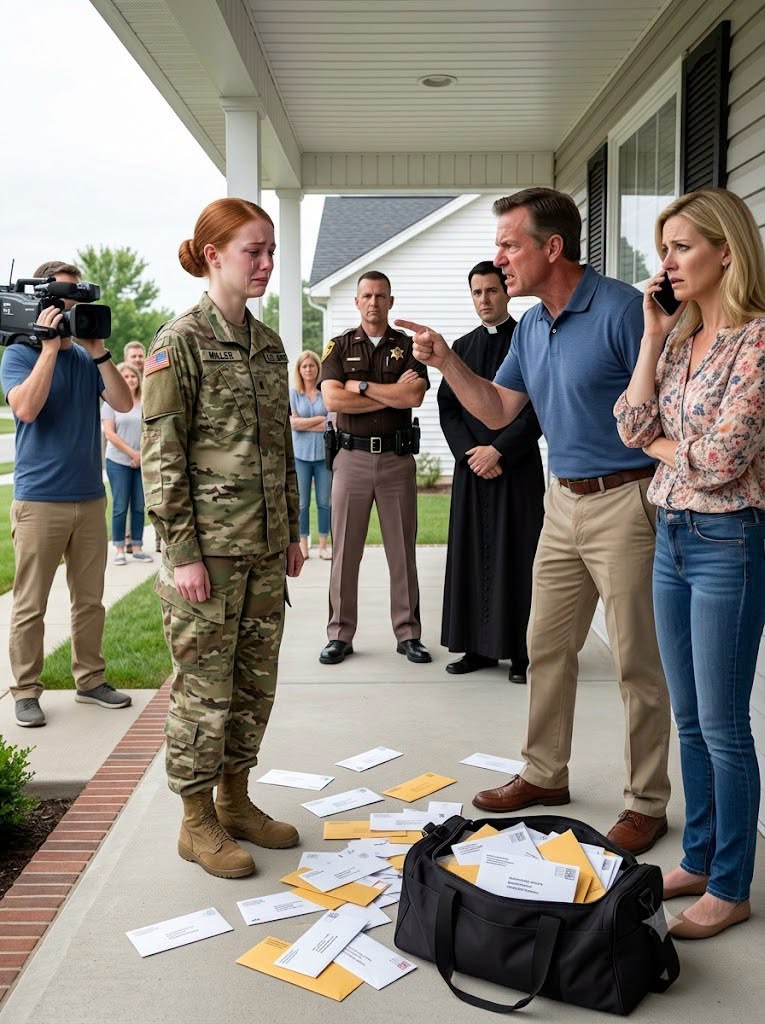
Then they called the police.
They reported that a dangerous stranger was standing on their property pretending to be their daughter.
For a moment, I could barely understand what was happening. I had expected surprise, perhaps tears. I had not expected my own parents to deny that I existed.
The commotion drew neighbors from their homes. Mrs. Donnelly, my former middle school teacher, came outside. So did Mr. Holloway, our longtime mailman, along with people who had known me since childhood.
Mr. Holloway looked especially troubled.
He knew I had been serving overseas because he had quietly helped forward some of my correspondence after noticing that letters sent home were repeatedly being rejected.
When Sheriff Walker arrived, I did not argue with my parents. I simply stood on the lawn and handed him my military identification.
He examined it carefully.
My parents still refused to admit the truth.
My mother insisted the uniform and identification were part of some elaborate attempt to manipulate them. My father loudly warned the sheriff not to believe me.
The more calmly I stood there, the more desperate they became.
Then my father made a mistake.
He disappeared upstairs and returned carrying a heavy bag. He opened a window and threw it onto the lawn as though getting it out of the house would somehow make the problem disappear.
The bag split open.
Letters scattered across the grass.
My letters.
Sheriff Walker picked up several envelopes. They carried international military postal markings from different deployment locations. Many had been deliberately marked for return.
There were dozens of them.
The street became quiet.
Pastor Glenn, who had arrived after hearing about the disturbance, picked up one of the envelopes and stared at it.
Then his expression changed.
Over the previous four years, my parents had told our church an entirely different story about me.
According to them, I had fallen into serious personal trouble and was too ashamed to return home. They claimed I needed financial assistance for legal expenses and other emergencies.
People had believed them because they trusted my parents.
The congregation had donated nearly seventy thousand dollars.
Not one dollar had reached me.
My parents had discovered that shame was useful. By portraying me as troubled and unstable, they discouraged people from contacting me directly. Questions could always be dismissed as intrusions into a painful family matter.
Standing on that lawn, I watched people who had known me since childhood realize they had been deceived.
I wanted to be angry with them.
Instead, I mostly felt sorry for them.
Their kindness had been exploited.
The situation became even more serious when Walter Briggs, a local mortgage broker, arrived.
His appearance immediately unsettled my father.
Investigators soon learned why.
Walter had helped my parents prepare documents claiming that I was missing and presumed dead. A forged power of attorney and fabricated psychiatric paperwork had then been used to gain control over property belonging to me.
The property was a small blue house on Cedar Lane.
My grandmother Evelyn had left it to me before I enlisted.
It was never theirs to take.
My parents had borrowed heavily against the property and used the money to support a lifestyle they could not otherwise afford. The church donations helped them manage the growing financial pressure.
Their lie had not begun as one enormous conspiracy.
It had grown piece by piece—one false statement protecting another, one forged document requiring another explanation, until maintaining the deception required them to erase me completely.
Then smoke began rising behind the house.
My mother shouted something toward my father, and he suddenly ran toward the detached garage.
Sheriff Walker moved immediately.
My father was stopped before he could do further damage, while several neighbors helped contain the small fire until emergency crews arrived.
Inside the garage, investigators recovered a metal barrel containing partially burned records.
Some documents had been damaged, but enough survived.
There were loan papers, property transfers, financial statements and folders documenting years of planning.
One folder reduced four years of my life to a chilling administrative problem.
It described my continued existence as an obstacle that needed to be managed.
Reading those words later hurt more than I expected.
I had spent years imagining my parents waiting for me.
They had spent those same years hoping I would remain far enough away for their story to survive.
The evidence eventually led to the arrest of my parents and Walter Briggs on serious fraud, forgery and false-statement charges.
The story attracted considerable local attention because of its extraordinary circumstances, but I wanted very little to do with the spectacle.
I had already spent four years serving under difficult conditions.
I did not want the next four years of my life to be defined by hatred toward my parents.
That did not mean excusing them.
There is a difference between refusing bitterness and refusing accountability.
I cooperated fully with investigators and allowed the legal process to proceed. My parents eventually received prison sentences for their actions, while the fraudulent property transactions were challenged and my grandmother’s house was restored to my control.
The church community struggled with what had happened as well.
Several members apologized to me for believing my parents’ story.
I told them they had nothing to apologize for.
They had tried to help someone they believed was suffering. The wrongdoing belonged to the people who had deliberately misused that compassion.
Once the financial matters were resolved, I focused on the blue house on Cedar Lane.
During deployment, I had dreamed of “home” as though it were something waiting unchanged for me.
Now I understood that I would have to build it myself.
I repaired the roof and restored the porch. I repainted the rooms and kept several pieces of my grandmother’s furniture. The work was slow, but I found something peaceful in repairing what deception had nearly taken away.
Mr. Holloway eventually delivered my first piece of mail to the restored house.
He walked up the path with an exaggerated seriousness and placed the envelope directly into my new mailbox.
“Making sure this one reaches the right address,” he said.
I laughed.
It was such an ordinary moment.
Perhaps that was why it meant so much.
For years, other people had controlled the story of where I was, who I had become, and whether my voice deserved to be heard.
Now my name was on my own mailbox.
My key opened my own front door.
And nobody needed to grant me permission to come home.
Months later, I was invited to speak at a small town ceremony recognizing local service members.
I almost declined.
Eventually, I agreed, but I did not use the opportunity to publicly condemn my parents.
Everyone already knew what they had done.
Instead, I spoke about something I had learned both overseas and after returning home.
Truth does not always arrive dramatically.
Sometimes it arrives as an identification card quietly placed in a sheriff’s hand.
Sometimes it is a returned envelope lying in the grass.
Sometimes it is a neighbor willing to say, “That isn’t what I saw.”
And sometimes truth requires patience because lies can appear powerful when many people have accepted them.
But a lie must constantly be maintained.
Truth only needs to be uncovered.
When the ceremony ended, I returned to the little blue house my grandmother had left me.
I placed my uniform carefully in the closet and sat on the porch as evening settled over Cedar Lane.
My parents had tried to erase me from their lives for money.
I could not change that.
I could only decide what their betrayal would turn me into.
So I chose not to spend my freedom seeking revenge or waiting for an apology that might never come.
Accountability belonged to the courts.
My life belonged to me.
And after four years of dreaming about coming home, I finally understood that home was not the place where people were obligated to welcome me.
It was the place where I could live in truth, dignity, and peace.