
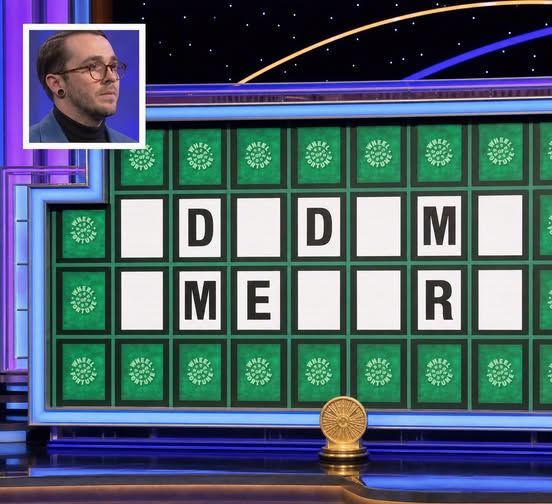
The category presented for the final round was designated as a Phrase, a classification that typically encompasses common idioms, expressions, or colloquialisms. As the letters were revealed on the board, Kemmsies successfully identified the first three words, which appeared as I DID MY, yet the final component of the puzzle remained blank. Despite his best efforts to deduce the missing word before the timer expired, he was unable to provide the correct solution, leaving the substantial cash prize unclaimed on the board.
When the buzzer sounded, signaling the end of the round, the host revealed the full solution to be I DID MY HOMEWORK. The revelation prompted an immediate reaction from the studio audience and viewers at home, many of whom had been actively participating in the game from their living rooms. While Kemmsies maintained a lighthearted demeanor, joking about his lack of recent homework experience, the atmosphere on social media platforms quickly shifted from sympathy for the contestant to a rigorous debate regarding the technical accuracy of the show’s category selection.
The core of the viewer contention rested on the grammatical structure of the solution. Critics argued that I DID MY HOMEWORK functions as a complete sentence, characterized by a clear subject and a predicate, rather than a traditional phrase. In linguistic terms, a phrase is generally defined as a group of words that functions as a single unit but lacks the subject-verb structure required to form a complete independent clause. By presenting a full sentence under the label of a phrase, some audience members felt the show had provided a misleading clue that hampered the contestant’s ability to solve the puzzle correctly within the allotted timeframe.
Conversely, defenders of the show’s production team pointed out that Wheel of Fortune has historically utilized the Phrase category to cover a wide variety of verbal expressions, including short, declarative statements. They argued that in the context of a game show, the distinction between a phrase and a sentence is often fluid, and that the category label is intended to be a broad guide rather than a strict grammatical constraint. This perspective suggests that the challenge is designed to test a contestant’s ability to recognize common patterns of speech rather than their adherence to formal linguistic definitions.
The episode, which aired on Valentine’s Day, has since become a notable example of how specific game show mechanics can trigger widespread public discourse. While the debate over the categorization of the puzzle continues to circulate among fans, the outcome for Kemmsies remains unchanged. He departed the stage with his original winnings of $19,080, a successful performance by any standard, even if the final bonus round prize remained just out of reach. The incident highlights the enduring popularity of the show and the intense level of scrutiny that viewers apply to its puzzles.
Ultimately, the situation serves as a reminder of the subjective nature of game show categories and the high expectations of a dedicated fan base. Whether one classifies the answer as a phrase or a sentence, the frustration expressed by viewers underscores their deep engagement with the program. As of the latest reports, there has been no official statement from the production regarding the categorization, suggesting that the puzzle will remain a point of discussion among enthusiasts who enjoy dissecting the intricacies of the game’s design. For Kemmsies, the experience remains a memorable chapter in his time on the show, defined by both his success in the main game and the unexpected conversation he ignited among the viewing public.