
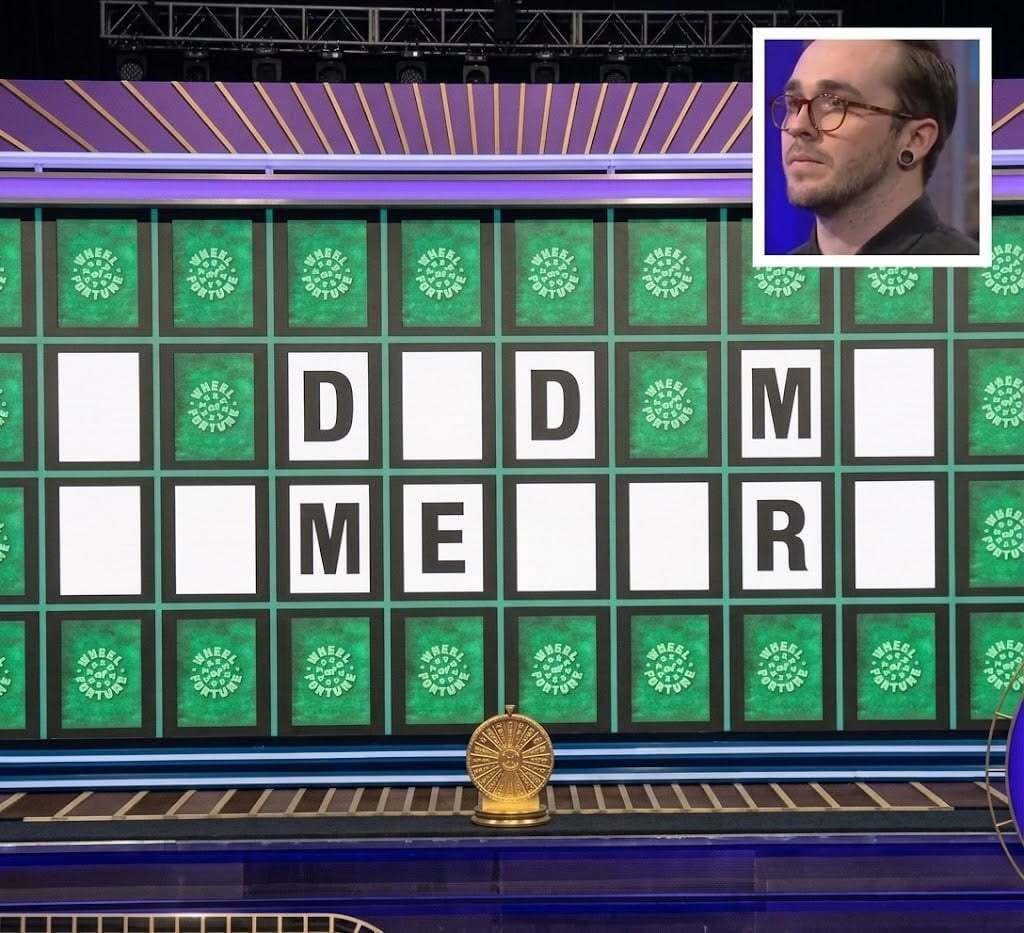
Unfortunately, identifying the final word was another matter.
With the Bonus Round clock ticking away, Conner tried to make sense of the remaining letters and complete the expression. Despite knowing most of the answer, nothing apparently clicked quickly enough.
Seconds later, time expired.
The complete solution was then revealed:
“I DID MY HOMEWORK.”
That final word made a significant difference. Had Conner solved the puzzle before the clock ran out, he would have walked away with an additional $40,000.
Rather than allowing the disappointing moment to overwhelm him, Conner responded with humor.
“Aw, dude, I don’t do homework anymore. I’m not in school now,”
he joked after discovering the answer.
His lighthearted reaction helped turn an otherwise painful Bonus Round loss into a memorable television moment. But once the episode aired, viewers began discussing something other than whether Conner should have figured out “HOMEWORK.”
Some questioned the puzzle itself.
The controversy centered primarily on the category “Phrase.” Several viewers argued that “I DID MY HOMEWORK” sounded less like a recognizable phrase or expression and more like an ordinary sentence someone might say after completing a school assignment.
One viewer acknowledged that the puzzle took some time to figure out but maintained that “I did my homework” wasn’t really a phrase. Another similarly characterized the answer as simply a normal sentence.
That distinction quickly became the center of the online conversation.
For critics, a “Phrase” puzzle should ideally resemble a familiar expression or commonly recognized combination of words. From that perspective, something like “I DID MY HOMEWORK” seemed overly broad because countless everyday statements could potentially qualify.
Other viewers weren’t convinced there was anything wrong with the puzzle.
Some said they recognized the answer quickly and considered it relatively straightforward once enough letters were visible. To them, Conner simply encountered the kind of unfortunate Bonus Round puzzle that can become obvious to someone watching comfortably at home but surprisingly difficult when a contestant is standing beneath studio lights with only seconds remaining.
And that pressure can make an enormous difference.
Conner had already identified “I DID MY,” meaning he needed only one additional word to claim the bonus. Yet with potentially $40,000 at stake and the countdown moving quickly, the familiar word “HOMEWORK” never came to him.
It was an especially ironic outcome given his occupation and his subsequent joke about no longer being a student.
The debate also highlights something that has long made Wheel of Fortune entertaining for viewers at home: people watching television often believe they would solve a puzzle faster than the contestant.
Without the pressure of cameras, an audience, a ticking clock and thousands of dollars hanging in the balance, solutions can appear considerably easier from the couch.
Whether “I DID MY HOMEWORK” was an appropriate “Phrase” puzzle ultimately became a matter of interpretation. Some viewers believed the category was broad enough to accommodate the answer, while others thought producers should have selected something more recognizable as an established expression.
Either way, Conner’s appearance was hardly unsuccessful.
Although the elusive final word prevented him from collecting another $40,000, the commercial pilot still finished his time on Wheel of Fortune with $19,080 in cash and prizes.
And his missed puzzle accomplished something else: it gave viewers another Wheel of Fortune moment to debate long after the wheel stopped spinning.
So, would “I DID MY HOMEWORK” have immediately occurred to you—or do you agree with the viewers who believe it wasn’t really a “Phrase” at all?