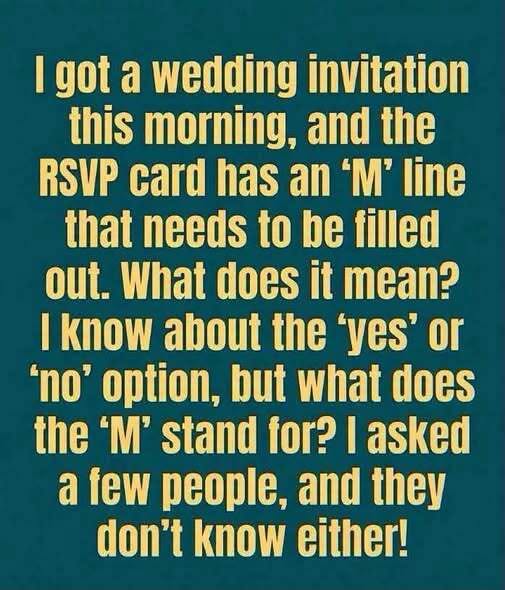
traditional prompt designed to help you begin your response with a proper courtesy title. Historically, the M serves as the first letter for titles such as Mr., Mrs., Ms., or Miss. By providing this starting point, the host is inviting the guest to complete the title that best reflects their personal preference before filling in their full name. For instance, a guest might complete the line to read Mr. John Doe or Ms. Jane Smith, maintaining the formal tone established by the invitation itself.
This practice is deeply rooted in the etiquette standards of previous generations, when the use of formal titles was a universal expectation in written correspondence. In that era, responding to a formal invitation required a level of decorum that mirrored the formality of the event being hosted. While these traditions have persisted in the stationery industry, the social expectations surrounding them have evolved significantly. Today, the inclusion of the M is largely a stylistic choice rather than a rigid requirement, reflecting a nod to elegance and historical continuity.
It is important to understand that you are not strictly bound by this traditional format if it does not align with your personal identity or comfort. If you prefer not to use a courtesy title, you are perfectly free to ignore the M entirely and simply write your name on the line. The primary purpose of this section is not to enforce a specific social standard, but rather to ensure the host can clearly identify which guests are responding. Whether you choose to use a title or simply provide your name, the goal remains the same: clear communication between the guest and the host.
Furthermore, the M should never be confused with other sections of the RSVP card. Modern response cards often contain multiple components, such as checkboxes for meal selections, dietary restrictions, or a simple count of the number of guests attending. These sections are distinct and serve entirely different purposes. While the M is strictly for identification, the other areas of the card are designed to help the host manage logistics, such as catering and seating arrangements. If you find yourself confused by a card, always look for the clearly labeled headers that distinguish the name line from the meal or attendance options.
For those currently planning their own events, it is helpful to recognize that the use of the M is completely optional. If you are designing your own invitations and want to ensure maximum clarity for your guests, you might consider replacing the M with a more modern label such as Name or Guest Name. This approach removes any potential ambiguity and is often preferred for contemporary celebrations where a more relaxed or direct tone is desired. The choice ultimately depends on the overall aesthetic and formality level you wish to convey to your invitees.
When you are tasked with filling out these cards, the most important rule is to follow the instructions provided by the host. Ensure that you clearly print the names of all guests included in the invitation to avoid any confusion during the planning process. If the invitation specifies a certain number of seats, be sure to respect that limit when listing your party. By providing your information clearly and returning the card by the requested date, you fulfill your role as a considerate guest.
In summary, the M is a relic of formal etiquette that serves as a helpful, albeit optional, starting point for your response. It is not an obstacle or a test of your knowledge of social rules, but a simple prompt intended to facilitate a polite reply. Whether you choose to embrace the tradition by adding your preferred title or decide to bypass it for a more straightforward approach, your response will be welcomed by the host. Simply fill in the required information, check your meal choices, and send your confirmation back in a timely manner to help the organizers finalize their plans for a successful event.
{"post":110018,"page":2,"next":[{"id":110015,"title":"A Mother\u2019s Discovery at 3 A.M. Reveals the Dark Truth Behind Her Son\u2019s Hospitalization","url":"https:\/\/new24.info\/110015"},{"id":110012,"title":"A Surrogate\u0027s Heartbreak: When My Twin Brother Rejected His Newborn Daughter Due to a Hidden Crisis","url":"https:\/\/new24.info\/110012"},{"id":110008,"title":"Born Remarkably Large, He Grew Up to Build a Quiet Life Away From the Spotlight","url":"https:\/\/new24.info\/110008"},{"id":110005,"title":"Wheel of Fortune\u201d Contestant Delivers Impressive Bonus Round Solve","url":"https:\/\/new24.info\/110005"},{"id":109993,"title":"Hayden Panettiere\u2019s Final Hours: Ex Brian Hickerson Was by Her Side \u2014 and He Wasn\u2019t the Only One There","url":"https:\/\/new24.info\/109993"},{"id":109984,"title":"Who Is Brian Hickerson? What We Know About Hayden Panettiere\u0027s on\u2011off Boyfriend Who Was Present at the Scene When She Passed Away \u2013 Details","url":"https:\/\/new24.info\/109984"},{"id":109980,"title":"At 71, I Fell in Love on My First Cruise \u2013 On the Last Night, I Followed Him Below Deck and Saw My Suitcase Outside His Cabin","url":"https:\/\/new24.info\/109980"},{"id":109977,"title":"I Became a Surrogate for My Brother \u2013 When He Came to the Hospital for His Newborn Daughter, He Looked at Her and Said, \u0027I Can\u0027t Take This Baby Home\u0027","url":"https:\/\/new24.info\/109977"},{"id":109974,"title":"After 69 Years of Marriage, My Husband Left Me Nothing in His Will \u2013 Then His Lawyer Handed Me a Letter That Began, \u2018This Was My Plan. Now I Have to Tell You the Truth\u2019","url":"https:\/\/new24.info\/109974"},{"id":109971,"title":"My Daughter\u0027s MIL Mocked Her Weight at Her Baby Shower \u2013 Her Husband Put Down His Fork and Asked His Mother One Question","url":"https:\/\/new24.info\/109971"},{"id":109966,"title":"What A Mysterious Key Revealed About My Mother\u2019s Eleven Years Of Silence","url":"https:\/\/new24.info\/109966"},{"id":109962,"title":"Faking Unconsciousness Helped Me Expose My Famous Partner And His Betrayals","url":"https:\/\/new24.info\/109962"},{"id":109958,"title":"Betrayed Wife Books Seat Beside Deceptive Husband To Uncover Hidden Secrets","url":"https:\/\/new24.info\/109958"},{"id":109954,"title":"Cruel Mother Demands House Ownership Before Discovering Secret Real Estate Sale","url":"https:\/\/new24.info\/109954"},{"id":109950,"title":"One Burned Hand And Dirty Dishes Revealed A Massive Family Betrayal","url":"https:\/\/new24.info\/109950"},{"id":109946,"title":"Why I Walked Away From My Wedding Over Three Unbelievable Family Demands","url":"https:\/\/new24.info\/109946"},{"id":109942,"title":"Midnight Rescue Mission Uncovers A Startling Secret Hidden By My Own Son","url":"https:\/\/new24.info\/109942"},{"id":109937,"title":"I Sacrificed Everything to Save My Husband\u2014He Left Me Buried in Debt After His Recovery, and His Mistress Delivered a Stunning Surprise","url":"https:\/\/new24.info\/109937"},{"id":109934,"title":"My 12-Year-Old Daughter Came Home with a Pixie Cut After Spending the Day with My MIL \u2013 When I Learned the Real Reason, I Burst Into Tears","url":"https:\/\/new24.info\/109934"},{"id":109929,"title":"With heavy hearts, we announce the passing of this beloved actress at age 94, who gave us so much.","url":"https:\/\/new24.info\/109929"}]}