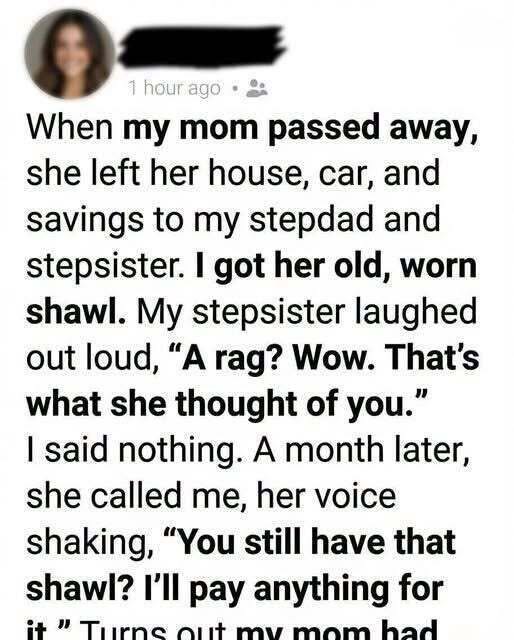
at the sight of it, her voice dripping with condescension as she remarked that the pathetic gift proved exactly how little our mother had valued me compared to the rest of the family. I said nothing in return, my pride bruised but my spirit quiet. I simply took the shawl home, folding it carefully into my bag, still trying to understand why Mom, who had always been so thoughtful, had chosen this specific, seemingly worthless item for me.
That evening, sitting alone in my small living room, I held the shawl in my hands and noticed a faint, lingering scent of dried lavender. Suddenly, the years melted away, and memories of my mother came rushing back with overwhelming clarity. I remembered how devoted she had been to her own mother, my grandmother, despite the old woman’s notoriously difficult personality and the way she had systematically driven most of the family away over the years. Mom had stayed beside her through every illness and every outburst, caring for her with a patience that I had never fully appreciated until that moment. She had served without asking for recognition, her quiet strength acting as a buffer against the world. Somehow, as the scent of lavender filled the room, the old shawl no longer felt worthless. It felt like a tangible connection to a history of endurance and selfless love that I had only witnessed from the periphery. I draped it over my shoulders, feeling a strange, comforting weight that seemed to settle my nerves.
A few weeks later, the silence of my mourning was broken by a frantic call from Lila. Her voice was completely different from the sharp, mocking tone she had used at the funeral; it was thin, jagged, and laced with a desperate, uncharacteristic panic. She asked if I would consider selling her the shawl, offering a sum of money that made my breath hitch. When I refused, she escalated her offer, her voice rising in pitch as she begged me to reconsider. I finally demanded to know what had happened to cause such a sudden change of heart. She hesitated, then confessed that the family lawyer had discovered something truly shocking buried deep within the archives of our grandmother’s estate.
The shawl was not merely a sentimental relic or a piece of old family history. According to the legal documents, Grandma had secretly placed a substantial fortune into a hidden, long-forgotten estate. Before her death, she had added one specific, unusual condition: whoever legally possessed the shawl would inherit every asset connected to that hidden fortune. No other family member, regardless of their status or their share of the house, could claim it simply because they were related. The shawl was the key, the legal instrument of transfer, and the only proof of ownership. As I listened to Lila’s frantic explanations, the realization hit me with the force of a physical blow. The weight of the fabric on my shoulders suddenly felt like a mantle of responsibility, a bridge between the past and the future that had been carefully constructed by the two women I had loved most.
I finally understood why Mom had left it to me. She hadn’t been insulting me or giving me a scrap of trash; she had been entrusting me with the one thing that mattered most, waiting for the right time for the truth to surface. She knew my character, and she knew that I would appreciate the legacy far more than the others. Lila had only ever seen an ugly, tattered piece of cloth, blinded by her own greed and her desire for the material wealth that had already been distributed. Mom, however, had seen a promise, a legacy, and a way of honoring everything she had sacrificed throughout her life.
The inheritance eventually changed my life in ways I never could have imagined, providing security that I had not known before. Yet, the money itself was not what mattered most to me in the end. Whenever I wear that shawl, I am reminded of my mother and the quiet, profound love behind her final act of trust. What my family had dismissed as worthless turned out to be the most precious thing I owned, not only because of the fortune it carried, but because it was my mother’s final, silent way of telling me that she had always believed in me, even when I doubted myself. I kept the shawl, and with it, I kept the memory of her love, resolved and whole at last. The house, the car, and the savings were merely things that would eventually fade, but the shawl remained, a testament to a bond that transcended the pettiness of inheritance and the bitterness of family disputes, grounding me in the truth of who I was and where I came from.