
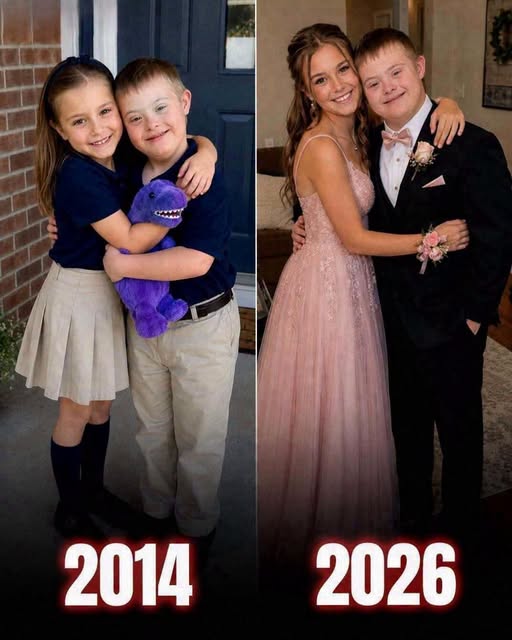
She pulled me upstairs and locked the bedroom door, her hands trembling as she looked at me with a mixture of fear and profound regret. I had always assumed her hesitation stemmed from Noah’s Down syndrome, but the reality was far more complex. She began to speak about the year my parents divorced, a time when I had withdrawn into a shell of silence and sadness. She had been drowning in her own grief, failing to notice that I was quietly fading away.
She confessed that during those dark months, Noah had approached her while she sat crying in the car. He had asked, with the blunt, piercing honesty of a child, if I was broken. When my mother told him I wasn’t, he simply replied that he didn’t know how to fix people, but he knew how to stay. Terrified and desperate, my mother had asked him to keep an eye on me. For years, she believed he was my caretaker, and that I was merely fulfilling a burdensome obligation of friendship out of pity or a misplaced sense of duty.
She admitted that she had spent over a decade watching our bond through a lens of suspicion, constantly worrying that I was sacrificing my youth to look after him. She had been so focused on what she thought Noah needed from me that she had completely overlooked the reality of our dynamic. She hadn’t seen the way Noah brought me ice cream after a failed driving test, or how he made me laugh when I wanted to give up on my art. She hadn’t realized that while she was looking for a victim and a savior, she was actually witnessing a partnership of equals. She saw the sacrifice, but never the sustenance.
Her condition for me to leave that night was that I had to be certain I was going because I chose to, not because of a childhood pact made in a classroom. I laughed, feeling the weight of her misunderstanding lift. The promise had been the spark, but our shared history—the thousands of small moments where we had simply shown up for one another—was the fire. I told her that I wasn’t going out of obligation; I was going because there was no one else on earth I would rather be with.
When we finally returned downstairs, my mother did something entirely unexpected. She walked over to Noah and asked him for a dance. They moved awkwardly across the living room floor, two people separated by a generation and a lifetime of misperceptions, finally finding a rhythm. When she thanked him for staying by my side through all those difficult years, Noah just looked at her with his characteristic, disarming simplicity. He told her, “She stays too.”
That was the revelation that finally broke through my mother’s defenses. She realized that our friendship wasn’t a one-way street of charity or protection. It was a mutual, reciprocal support system that had sustained us both. We weren’t carrying each other; we were walking together. As we left for the dance, I saw her watching us from the driveway, her expression shifting from worry to a quiet, peaceful acceptance of the truth she had finally grasped. It was as if she were seeing us for the first time, not as a girl and her dependent, but as two young adults who had weathered the storms of childhood together.
At the prom, the night was far from the cinematic perfection one might expect. Noah stepped on my dress almost immediately, and we spent the rest of the evening laughing about his lack of coordination. We didn’t need grand gestures or the approval of the crowd. We were just two eighteen-year-olds navigating the dance floor, comfortable in the silence and the noise alike. When my feet grew tired, he carried my heels; when he grew warm, I carried his jacket. It was effortless, natural, and entirely our own.
The music swelled and faded, yet we remained in our own little orbit. I watched him interact with our peers, seeing the same stubborn, funny boy who had once told me my drawings looked like potatoes with arms. He was still that same person, yet he had grown into a man who understood the value of presence. There was no dramatic applause and no grand moment in which anyone treated our friendship as an inspirational lesson. We were simply two friends enjoying the evening.
Watching us from the car later that night, my mother understood that no one had been rescued. There was no martyr, no victim, and no burden. We had simply learned, long before we were old enough to understand the weight of the words, that love is not about fixing the broken parts of another person. It is about recognizing when someone is hurting, sitting beside them in the dark, and staying until the light returns. I had stayed for him, and he had stayed for me, and in that simple, enduring commitment, we had found the greatest gift of our lives. The resolution was not in the dance, but in the quiet, absolute understanding that we had always been enough for each other, and that our bond was a choice we made every single day.