
They didn’t know the truth.
The candle was for Clara.
My daughter had walked out of my house at eighteen after an argument that never should have become big enough to separate us.
I was fifty-eight now, which meant I had spent almost a quarter of my life wondering where she was, whether she was safe, whether she hated me, and whether she ever thought about the mother she had left behind.
There is a particular kind of loneliness that comes from knowing exactly who is missing.
I learned to build my life around that absence.
Carefully.
Quietly.
Like arranging furniture around a hole in the floor.
From the outside, my life looked normal enough.
I still lived in the same house where I had raised Clara.
I kept a garden.
I baked for church sales.
I waved to neighbors from my porch.
I remembered birthdays and sent Christmas cards.
People probably thought I had handled whatever grief life had given me.
They had no idea that Clara’s empty place followed me into every room.
The argument that separated us had been almost embarrassingly ordinary.
She had made a decision about her future that frightened me.
I criticized it.
Then I criticized her.
She accused me of trying to control her.
I accused her of being irresponsible.
At eighteen, Clara knew exactly where to place a sentence if she wanted it to hurt.
Unfortunately, so did I.
By the end, neither of us was talking about the original disagreement anymore.
We were simply trying to win.
Clara packed a bag.
I stood in the hallway with my arms folded and told myself she would cool down.
She stopped at the door.
I still remember the anger in her face.
I also remember how young she looked beneath it.
“You never believe I can do anything without ruining my life,” she said.
“That isn’t true.”
“It is.”
“Clara, don’t be ridiculous.”
There are sentences you regret because they were cruel.
Others because they were careless.
That one was both.
She opened the door.
I should have crossed the hallway.
I should have hugged her.
I should have said, Stay. We’ll figure it out tomorrow.
Instead, pride kept my feet planted.
She left.
For the first week, I expected her to return.
For the first month, I checked the driveway whenever a car slowed outside.
During the first year, I wrote letters constantly.
Long ones at first.
Then shorter ones when I realized I was repeating myself.
I apologized.
I told her I loved her.
I told her the door was open.
Eventually, the letters became little more than:
I’m still here.
I’m still sorry.
I still love you.
I never knew whether Clara received them.
She never answered.
Two years after she left, a mutual friend told me Clara had moved to another city and seemed to be doing well.
That tiny piece of information became precious.
She was alive.
At least then, she had been alive.
After that, even the indirect news disappeared.
No one seemed to know where she had gone.
Or perhaps Clara simply made it clear she didn’t want information traveling back to me.
Either possibility hurt.
Still, I kept lighting the candle.
I kept her room too.
Not exactly frozen in time.
Guests occasionally slept there.
I changed the sheets.
I dusted the furniture.
But Clara’s books remained on the shelf.
A photograph stayed on the dresser.
One old jacket still hung in the back of the closet.
I told myself I was keeping those things in case she came back.
At three in the morning, when I was honest with myself, I knew the real reason.
Throwing them away would have felt like admitting she never would.
So I didn’t.
Fifteen years passed.
Then, on an ordinary Tuesday morning in October, I opened my mailbox and saw my daughter’s handwriting.
I knew it before I fully understood what I was looking at.
A small padded envelope sat beneath a bill, an advertisement, and a reminder from my dentist.
My name was written across the front.
Eleanor.
Clara had always made her capital E too large.
Her handwriting leaned slightly to the left.
Fifteen years had passed, and my body recognized it before my mind caught up.
My hands started shaking.
I stood beside the mailbox for what might have been thirty seconds or five minutes.
A neighbor drove by and waved.
I don’t think I responded.
Eventually, I carried the envelope inside.
I sat at my kitchen table.
The candle was still visible through the doorway, pale in the morning light.
I placed the envelope in front of me and stared at it.
For fifteen years, I had wanted something from Clara.
A phone call.
A postcard.
Three angry sentences.
Anything.
Now that something had finally arrived, I was terrified to open it.
What if she was telling me never to contact her again?
What if she was returning something?
What if this was the only message I would ever receive?
Finally, I whispered, “I’m still here, sweetheart.”
Then I tore open the envelope.
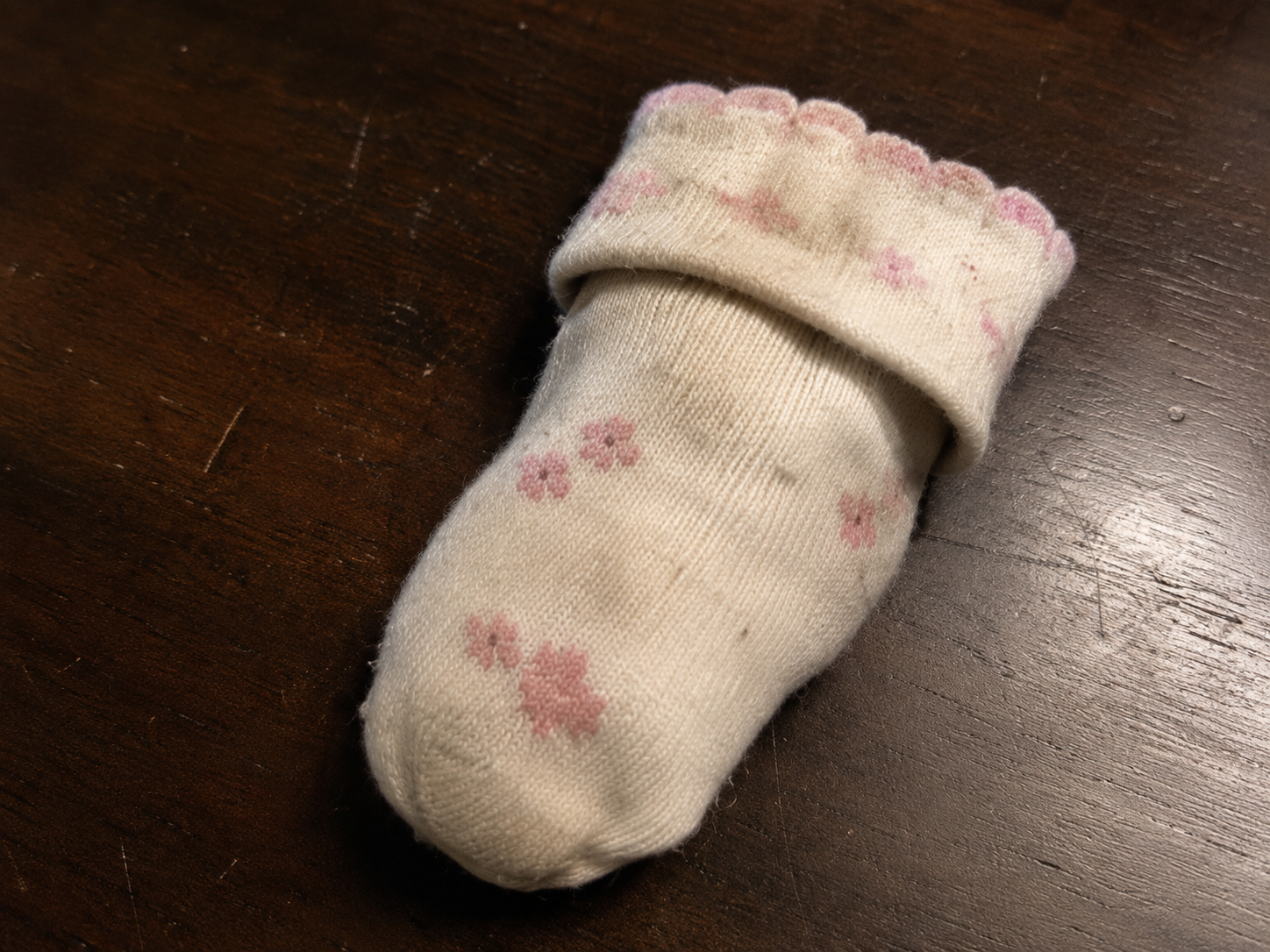
A tiny faded yellow baby sock fell onto the table.
I stared at it.
For several seconds, I genuinely thought I had made some mistake.
Then I recognized the white stripe around the cuff.
My breath caught.
It was Clara’s.
The sock she had worn home from the hospital thirty-three years earlier.
I had kept the pair inside a memory box for years.
Apparently, Clara had taken one when she left.
I picked it up.
It was so small.
That was my first thought.
How had my daughter ever been small enough for this?
I turned the envelope upside down.
Nothing else came out.
No letter.
No card.
No explanation.
Just one old baby sock after fifteen years of silence.
And for one terrible moment, anger rose through the grief.
Was this supposed to be a message?
Was she returning the past?
Was this all I deserved after fifteen years?
I squeezed the sock.
That was when I felt something hard inside the toe.
I froze.
Carefully, I pushed my fingers into the fabric.
Something had been hidden deep inside.
The seam was old and tight, and I couldn’t work the object free without damaging it.
Finally, I pulled carefully at the stitching until several threads broke.
A tiny tarnished silver locket slipped out and landed on the table.
My heart began pounding.
I opened it.
Inside was a photograph of a little girl.
She looked about five.
Dark curls framed her face.
Hazel eyes looked straight into the camera.
I had never seen her before.
And yet something about her was instantly familiar.
The eyes.
The hair.
The shape of her face.
For one dizzying second, I saw myself as a child.
Then Clara.
Then myself again.
My fingers went numb.
There was a tiny folded piece of paper tucked behind the photograph.
I opened it.
Clara’s handwriting.
The first line said:
Mom, by the time you read this, I will be gone.
I don’t remember deciding to stand.
I only remember my knees giving out.
One second I was sitting at the table.
The next, I was on the kitchen floor with Clara’s letter in my hand.
The sound that came out of me didn’t feel human.
For fifteen years, I had imagined reunion.
I had imagined Clara standing at the door older and angrier.
I had imagined apologies.
Awkward coffee.
Questions.
Maybe forgiveness.
I had never imagined finally hearing from my daughter only to learn that I had already lost the chance to hear her voice again.
I kept reading.
Clara wrote that she had been diagnosed with a terminal illness two years earlier.
She had known there was little chance of recovery.
And during those two years, she had been making arrangements for the little girl in the photograph.
Her daughter.
My granddaughter.
Lily.
I pressed the letter against my chest and sobbed.
Clara had a child.
I had a granddaughter.
Somewhere during those fifteen years of silence, my daughter had become a mother.
And I had known none of it.
Then I reached the part of her letter that made the room disappear around me.
I told Lily about you every day.
I stopped breathing.
Clara wrote about my garden.
My tomatoes.
The way I burned toast when I was distracted.
The old blue mug I always used for coffee.
And the candle.
Especially the candle.
She knows you keep one in the window. I told her it means someone is always welcome home. I know I didn’t deserve to make you wait this long.
I covered my mouth.
Fifteen years.
All those evenings I had wondered whether Clara had forgotten me.
She hadn’t.
Whatever anger had kept her away had not erased me completely.
Then came the sentence I still cannot read without crying.
Please don’t make Lily wait the way I made you wait. She deserves better than the pride that kept us apart. So do you.
The doorbell rang.
At first, I didn’t move.
It rang again.
I pulled myself upright using the kitchen table.
My legs barely supported me.
I walked toward the front door with Clara’s letter still crushed in my hand.
A woman stood on the porch.
She looked professional.
Mid-forties, perhaps.
A clipboard tucked against her chest.
When she saw my face, her expression immediately softened.
“Mrs. Eleanor?”
I nodded.
“My name is Angela. I’m a social worker with Family Services.”
My fingers tightened around the paper.
“You knew?”
Angela glanced toward the letter.
“Clara asked us to wait until you received the envelope.”
The sound of my daughter’s name nearly broke me again.
“She sent you?”
“Yes.”
“Why?”
Angela looked down.
Only then did I notice the small figure half-hidden behind her coat.
A little girl stood there gripping Angela’s sleeve.
Dark curls.
Hazel eyes.
The child from the locket.
Angela stepped slightly aside.
“Lily?”
The girl looked up.
“This is your grandmother.”
I covered my mouth.
Lily stared at me with the careful seriousness children have when adults have already told them something important is about to happen.
For several seconds, none of us spoke.
Then she looked past me toward the living room window.
“Is the candle still there?”
My heart stopped.
“The candle?”
She nodded.
“Mom said you keep one burning every night.”
I looked behind me.
There it was.
Still in the window.
I had lit it the evening before.
I turned back to Lily.
“Yes,” I whispered. “It’s still there.”
Her shoulders relaxed slightly.
Angela smiled.
“Clara talked about you often.”
I looked at her.
“She did?”
“Very often.”
Fifteen years of silence suddenly felt different.
Not less painful.
But different.
I had spent all that time believing my daughter might never have spoken my name.
And now a child I’d never met knew about my tomatoes and the candle in my window.
Lily shifted nervously.
“Mom said you grow really big tomatoes.”
A laugh escaped me through my tears.
“I do.”
“How big?”
“Ridiculously big.”
She seemed pleased by that answer.
Then she reached into her coat pocket.
“I have something for you.”
She pulled out another tiny yellow sock.
White stripe around the cuff.
The match.
My knees nearly weakened again.
Lily held it toward me.
“Mom said this belongs with the other one.”
I took it carefully.
The two socks had spent fifteen years apart.
Just like Clara and me.
Angela waited quietly before saying, “Would it be all right if we came inside?”
“Of course.”
I stepped aside immediately.
Lily walked past me.
She stopped in the hallway and slowly looked around.
The photographs.
The stairs.
The furniture.
Then her eyes found the candle.
“That’s it,” she whispered.
“Yes.”
She walked closer to the window.
Angela remained near the door.
“Clara was very specific about what she wanted for Lily,” she told me quietly.
I turned.
“What did she want?”
“She wanted Lily placed with you, if you were willing and if the legal assessment was completed successfully.”
I stared at her.
“With me?”
Angela nodded.
“She said you were the person she trusted to love Lily after she couldn’t.”
That sentence nearly brought me back to the floor.
I looked toward my granddaughter.
She was studying a framed photograph on the wall.
It showed Clara at about twelve years old, laughing with her hair blowing across her face.
Lily pointed toward it.
“That’s Mom.”
“Yes.”
“She looks funny.”
“She was very funny.”
Lily looked at me.
“Did she get mad a lot?”
Despite everything, I smiled.
“Sometimes.”
“Me too.”
“I believe it.”
For the first time, Lily smiled.
Just a little.
But there it was.
Clara.
Not exactly.
Lily was her own child.
Her own person.
But I saw my daughter in that smile.
I crouched carefully so we were closer to eye level.
“I’m sorry you lost your mom.”
Lily’s expression changed.
“She said you lost her first.”
I closed my eyes.
Children have a way of saying the sentence adults spend years avoiding.
“Yes,” I whispered.
“I did.”
She looked toward the candle again.
“Were you really waiting all that time?”
“Yes.”
“All fifteen years?”
“Every single one.”
Lily considered that.
Then she took my hand.
I hadn’t expected it.
Her fingers were small and warm.
I looked down at them and started crying again.
This time, quietly.
Lily didn’t pull away.
Angela eventually explained there would be paperwork.
Assessments.
Temporary arrangements.
Legal steps that could not simply disappear because Clara had requested them.
I barely heard half of it.
I understood enough.
Nothing was guaranteed that morning.
But Clara had opened the door.
Literally, after fifteen years, she had found a way to send someone through it.
Later, Lily asked if she could see her mother’s room.
I hesitated.
Then I took her upstairs.
She walked inside slowly.
Her eyes moved across the bookshelf.
The dresser.
The photograph.
Then she noticed the jacket hanging in the closet.
“Mom had this?”
“She left it here.”
Lily touched the sleeve.
“Can I have it someday?”
“If you want it.”
She nodded.
Then she sat on the edge of Clara’s old bed.
I sat beside her.
For a long moment, neither of us spoke.
Finally, Lily asked, “Why didn’t Mom come home?”
There was no answer that could make fifteen years make sense to a five-year-old.
So I gave her the truth I could.
“Your mom and I loved each other very much. But sometimes people who love each other can also hurt each other. And sometimes they wait too long to fix it.”
Lily frowned.
“That’s silly.”
A sad laugh escaped me.
“Yes.”
“It is.”
She leaned against my arm.
That evening, for the first time in fifteen years, I almost forgot to light the candle.
I was making grilled cheese because Lily said it was the only dinner she wanted.
Angela had stayed nearby while we worked through the immediate arrangements.
The house felt different.
There were little shoes beside the door.
A child’s coat over a chair.
Crumbs on the kitchen counter.
Noise.
Life.
Then Lily suddenly pointed toward the window.
“Grandma.”
I froze.
It was the first time she had called me that.
“The candle.”
I looked.
The old one had burned almost completely down.
I reached for a new candle.
Then stopped.
For fifteen years, I had lit it because I was waiting for Clara.
Now Clara was never going to walk through my door.
That truth hurt more than I could explain.
Lily watched me.
“Are you going to light it?”
I looked at my granddaughter.
Then I lit the candle.
“Yes.”
“Who are we waiting for now?”
I thought about that.
“No one.”
She looked confused.
“Then why light it?”
I placed it back in the window.
“Because sometimes a light doesn’t have to mean you’re waiting for someone to come home.”
“What does it mean?”
I looked at the two faded yellow socks lying together on the kitchen table.
“It can also mean someone found their way here.”
Lily seemed satisfied.
She returned to her sandwich.
I stood there looking at the flame.
For fifteen years, that candle had represented everything I had lost.
My daughter.
Our wasted years.
My regret.
That night, for the first time, it meant something else too.
Clara had not come home.
I would have to live with that for the rest of my life.
But before she left this world, she had sent me the person she loved most.
Not as a replacement.
Lily could never replace Clara.
She wasn’t supposed to.
She was a child with her own grief, her own memories, and her own future.
But she was also proof that Clara’s life had continued during all those silent years.
Proof that my daughter had loved.
Laughed.
Become a mother.
Told stories about home.
And remembered the candle.
Fifteen years earlier, I had watched Clara walk through my front door and believed pride mattered more than following her.
I would never make that mistake again.
So when Lily reached across the kitchen table that night and slipped her little hand into mine, I held on.
Not tightly enough to trap her.
Just firmly enough to let her know I was there.
I had spent fifteen years waiting for my daughter to come back.
In the end, she returned in the only way she still could.
Through a faded yellow baby sock.
A tiny silver locket.
A letter filled with everything we had never managed to say.
And a five-year-old girl who looked at the candle in my window and already knew what it meant.
Someone had been waiting.
And this time, when family came through my door, I wasn’t going to let pride send them away.