
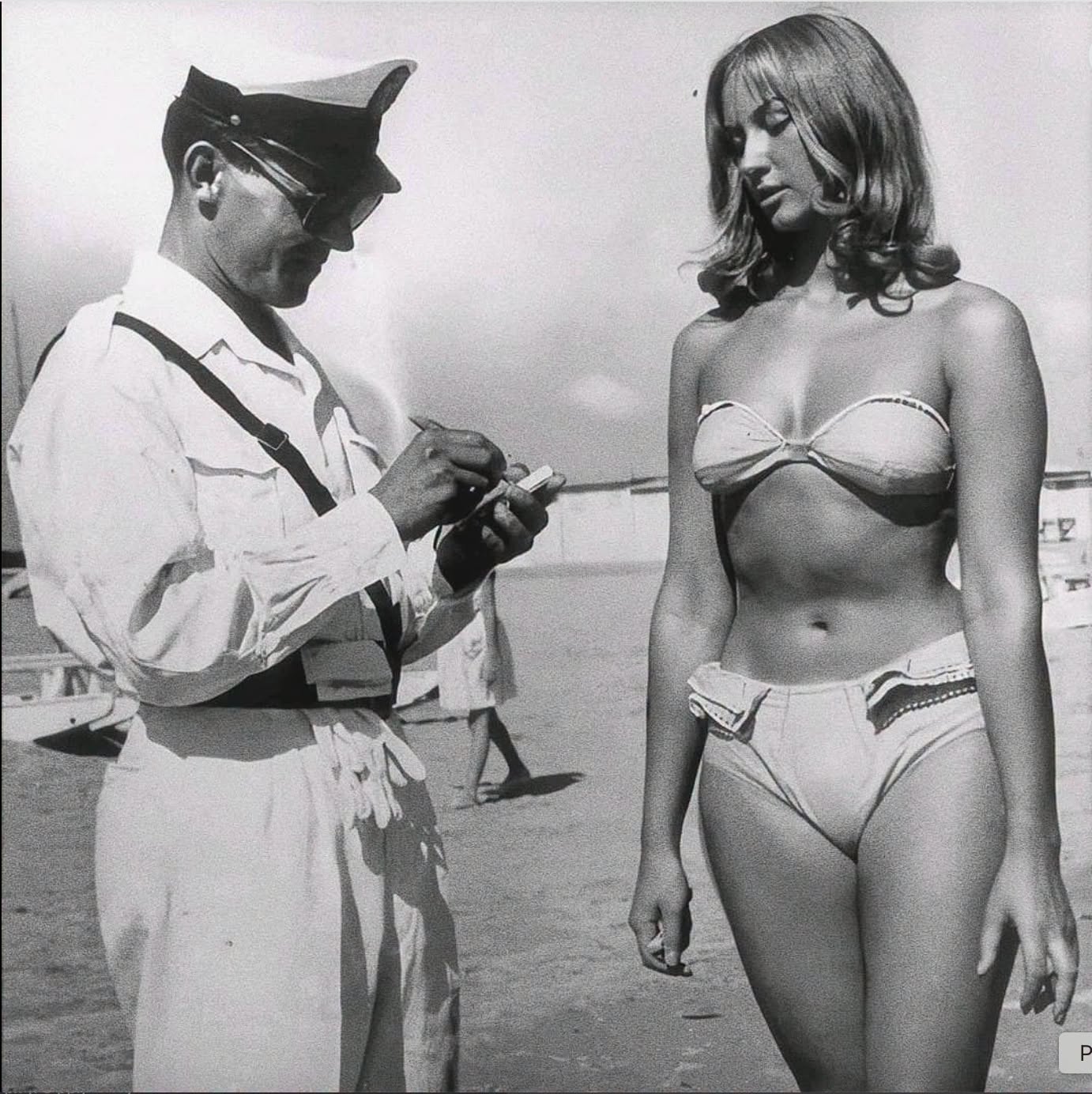
Yet women kept wearing it.
And with every appearance, attitudes slowly changed.
At the beginning of the 20th century, swimwear looked nothing like the sleek designs people wear today. Bathing suits were often bulky, full-body garments made from wool and designed to cover as much skin as possible.

Fashion was secondary.
Modesty came first.
Across the United States, strict beach dress codes were common. According to Kathleen Morgan Drowne and Patrick Huber, authors who documented 1920s popular culture, Chicago’s Clarendon Beach even employed tailors who could make immediate adjustments to swimsuits considered too revealing.
Other cities had similarly strict rules.
At Coney Island in 1915, bathing socks that exposed too much of a woman’s knees reportedly became unacceptable. In Washington, D.C., beach officials were even known to measure swimsuits to determine whether they complied with local standards.
During this era, both men and women were expected to remain covered from roughly the neck to the knees.
Showing too much skin could cause a genuine public scandal.
One of the earliest women to challenge those expectations was Australian swimmer Annette Kellerman.
In 1907, Kellerman wore a one-piece bathing suit that exposed her arms, legs, and neck rather than the bulky pantaloons commonly worn by female swimmers.
Known as the “Australian Mermaid” because of her remarkable swimming abilities, Kellerman spent much of her career pushing against restrictive ideas about what women should be allowed to wear while swimming.
Kellerman later claimed that police arrested her for wearing the supposedly indecent swimsuit, although historians have noted that official documentation confirming the arrest is difficult to find.

Whether every detail of that story is accurate or not, the controversy surrounding her swimwear was real.
Her fitted one-piece suits attracted public attention, and demand eventually became strong enough for Kellerman to launch her own swimwear line.
The designs became known as “Annette Kellermans” and represented an important early step toward modern women’s swimwear.
By the 1920s, attitudes were beginning to change even more quickly.
The flapper era had already transformed women’s clothing, and that rebellious energy eventually reached the beach.
In California, a group of women nicknamed the “skirts be hanged girls” pushed for swimsuits that were more practical for actual swimming.
Their argument was straightforward: women should be able to move freely in the water.
Gradually, bathing suits became shorter, more fitted, and more functional.
By modern standards, they were still conservative.
But compared with the heavy bathing costumes of previous decades, they represented a major change.
The real shock, however, came in 1946.

That was the year French engineer Louis Réard introduced the bikini.
The new two-piece design revealed the navel and exposed considerably more skin than most Western societies considered acceptable in public.
Its name became nearly as famous as the swimsuit itself.
Only days before Réard introduced his design, the United States had conducted an atomic test at Bikini Atoll in the Pacific.
Réard never clearly documented exactly why he chose the name, but the connection was obvious enough that many people interpreted it as a reference to the explosive cultural impact he expected the swimsuit to create.
He was right about the reaction.
The bikini immediately generated controversy.
Beaches in several places restricted it, and conservative communities treated the design as a symbol of declining morality.
In Europe, resistance was just as intense.
The bikini faced restrictions in countries including Italy, Spain, Portugal, and Belgium, while certain political groups criticized it as an example of Western or capitalist decadence.
Pope Pius XII also publicly condemned revealing swimwear, reinforcing opposition among conservative Catholics.
Australia had its own controversies.
In a widely reported 1952 incident, model Ann Ferguson was reportedly asked to leave the beach at Surfers Paradise because the Paula Stafford bikini she wore was judged too revealing.
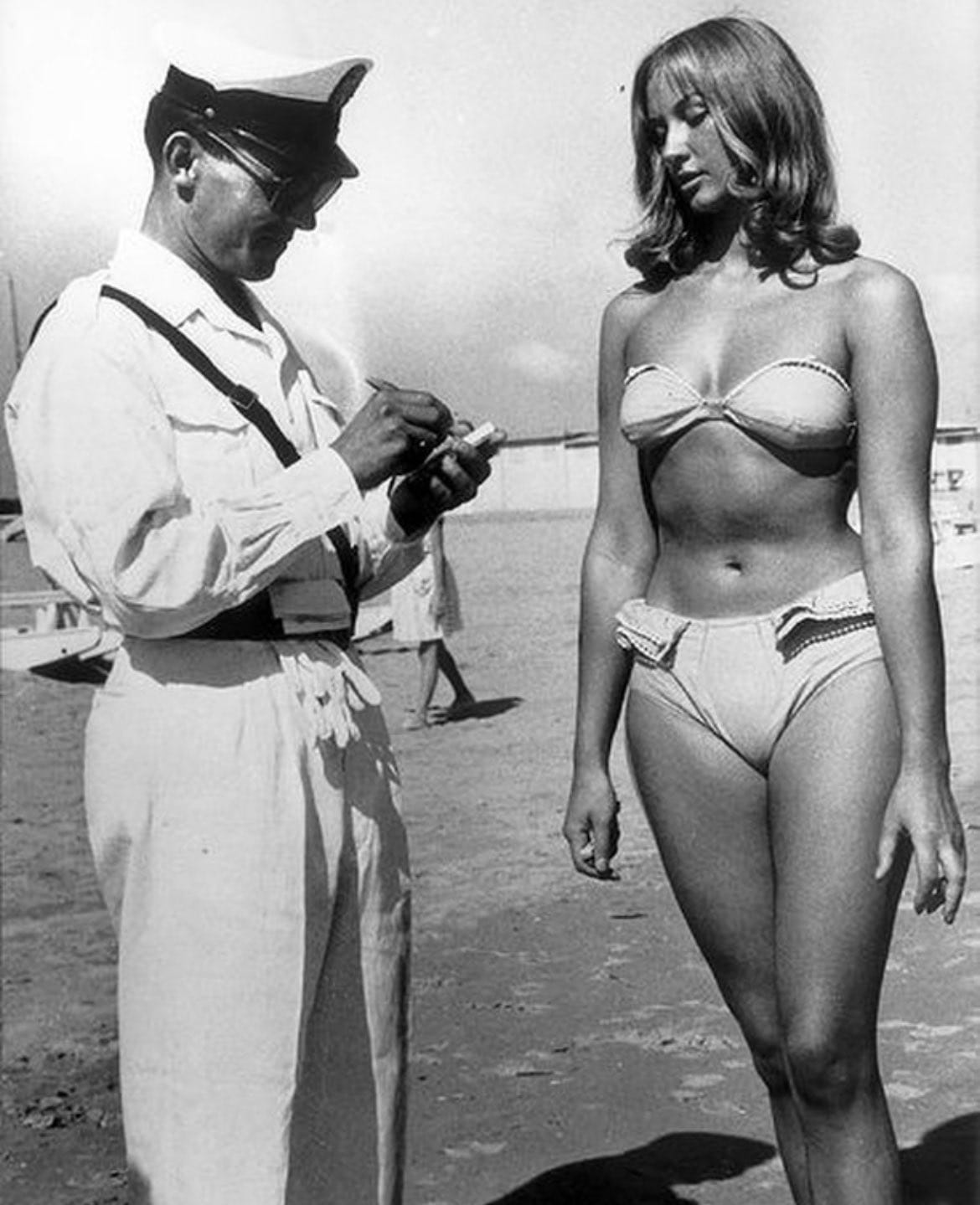
One photograph from this period has become especially famous online.
The black-and-white image shows a young woman wearing a bikini while a uniformed man stands beside her on a beach.
For years, social media posts have claimed the picture was taken in Rimini, Italy, in 1957 and shows a police officer issuing the woman a ticket simply for wearing a bikini.
The photograph itself appears to be genuine.
The problem is that the story attached to it remains uncertain.
There is no definitive evidence proving that the woman was actually being fined for her swimsuit.
Some researchers have suggested the scene may have been staged, while others believe the uniformed man could have been speaking with her for an unrelated reason.
Still, the image reflects a real historical climate.
Gianluca Braschi, director of the State Archives of Rimini, previously confirmed that Italy did have laws regulating swimwear during that period.

A law dating back to 1932 prohibited public bathing in complete nudity or in what authorities considered indecent swimwear.
That law technically remained in existence for decades, although enforcement varied considerably.
So even if the precise story behind the famous photograph remains unresolved, women genuinely could face official scrutiny over what they wore at the beach.
Hollywood played an enormous role in changing those attitudes.
By the 1950s and 1960s, actresses increasingly appeared in more daring swimwear, helping transform the bikini from a symbol of scandal into an object of glamour.
But restrictions remained.
The Motion Picture Production Code, commonly called the Hays Code, allowed some two-piece costumes in American films but prohibited visible navels.
Meanwhile, religious organizations such as the National Legion of Decency pressured studios to avoid overly revealing imagery.
Then came stars who changed everything.
Marilyn Monroe, Ursula Andress, and Brigitte Bardot helped transform swimsuits into symbols of confidence, glamour, and modern femininity.
Few actresses were more influential in popularizing the bikini than Brigitte Bardot.
In The Girl in the Bikini, Bardot helped turn the controversial swimsuit into a central part of her screen image.
Her relaxed, sun-drenched appearance challenged the idea that a woman wearing a bikini had to be presented as scandalous.
Instead, the swimsuit became associated with youth, independence, and effortless confidence.
Bardot was not the first woman to wear a bikini, but her films helped make it internationally fashionable.
Then, in 1962, Ursula Andress emerged from the sea in Dr. No wearing a white bikini with a knife strapped to her hip.
The scene became one of the most recognizable images in James Bond history.
Andress’s character was not presented merely as decorative.
She appeared confident, self-assured, and physically capable.
That combination helped cement the bikini as a symbol not only of sex appeal but also of bold femininity in popular culture.
By the 1970s, the bikini had largely completed its transformation.
It was no longer an unusual sight.
String bikinis appeared.
Cuts became smaller.
Thong-style swimwear eventually entered mainstream beach fashion.
Men’s swimwear changed too, becoming shorter and more fitted as the strict modesty standards of the early 1900s faded.
Today, swimwear exists across an enormous spectrum.
Some people prefer full-coverage one-piece suits.
Others choose bikinis, swim dresses, board shorts, string designs, or highly revealing styles.
The major difference is that modern swimwear is increasingly viewed as a matter of personal preference rather than a single social standard everyone must obey.
The conversation has also expanded beyond modesty.
Body positivity, inclusivity, comfort, cultural preference, and individual identity now play significant roles in swimwear fashion.
Brands increasingly design for different body types, ages, religious preferences, and levels of coverage.
That is perhaps the most remarkable part of the bikini’s history.
What began as a garment considered shocking enough to attract bans and moral condemnation eventually became ordinary.
The swimsuit itself changed very little compared with the society looking at it.
A century ago, authorities measured hems and worried about exposed knees.
Decades later, governments debated whether women should be allowed to reveal their navels.
Today, beaches are filled with everything from conservative full-coverage swimsuits to tiny bikinis.
The long history of swimwear shows that fashion has never been only about fabric.
It has also reflected changing attitudes toward women, bodies, morality, freedom, and who gets to decide what another person is allowed to wear.
So the next time someone puts on a swimsuit and heads toward the beach, they are participating—whether they realize it or not—in a story that took more than a century to unfold.
What once caused outrage, arrests, and bans ultimately became another expression of personal choice.