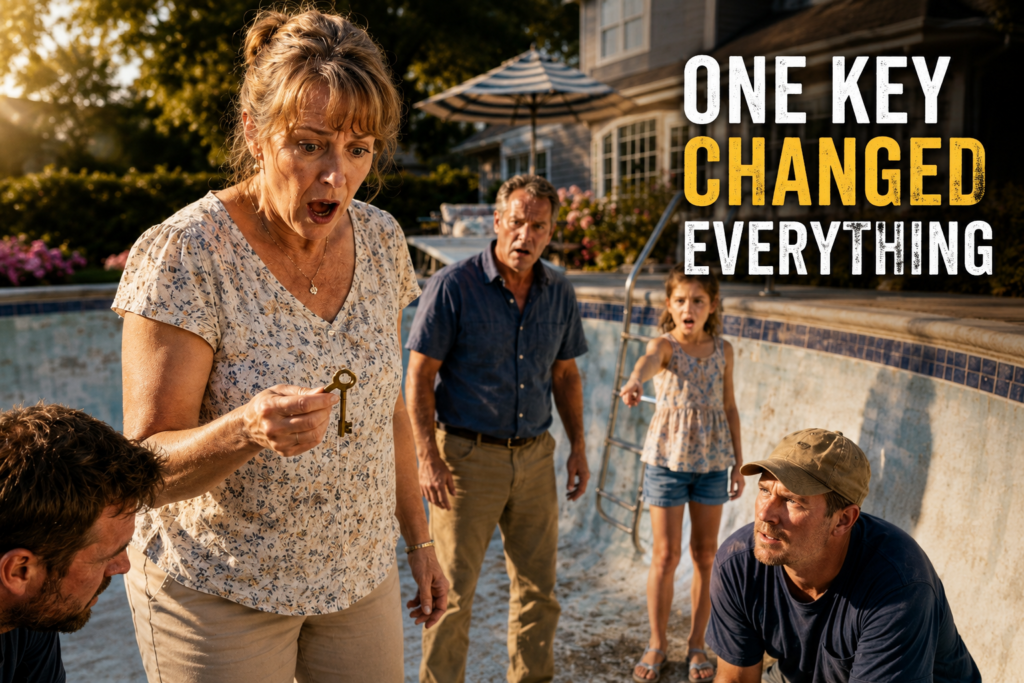
The repair crew arrived at nine.
By noon, pumps had removed most of the water.
I stood at the edge, staring into the empty shell.
Without water, the pool looked smaller and strangely vulnerable. Stains marked the walls. A collection of coins, hair clips, and faded plastic toys rested near the deep-end drain.
One of the workers, a young man named Luis, tapped several tiles beneath the diving board.
“These are newer than the surrounding tiles,” he said.
“How much newer?”
“Maybe twenty years.”
That matched the year our younger son was born.
Luis removed the first tile.
A second layer lay beneath it.
The older tiles were white, each painted with a small blue letter.
As more were uncovered, three names appeared:
CALEB — MASON — EMILY
My sons’ names made sense.
Emily’s did not.
I had chosen that name for the daughter I lost 21 years earlier.
The pregnancy had been difficult. At 32 weeks, I suffered severe bleeding and was rushed to a private hospital where Walter knew the chief administrator.
I remembered bright lights, Richard’s frightened face, and a nurse placing a mask over my mouth.
When I woke, my daughter was gone.
Richard sat beside the bed and told me she had lived for less than an hour.
I asked to see her.
He claimed doctors advised against it.
Walter handled the burial.
The casket remained closed.
For 21 years, I visited a grave containing the child I never held.
Now her name was hidden beneath my family’s swimming pool.
Luis uncovered a small metal compartment behind the tiles.
Inside was a hospital bracelet bearing my full name:
DIANE MARIE BENNETT
Beside it lay a brass key stamped with the number 6.
I was still holding it when Richard entered the backyard.
Richard’s Reaction
He didn’t ask why the pool was empty.
He saw the names and stopped breathing.
“You weren’t supposed to drain it.”
That sentence told me the pool’s condition had never been his real concern.
I climbed down the ladder and stood beside him.
“Why is Emily’s name here?”
Richard stared at the deep-end drain.
“Dad added the names when the boys were little.”
“Emily was never in this pool.”
“He included her as a memorial.”
“Then why did he cover her name with newer tiles?”
Richard had no answer.
I showed him the hospital bracelet.
His face lost its color.
“Where did you get that?”
“It was hidden behind the wall.”
“You need to give it to me.”
Instead, I closed my hand around the key.
Our nine-year-old granddaughter, Lily, entered the yard while we were arguing.
She was Caleb’s daughter and spent most afternoons with us during school vacation.
Lily climbed down the ladder, despite my warning that the surface was slippery.
When she saw Emily’s name, she smiled.
“I know her.”
Richard moved so quickly that he almost knocked me over.
“No, you don’t.”
“Yes, I do.”
He grabbed her arm.
Caleb pulled his daughter away.
“Don’t touch her.”
Lily looked confused by the adults surrounding her.
“Grandpa Walter took me to Emily’s house on Thursdays.”
Caleb frowned.
“He said you went for ice cream.”
“We did. After swimming.”
The empty pool became silent.
“Swimming where?” I asked.
“At Emily’s house. She has a pool with green tiles. She looks like the lady in Dad’s old family picture.”
“What lady?”
“Aunt Sarah.”
The Girl Who Drowned
Sarah was Richard’s younger sister.
She had supposedly drowned at 17 in the swimming pool behind our house.
The tragedy happened before Richard and I met.
According to the story I had heard for years, Walter blamed the old pool’s faulty drain system. He demolished it and built a new one in the same place.
There were no photographs of Sarah displayed inside Walter’s house.
Richard explained that seeing her face caused his father too much pain.
Only one picture survived in Richard’s childhood album.
It showed a serious teenage girl with dark hair standing beside a lake.
Lily claimed Emily looked like her.
“That’s impossible,” Richard said.
“Why?” I demanded.
“Because Sarah died.”
“Then who raised Emily?”
Nobody moved.
Finally, Lily said, “She calls the lady Aunt Sarah too. But Emily said Aunt Sarah is really her mother.”
Richard climbed toward the ladder.
Caleb blocked him.
“You’re staying here until you explain.”
“I don’t have to answer questions based on a child’s imagination.”
Lily crossed her arms.
“I have the address.”
The Passage Beneath the Diving Board
Luis called to us from the deep end.
He had removed a rusted panel beneath the diving board.
Behind it was a narrow maintenance passage extending beneath the pool deck.
At the end stood a steel door marked with the number 6.
The brass key fit.
Inside was a storage room no larger than a closet.
It contained six plastic boxes.
The first held hospital records.
The second contained letters.
The third was filled with canceled checks written by Walter.
The remaining boxes held photographs documenting every year of Emily’s life.
Her first birthday.
Her first day of school.
A swimming competition when she was 11.
Her high school graduation.
Her twenty-first birthday beside a green-tiled pool.
Across the back of that photograph, Walter had written:
Emily still believes Sarah is her biological mother. Richard insists Diane can never know.
My daughter was alive.
She had grown up less than an hour away.
Walter had watched her become a woman while I placed flowers on an empty grave.
I turned toward Richard.
“You knew.”
He sat down against the pool wall.
“Yes.”
The word came out as a whisper.
What Happened When Emily Was Born
Emily was born with a congenital heart condition.
Doctors transferred her to a specialized neonatal unit while I remained unconscious.
Richard panicked.
We already had one young child, significant medical debt, and little savings.
Walter offered a solution.
His niece, Rebecca, had recently lost a baby and wanted to adopt. Walter promised she could provide Emily with medical care and a stable home.
Richard signed temporary guardianship papers.
“Temporary?” I repeated.
“That was the plan.”
“Then why did you tell me she died?”
“Dad said you would never agree.”
“He was right.”
Richard claimed Walter planned to return Emily after surgery.
Instead, Walter changed the documents.
He created a false death certificate and arranged the closed-casket funeral.
Rebecca moved to another town and raised Emily as her daughter.
“But why did Emily believe Sarah was her mother?”
Richard looked toward the hidden boxes.
“Because Rebecca wasn’t her mother.”
Sarah’s Real Story
Sarah had not drowned at 17.
The girl in Richard’s family photograph wasn’t Sarah.
She was Rebecca.
Sarah and Rebecca were cousins close in age who looked remarkably alike.
One summer, both girls were swimming when a younger child fell into the deep end.
Sarah entered the water to save her.
The child survived.
Sarah did not.
Walter blamed the tragedy on the pool.
But he also blamed the child.
That child was me.
I stared at Richard, convinced I had misunderstood.
“I didn’t meet your family until I was 22.”
“That’s what you remember.”
When I was eight, my mother worked as a housekeeper for Walter’s family.
She sometimes brought me with her.
One afternoon, I slipped beneath the pool cover while trying to retrieve a toy.
Sarah pulled me out.
I suffered oxygen deprivation and remembered almost nothing from that summer.
My mother resigned immediately and moved us away.
Years later, Walter recognized my name when Richard introduced me as his girlfriend.
He encouraged the relationship.
At first, I assumed he simply liked me.
In reality, he had spent years watching my family from a distance because guilt connected us.
My mother never told me about Sarah.
She believed forgetting was the kindest thing.
Richard knew before our wedding.
“You married me knowing your sister died saving me?”
“Yes.”
“Did you blame me?”
“No. You were a child.”
“Then why hide it?”
“Dad made me promise.”
Walter feared the truth would destroy my relationship with Richard.
So everyone remained silent.
Why My Name Was Beneath the Pool
The workers uncovered a fourth name beneath the diving board.
DIANE — JULY 14, 1984
That was the day Sarah died.
Walter rebuilt the pool as a memorial.
The names were not merely decorative.
Each marked a child whose life had been changed by that place.
Sarah’s name had once been there too, but Walter later covered it.
The hidden storage room contained the original tile.
SARAH — SHE SAVED DIANE
I touched the painted letters.
A memory surfaced.
Cold water.
A red ball floating above me.
Dark hair spreading across the surface.
Someone pushing me upward.
For more than 40 years, my mind had buried the final moments of a girl who gave her life for mine.
The Woman at the Gate
Lily announced that Emily was coming to the house.
She had called her that morning after overhearing us discuss the repairs.
A car stopped outside.
A woman entered through the backyard gate.
She was 21, with my eyes and my mother’s face.
Behind her walked Rebecca.
Richard whispered, “Sarah.”
Rebecca shook her head.
“You know who I am.”
He had spent so many years reshaping identities that even he seemed confused by his own lies.
Emily stopped at the edge of the empty pool.
She looked at me.
“Are you Diane?”
I nodded.
She stepped down the ladder.
Neither of us knew whether to embrace.
I wanted to pull her against me, but she was not a child returning from school. She was an adult meeting a stranger whose body had once carried her.
“I was told you didn’t want me,” she said.
“I was told you died.”
Rebecca covered her mouth.
Walter had convinced her that I voluntarily surrendered Emily after learning about the heart condition.
She had never known about the false funeral.
Richard had allowed both women to live with opposite lies.
Emily’s Childhood
Rebecca had given Emily a loving home.
She attended every hospital appointment, slept beside her after surgery, taught her to read, and helped her become a competitive swimmer.
I could not hate the woman who raised my daughter.
But I could not immediately forgive her either.
“You never questioned why I didn’t sign the adoption papers?”
“Walter showed me papers bearing your signature.”
“They were forged.”
Rebecca began crying.
“I believed him.”
Emily stood between us.
“I’m not choosing one mother over another.”
“You shouldn’t have to,” I said.
That became the first honest promise anyone made that day.
Walter’s Final Plan
Walter knew his health was failing.
During the final year of his life, he began taking Lily to meet Emily.
He apparently hoped the child would build a bridge between families.
But he still lacked the courage to tell me directly.
Instead, he left instructions inside the pool.
The boxes contained a recorded confession and a new will.
Walter placed money into a trust for Emily and directed that the pool property be divided among all three of my children.
Caleb and Mason were stunned.
They had gained a sister in the same moment they lost faith in their father.
Mason asked the question I had been afraid to voice.
“If the pool hadn’t cracked, would you ever have told us?”
Richard looked at him.
“No.”
That answer ended what remained of our family as it had existed.
What Happened to Richard
I asked Richard to leave that evening.
He moved into Walter’s vacant house.
The false death certificate and forged medical documents triggered an investigation. Because decades had passed, the legal consequences were complicated, but the fraud surrounding Emily’s trust was current.
Richard had withdrawn money from it several times.
He claimed the funds were used for family expenses.
Records showed otherwise.
He used some of the money to pay business debts and purchase a boat.
I filed for divorce.
Richard repeatedly asked for forgiveness.
I could understand his fear as a young father facing a critically ill newborn.
I could not excuse 21 years of silence.
Fear might explain a terrible moment.
It cannot justify a lifetime of deliberate deception.
Our First Summer Together
The pool remained empty for six weeks.
During that time, Emily visited almost every afternoon.
At first, our conversations were awkward.
I asked too many questions.
She sometimes gave one-word answers.
Then we found easier ways to know one another.
We planted flowers.
We cooked my mother’s recipes.
She taught Lily new swimming exercises on the lawn.
Caleb and Mason did not immediately know how to behave around their sister. They worried that every childhood story would remind her of what she missed.
Emily finally stopped them during dinner.
“I don’t want your memories,” she said. “I want new ones with you.”
That changed everything.
Mason invited her to a baseball game.
Caleb asked her to help choose Lily’s birthday present.
The relationships formed slowly, without pretending the stolen years could be recreated.
Rebuilding the Pool
When repairs began, I made one decision.
The old names would remain visible.
We moved them from the deep end to the wide steps where sunlight could reach them.
CALEB
MASON
EMILY
DIANE
And finally:
SARAH — SHE SAVED DIANE
On the first day we refilled the pool, Emily stood at the edge.
“You don’t have to swim,” I told her.
She smiled.
“Swimming is the one thing nobody managed to ruin for me.”
She entered first.
Caleb and Mason followed.
Then Lily jumped in wearing bright orange arm floats, even though she insisted she no longer needed them.
Rebecca sat beside me.
For a while, neither of us spoke.
Then she reached for my hand.
“I’m sorry.”
“I know.”
It was not complete forgiveness.
But it was a beginning.
The Following Summer
One year later, Emily celebrated her twenty-third birthday beside our pool.
She invited Rebecca.
I baked the cake.
Caleb hung lights between the trees, and Mason arrived with enough food for twice the number of guests.
Richard was not present.
Emily had met him twice in counseling, but she was not ready to include him in family celebrations.
Nobody pressured her.
At sunset, Lily asked why names were written on the pool steps.
Emily sat beside her.
“Because families sometimes hide things they’re ashamed of.”
“Why don’t we cover them again?”
“Because hidden things still exist. You just can’t learn from them.”
The underwater lights turned on.
The blue letters shimmered beneath the surface.
For 24 years, Richard believed keeping the pool full would preserve his secrets.
He was wrong.
Water can cover a name.
Tiles can cover evidence.
A closed casket can contain nothing at all.
But the truth does not disappear simply because a family refuses to look beneath the surface.
That summer, every name remained visible.
And when my three children entered the pool together, no daughter was missing anymore.
{"post":108872,"page":2,"next":[{"id":108874,"title":"Hidden Family Will Revealed At Graduation Completely Flipped Our Wealthy Dynasty","url":"https:\/\/new24.info\/108874"},{"id":108869,"title":"My Neighbor Filled My Pool With Concrete Because My Kids Were \u0027Too Loud\u0027 \u2013 She Never Expected What Happened Next","url":"https:\/\/new24.info\/108869"},{"id":108865,"title":"Early in the morning, I went outside to get some fresh air and found this w...","url":"https:\/\/new24.info\/108865"},{"id":108862,"title":"I Got a Breast Reduction After Years of Pain \u2013 When I Came Home, My Husband Gave Me an Ultimatum","url":"https:\/\/new24.info\/108862"},{"id":108854,"title":"This natural and effective remedy for relieving constipation","url":"https:\/\/new24.info\/108854"},{"id":108851,"title":"The Shocking Trap That Caught Two Corrupt Police Officers Red-Handed","url":"https:\/\/new24.info\/108851"},{"id":108846,"title":"How A Cruel Text Message Inspired The Ultimate Vanishing House Act","url":"https:\/\/new24.info\/108846"},{"id":108842,"title":"Devoted Friend Crafts Beautiful Prom Dress After Shops Refuse Grieving Daughter","url":"https:\/\/new24.info\/108842"},{"id":108838,"title":"My Husband Lost His Phone Yesterday, and I Was So Relieved When a Stranger Called Me from His Number \u2013 But When the Man Explained Exactly Where He Found It, I Forgot How to Breathe","url":"https:\/\/new24.info\/108838"},{"id":108835,"title":"The Polite Boy at Our Resort Asked to Take My Daughter on a Banana Boat Ride \u2013 Forty-Five Minutes Later, the General Manager Was Walking Toward Us, His Face Completely Pale","url":"https:\/\/new24.info\/108835"},{"id":108833,"title":"Paris Jackson: Crafting a Personal Identity and Artistic Path Beyond Her Famous Family Heritage","url":"https:\/\/new24.info\/108833"},{"id":108830,"title":"A Husband\u0027s Final Goodbye Turns Into a Miraculous Return from the Brink of Death","url":"https:\/\/new24.info\/108830"},{"id":108825,"title":"How To Get Rid Of Gnats","url":"https:\/\/new24.info\/108825"},{"id":108821,"title":"I Married My Terminally Ill First Love to Fulfill Her Dying Wish \u2013 At Her Funeral, a Stranger Said, \u0027She Wasn\u0027t Ready to Tell You Why She Really Came Back. Now She Has Nothing to Fear\u0027","url":"https:\/\/new24.info\/108821"},{"id":108818,"title":"My SIL Held Her Wedding at My Grandma\u0027s Lake House but Destroyed the Garden and Turned the Yard Into a Dump \u2013 So I Brought Her a Wedding Gift She\u0027d Never Forget","url":"https:\/\/new24.info\/108818"},{"id":108816,"title":"He Sent Me Money Meant For His Mistress, Not Knowing I Saved Every Piece First","url":"https:\/\/new24.info\/108816"},{"id":108809,"title":"Wealthy Groom Liquidates Ten Million Dollar Trust Following Unforgivable Fountain Incident","url":"https:\/\/new24.info\/108809"},{"id":108805,"title":"Desperate Flight To Mexico City Uncovers A Shocking Conspiracy And Hidden Wealth","url":"https:\/\/new24.info\/108805"},{"id":108801,"title":"Husband Sneaks His Parents Into Wyoming Home Before Wife Fights Back","url":"https:\/\/new24.info\/108801"},{"id":108797,"title":"Humble Farmer Rescued An Abandoned Newborn And Received An Astonishing Reward","url":"https:\/\/new24.info\/108797"}]}