
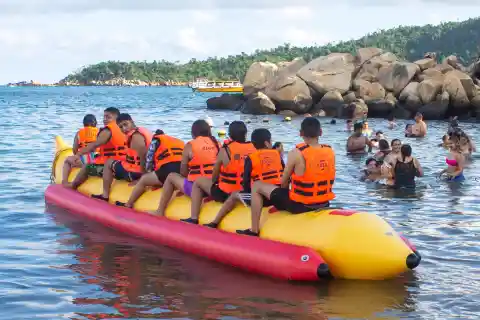
Forty-five minutes later, the boat still had not returned.
And that photograph became the only proof I had that Maya had been smiling when I last saw her.
That summer, our daughter had turned sixteen.
Somewhere between fifteen and sixteen, she had perfected the art of making her parents feel simultaneously loved and unnecessary.
When she was little, Maya used to reach automatically for my hand whenever we crossed a street.
Now affection came in smaller doses.
A quick hug before school.
A distracted, “Love you, Mom,” while walking out the door.
A text instead of a conversation.
I understood.
Children grow.
That is what they are supposed to do.
But understanding something does not always make it easier.
So when my husband, Daniel, suggested one final family vacation before Maya began her junior year, I agreed immediately.
Maya did not.
“I already promised Emma I’d go shopping with her.”
“You can shop when we get back,” I said.
She groaned.
“I’ll miss everything.”
Daniel looked up from his laptop.
“What exactly is everything?”
“Life.”
I laughed.
“You’ll survive seven days.”
She remained unconvinced.
It took nearly two weeks of negotiations.
We promised she would not have to spend every second with us.
She could sleep late.
Join activities.
Meet other teenagers.
Disappear to the pool, as long as we knew where she was.
Eventually, she agreed.
On the flight, Daniel leaned toward me and nodded toward Maya, who sat several rows ahead wearing headphones and staring at her phone.
“You know this might be the last one.”
I knew exactly what he meant.
“The last family vacation she actually agrees to take.”
I looked at her.
“I know.”
And suddenly, I wanted to memorize everything.
By our second day at the resort, Maya had created a routine.
Breakfast with us.
Beach volleyball afterward.
Back to the room to change.
Then dinner together.
I kept catching myself watching her from across the resort.
Not because I distrusted her.
Because sixteen felt like standing at the edge of something.
Soon there would be college applications.
Driving alone.
Trips without us.
A life that would belong mostly to her.
The resort itself looked almost unreal.
White sand.
Turquoise water.
Palm trees leaning toward the ocean.
Families everywhere.
It felt safe enough that even I started relaxing.
That was where Maya met Liam.
I noticed him before she introduced us.
Unlike the teenagers crowded around the pool, Liam sat beneath an umbrella reading a paperback.
Maya walked over.
I assumed she was asking whether the empty chair beside him was available.
Ten minutes later, they were laughing.
Daniel nudged me.
“Looks like someone made a friend.”
“I see that.”
“Should I embarrass her?”
“Absolutely not.”
An hour later, Maya brought him over.
“Mom, Dad, this is Liam.”
He smiled immediately.
“Nice to meet you, ma’am.”
Then he shook Daniel’s hand.
“Nice to meet you, sir.”
I almost laughed.
“You can relax. We’re not interviewing you.”
“My parents say manners are free.”
His mother, Rebecca, arrived moments later with his father, Chris.
Within half an hour, all six of us were talking beside the pool.
They had been coming to the resort every summer since Liam was eight.
“He probably knows the property better than management,” Chris joked.
Liam groaned.
“Please ignore him.”
By the third day, seeing Maya and Liam together had become normal.
They played volleyball.
Bought smoothies.
Walked along the beach.
And Maya laughed more than I had seen her laugh in months.
That evening, the resort organized activities near the water before sunset.
Music played from speakers.
Children ran barefoot through the sand.
Adults crowded around the drinks tables.
One of the most popular attractions was the banana boat.
Every fifteen or twenty minutes, a speedboat dragged a long yellow inflatable across the bay while riders bounced over the waves screaming and laughing.
Before anyone could participate, a resort employee gathered the riders for a safety briefing.
I listened only because being a mother had trained me to listen whenever strangers used words like safety.
“If someone becomes sick or injured while you’re on the water,” the employee said, “do not automatically return to this beach.”
He pointed toward a rocky section farther down the coast.
A small white building was barely visible between the rocks.
“That is Blue Cove Clinic. It has an emergency dock. If there’s a serious medical problem, it’s much faster to go there.”
Most people barely looked.
The teenagers certainly didn’t seem interested.
Or so I thought.
About an hour later, Maya and Liam approached us.
Both were smiling in the particular way teenagers smile when they have already decided what answer they want.
“Liam has a question,” Maya said.
I folded my arms.
“That sounds suspicious already.”
Liam laughed nervously.
“Would it be okay if Maya came on the last banana boat ride with me?”
I glanced toward the water.
“How long?”
“Twenty minutes. Maybe a little more.”
Rebecca nodded from her chair.
“He’s done it dozens of times.”
Daniel looked at me.
“They’ll have life jackets.”
I hesitated.
Maya saw it instantly.
“Mom.”
Just one word.
But I heard everything underneath it.
Please.
Trust me.
Stop treating me like I’m eight.
I smiled.
“Fine.”
Her whole face changed.
“Really?”
“Really.”
She hugged me quickly.
Daniel grinned.
“That was definitely a permission hug.”
“I’m counting it anyway.”
At the dock, an employee helped them into bright orange life jackets.
I watched Liam tug gently on one of Maya’s straps to make sure it was secure before fastening his own.
That tiny gesture reassured me.
They climbed onto the inflatable with several other riders.
Just before the boat pulled away, I lifted my phone.
“Maya!”
She turned.
Liam turned too.
She grinned.
He gave me a thumbs-up.
I took the picture.
Seconds later, the boat accelerated across the bay.
Maya screamed with laughter.
She waved once.
Then they disappeared into the glittering sunset.
Daniel put an arm around me.
“See?”
“See what?”
“You let her go.”
“Temporarily.”
He laughed.
“They’ll be back before you know it.”
Fifteen minutes passed.
Another banana boat came toward shore.
I sat up.
Wrong group.
Families stepped off laughing and soaked.
No Maya.
No Liam.
“Maybe theirs went farther out,” Daniel said.
I nodded.
Twenty-five minutes passed.
Then thirty.
The sunset deepened from yellow into orange.
The families on the beach began gathering towels and heading toward dinner.
I checked my phone.
No message.
At thirty-five minutes, I stood.
“They’re late.”
Daniel looked toward the horizon.
“Yeah.”
The uncertainty in his voice frightened me more than the delay.
“I’m asking someone.”
The attendant at the dock looked up when I approached.
“My daughter is on the sunset banana boat. She left with a boy named Liam.”
He checked his clipboard.
“When did they leave?”
“Almost forty minutes ago.”
His expression changed.
Only slightly.
But I saw it.
“They should be back.”
My stomach tightened.
“What does that mean?”
“The route usually takes about twenty minutes.”
He picked up a radio.
“Dock One to sunset run. Status check.”
Static.
He tried again.
“Sunset run, this is Dock One. Come in.”
Nothing.
Daniel appeared beside me.
“What’s going on?”
The employee kept staring at his radio.
“I’m not getting a response.”
Daniel’s face hardened.
“Call them again.”
The attendant did.
Static.
I turned toward the ocean.
Forty-five minutes.
That was when fear became something physical.
The sea no longer looked beautiful.
The water had darkened, and the horizon seemed impossibly wide.
I pulled out my phone and opened the photograph.
Maya smiling.
Orange life jacket.
Liam beside her.
Sunset behind them.
I zoomed in on her face.
For some reason, I needed to see it.
I needed to know exactly what she looked like the last time I saw her.
Daniel touched my arm.
“Don’t do that.”
“Do what?”
“Look like this is the last picture.”
I stared at him.
He had understood exactly what I was thinking.
“She’s fine,” he said.
But his voice broke slightly.
Another employee came running toward the dock.
The two spoke quickly.
A rescue boat was launched.
Someone contacted emergency services.
Then Rebecca and Chris appeared.
Rebecca saw my face and stopped.
“Where’s the boat?”
Nobody answered quickly enough.
Her hand flew to her mouth.
“No.”
Chris moved beside Daniel.
“They’re probably having engine trouble.”
“Yes,” I said.
Too quickly.
“That’s probably it.”
Every parent there was lying for the others.
An hour after Maya had left the beach, emergency vehicles arrived at the resort.
Flashing lights reflected across the hotel windows.
Guests gathered near the shore.
Staff began moving people away from the dock.
I stood there clutching my phone.
Still looking at the same photograph.
Still imagining every version of what might be happening beyond the dark water.
Then the resort manager approached us.
His face was pale.
He held a phone in his hand.
My heart stopped.
“Mr. and Mrs. Miller?”
“Yes.”
“I need you to come with me.”
“Did you find them?”
He hesitated.
Rebecca grabbed my hand.
The manager swallowed.
“There is footage you need to see.”
That was worse than any answer he could have given.
He led all four of us into a private office near the lobby.
The door closed.
The manager placed his phone on the desk.
“This came from one of our cameras near the western side of the bay.”
He pressed play.
The banana boat appeared on-screen.
“There!”
I leaned forward.
It was them.
The boat was returning.
It was clearly heading toward the resort.
Relief hit me so quickly I almost laughed.
“They were coming back.”
Then something happened.
Liam turned toward Maya.
Even in the grainy footage, I saw his body change.
He leaned closer.
Then suddenly stood as far as his safety line allowed and began waving frantically toward the driver.
The speedboat turned sharply.
Away from the resort.
My relief vanished.
“What is he doing?”
Rebecca stepped toward the screen.
“Why is Liam telling him to leave?”
The manager said nothing.
“Keep watching.”
A few seconds later, Maya collapsed.
One moment she was sitting upright.
The next, her body folded sideways against the inflatable.
I made a sound I didn’t recognize.
Daniel grabbed me.
“No. No, no, no.”
On the screen, Liam threw himself toward her.
He grabbed Maya.
Shouted.
Then pointed violently toward the rocky cove.
Blue Cove.
The clinic.
The manager switched videos.
“This came from the clinic’s exterior camera.”
A small stretch of beach filled the screen.
Seconds later, the speedboat appeared.
Before it had fully stopped, Liam jumped into shallow water.
He turned back.
Lifted Maya.
And carried her.
My sixteen-year-old daughter hung completely limp against him.
I covered my mouth.
“Oh God.”
He ran across the sand.
A nurse appeared.
Then another.
Someone brought a stretcher.
Within seconds, Maya disappeared through the clinic doors.
Nobody in the office spoke.
The manager quietly paused the footage.
“They contacted us once they identified her.”
My voice barely worked.
“Is she alive?”
The office door opened.
A doctor entered.
He looked directly at me.
“Yes.”
My knees almost gave out.
“Your daughter is alive, Mrs. Miller.”
Daniel caught me as I dropped into the chair.
Rebecca started crying beside us.
“What happened?” Daniel asked.
The doctor introduced himself as Dr. Alvarez.
“Your daughter suffered a severe anaphylactic reaction.”
I stared at him.
“From what?”
“We believe she ate mango sorbet shortly before the ride.”
I shook my head.
“Mango isn’t a problem.”
“No. But cashews are.”
Everything clicked.
“Maya is severely allergic to cashews.”
“We know.”
Dr. Alvarez nodded.
“The sorbet apparently contained traces from shared equipment.”
My chest tightened.
“She has an epinephrine injector.”
“She did.”
He looked toward the frozen image of Liam.
“Liam found it.”
Rebecca covered her face.
“He administered it?”
“Yes.”
Dr. Alvarez continued.
“But what may have made the greatest difference was remembering the safety briefing.”
Blue Cove Clinic.
The white building everyone had barely noticed.
“He realized returning to the resort would take too long. He told the driver to come directly here.”
I looked at the image of Liam carrying my daughter.
“He saved her.”
Dr. Alvarez nodded.
“He reacted remarkably well.”
Then he hesitated.
“If he had waited another five minutes before getting her to medical care…”
He stopped.
I didn’t need the rest.
We reached the clinic minutes later.
Maya was sitting upright in a hospital bed.
Her face was pale.
Her hair was tangled.
An IV ran into her arm.
But she was alive.
The moment she saw me, she burst into tears.
“Mom.”
I crossed the room so fast I nearly knocked over the chair beside her bed.
She wrapped her arms around me.
“I’m sorry.”
“No.”
I held her tighter.
“No, baby. You have nothing to be sorry for.”
“I thought I was dying.”
My heart broke.
“I know.”
Daniel leaned over us and kissed her forehead.
“We’re here.”
For several minutes, I forgot anyone else existed.
Then I noticed Liam.
He stood near the window.
Still wearing wet clothes.
His hair was dripping onto his shoulders.
His hands were shaking.
He looked almost frightened to be in the room.
I walked toward him.
He straightened.
“Mrs. Miller, I—”
I hugged him.
Hard.
He froze.
Then slowly relaxed.
“Thank you.”
My voice broke.
“You saved my daughter.”
He looked embarrassed.
“I just remembered what they told us.”
“No.”
I stepped back.
“You paid attention when everyone else didn’t.”
He lowered his eyes.
“When Maya said she couldn’t breathe, I remembered the clinic.”
I started crying again.
Then I told him something I was ashamed to admit.
“For a minute, when I saw you telling that boat to go away from the resort, I thought you were taking her away from us.”
Liam looked surprised.
Then he gave me a small, sad smile.
“If I saw that video without knowing what happened, I probably would have thought the same thing.”
Rebecca hugged her son next.
Chris turned away and wiped his eyes.
The following morning, after doctors cleared Maya to return to the resort, she asked to walk along the beach.
She was tired, so we moved slowly.
Daniel walked slightly ahead.
Maya stayed beside me.
Then something happened that she had not done in years.
She reached for my hand.
I looked down.
Her fingers wrapped around mine exactly the way they had when she was five.
I squeezed them.
Neither of us mentioned it.
After a few minutes, she spoke.
“Mom?”
“Yes?”
“I know you worry too much.”
I laughed softly.
“That is well established.”
She smiled.
“But I think I understand it better now.”
I looked at her.
She leaned her head briefly against my shoulder.
“I don’t want you to stop.”
My throat tightened.
“I probably couldn’t if I tried.”
“Good.”
We continued walking.
The ocean looked peaceful again.
Almost innocent.
Farther down the beach, I could see the small white building beside the rocks.
Blue Cove Clinic.
The place I barely noticed during the safety briefing.
The place Liam had remembered when every second mattered.
I thought about that photograph still sitting on my phone.
Maya laughing.
Liam giving a thumbs-up.
Me standing safely on shore, believing I was the person responsible for protecting her.
But raising children eventually demands something terrifying.
You have to let them step beyond the distance your own arms can reach.
And when they do, you can only hope the people standing beside them are kind, alert, and brave enough to act when you cannot.
That afternoon, I looked at the photograph again.
For forty-five terrifying minutes, I had thought it might become the last image I would ever have of my daughter.
Instead, it became something completely different.
It was the picture of the moment just before I learned that letting Maya grow up did not mean losing the ability to protect her.
Sometimes it meant trusting that she was beginning to surround herself with people who would protect her too.