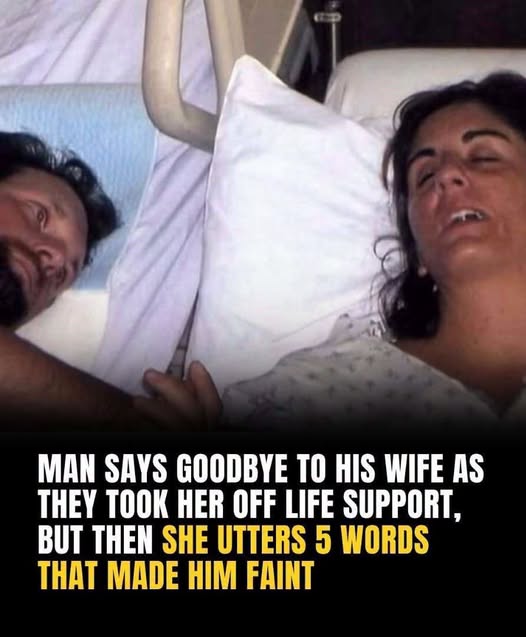
For nearly two agonizing weeks, the hospital room became the entire universe for Ryan. He sat in the dim light, his hands often resting on her still frame, his voice low as he read passages from a Bible brought by a relative. He prayed for a miracle, for a flicker of recognition, or for the simple rise and fall of her chest to signal a return to consciousness. Yet, the medical team remained grim. They explained that her condition was not improving, and eventually, the crushing weight of reality forced Ryan to make the most painful decision of his life: to remove the life support that was keeping her body tethered to this world. He said his final, tearful goodbyes, believing he was letting her go forever, surrendering to a grief that felt absolute and final. The room felt cold, the air thick with the finality of his choice, as he prepared himself for the inevitable silence that would follow the cessation of the machines.
The hospital was quiet five hours later when the impossible happened. The monitors, which had been silent witnesses to her slow decline, began to register a sudden, inexplicable change. A nurse, startled by the shift in the readings, rushed to find Ryan, who was still nearby in the hospital. When he entered the room, he did not find the stillness he had left behind. Jill was moving. Her eyes, which had been closed for so long, fluttered open. Then, with a clarity that defied every medical expectation, she looked at her husband and spoke five simple, earth-shattering words: I want to go home now. It was a sentence that shattered the grief he had been carrying, replacing it with a shock so profound it left him breathless and trembling in the doorway. She was not just awake; she was aware, her mind seemingly intact despite the trauma her body had endured.
The recovery process that followed was not instantaneous, but it was a testament to the resilience of the human spirit. Jill had to relearn the most basic rhythms of daily life. Simple tasks that most take for granted—brushing her teeth, tying her shoelaces, or navigating the physical world—became monumental hurdles. She required extensive rehabilitation, a slow, methodical journey of rebuilding strength and coordination. Throughout these months, Ryan remained her constant anchor, witnessing her determination to reclaim the life that had been so nearly stolen from her. He watched as she regained her independence, piece by agonizing piece, marveling at the strength she possessed as she fought to return to the person she had been before the cardiac arrest. Every small victory in physical therapy was a cause for celebration, a milestone on the long road back to normalcy.
As Jill grew stronger, the couple found themselves navigating a new reality together. The experience had stripped away the trivial worries that once occupied their days. In the quiet, reflective moments of their shared life, they often spoke of the ordeal, viewing her survival as nothing short of divine intervention. The fear of losing everything had been replaced by a profound, unshakable gratitude for the mundane. They found beauty in the simple act of sitting together, in the sound of each other’s voices, and in the quiet comfort of their home. The pets they had worried about during her coma were now constant companions, their presence a reminder of the normalcy she had fought so hard to return to. Even planning a meal at their favorite restaurant became an event of immense joy, a celebration of the time they had been granted by fate, and a way to reconnect with the life they had almost lost.
This journey did not just restore Jill’s health; it fundamentally altered the way they viewed their existence. Every morning felt like a gift, every evening a victory. They recognized that the fragility of life was not a reason for fear, but a call to live with intention. The trauma of the cardiac arrest and the subsequent coma had left scars, but those scars served as a map of where they had been and how far they had come. They were no longer the same people who had walked into that hospital weeks prior; they were survivors who had looked into the abyss and chosen to step back into the light of a second chance. They found that their bond had deepened, forged in the fires of a crisis that would have broken many others.
In the end, the story of Ryan and Jill Finley is not merely about a medical anomaly or a miraculous recovery. It is a story about the endurance of love and the unexpected turns that define our lives. It serves as a reminder that even when the path ahead seems obscured by the deepest darkness, there is always the possibility of a new beginning. They moved forward, not by forgetting the past, but by embracing the present with a renewed sense of purpose. The silence that had once filled their home was now replaced by the vibrant, steady hum of life, a testament to the five words that changed everything and the enduring bond that kept them together through it all. They lived each day with the knowledge that their time was precious, a lesson learned in the most difficult way possible, yet one they cherished with every fiber of their being as they continued their life together, hand in hand, fully present in the miracle of their shared future, forever grateful for the life they had reclaimed.