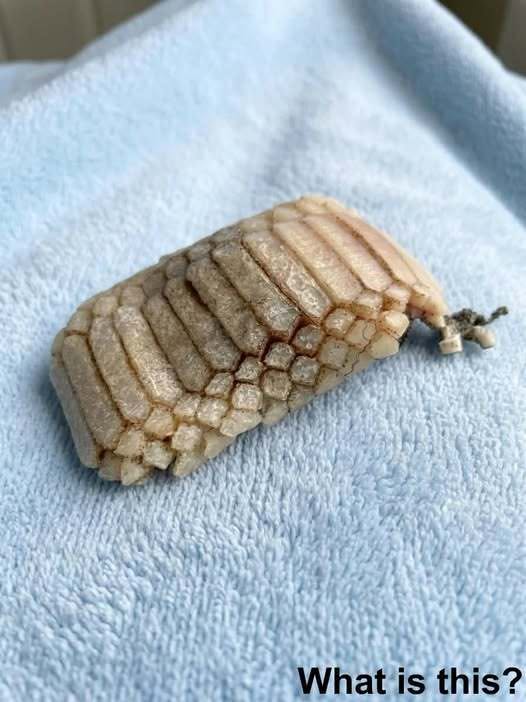
The object actually comes from a chiton, a small marine mollusk that lives along rocky shorelines around the world. Chitons spend most of their lives firmly attached to rocks in the intertidal zone, where they must withstand crashing waves, changing tides, and strong ocean currents. From above, they appear quite ordinary, protected by eight overlapping shell plates that act like flexible armor.
The mystery begins when you see the underside. Beneath the shell is a large muscular foot surrounded by specialized tissues that help the animal cling tightly to rocks. If this portion becomes separated from the rest of the body and washes ashore, it can take on an eerie appearance. The rows of gripping structures often resemble sharp teeth or the jaws of a prehistoric creature, making the harmless animal seem far more intimidating than it really is.
These unusual features are perfectly designed for survival. Chitons rely on their powerful muscular foot to remain attached to slippery rocks even as waves pound against them. Their remarkable grip allows them to stay in place where many other sea creatures would be swept away. What may look frightening is actually an excellent example of nature adapting an animal to one of the ocean’s harshest environments.
Even more impressive is the chiton’s feeding apparatus. Like many mollusks, chitons feed using a ribbon-like structure called a radula, which is covered with rows of tiny teeth. Unlike the teeth of most animals, chiton teeth are reinforced with magnetite, an iron-rich mineral that gives them extraordinary strength and durability. Scientists often cite these teeth among the hardest biological materials found in nature, allowing chitons to scrape algae and microscopic organisms from solid rock surfaces without wearing them down quickly.
The use of magnetite makes the chiton a remarkable example of natural engineering. What appears to be a strange or even mechanical object is actually the result of millions of years of evolution, with every structure serving a specific purpose. Its unusual appearance reflects adaptation rather than danger.
Discoveries like this remind us that the ocean often creates mysteries simply by separating parts of marine organisms from the whole animal. Waves, tides, and storms constantly move shells, plants, and animal remains along the shoreline, making familiar creatures appear completely unfamiliar. Without seeing the entire organism, it’s easy to imagine something far more dramatic than reality.
The next time you come across an odd-looking object on the beach, curiosity is always worthwhile—but so is caution before jumping to conclusions. Nature is capable of producing forms that seem stranger than fiction, and many of them have fascinating scientific explanations.
In the end, the mysterious object isn’t evidence of a sea monster or an unknown creature lurking beneath the waves. It’s simply part of an extraordinary little mollusk whose specialized anatomy has helped it survive in one of the ocean’s most demanding environments. Sometimes the most astonishing discoveries are not the mythical ones, but the real wonders that evolution has quietly created over millions of years.
{"post":108773,"page":2,"next":[{"id":108771,"title":"Essential Culinary Rules for Avoiding Common Slow Cooker Failures and Achieving Better Results","url":"https:\/\/new24.info\/108771"},{"id":108769,"title":"Understanding the True Significance Behind Popular Minimalist Black Band Tattoos","url":"https:\/\/new24.info\/108769"},{"id":108767,"title":"Understanding the Personal Significance and Aesthetic Appeal of Black Band Tattoos in Modern Body Art Culture","url":"https:\/\/new24.info\/108767"},{"id":108764,"title":"Victor Willis: The Iconic Voice of the Village People and His Fight for Musical Justice","url":"https:\/\/new24.info\/108764"},{"id":108762,"title":"Victor Willis: The Iconic Voice of the Village People and His Fight for Musical Legacy","url":"https:\/\/new24.info\/108762"},{"id":108756,"title":"A Practical Guide to Eliminating Gnat Infestations in Your Home Using Gentle and Effective Methods","url":"https:\/\/new24.info\/108756"},{"id":108753,"title":"Chuck Negron, the Iconic Voice of Three Dog Night, Passes Away at Age 83","url":"https:\/\/new24.info\/108753"},{"id":108750,"title":"The Enduring Psychology and Global Consistency Behind the Iconic Lay\u2019s Logo","url":"https:\/\/new24.info\/108750"},{"id":108747,"title":"The Nutritional Profile of Avocados and Their Role in Supporting Long-Term Human Health and Wellness","url":"https:\/\/new24.info\/108747"},{"id":108744,"title":"Understanding the Theological Perspective on Cremation Within the Christian Faith","url":"https:\/\/new24.info\/108744"},{"id":108741,"title":"Identifying Insects in Your Child\u2019s Hair: Separating Fact from Misleading Information","url":"https:\/\/new24.info\/108741"},{"id":108738,"title":"Unmasking the Mystery of the Strange Armored Object Found Along the Rocky Shoreline","url":"https:\/\/new24.info\/108738"},{"id":108735,"title":"Understanding Carpet Beetles: A Practical Guide to Identifying and Managing Household Pests Found Under Your Mattress","url":"https:\/\/new24.info\/108735"},{"id":108728,"title":"Midnight Hospital Call Revealed A Secret I Had Documented For Months","url":"https:\/\/new24.info\/108728"},{"id":108724,"title":"My Overstepping HOA President Built An Illegal Dock And Uncovered Massive Fraud","url":"https:\/\/new24.info\/108724"},{"id":108721,"title":"I am 73 years old, I live alone and I feel fulfilled: 4 tips that work for me.","url":"https:\/\/new24.info\/108721"},{"id":108718,"title":"Warning! If you have found this insect in your home, it\u2019s a sign that you need to\u2026see more...","url":"https:\/\/new24.info\/108718"},{"id":108714,"title":"Which Way Is the Correct Way to Hang Toilet Paper? (The Answer Might Surprise You)","url":"https:\/\/new24.info\/108714"},{"id":108711,"title":"A Boy at Our Summer Resort Called My Daughter by Another Name\u2014Then We Found Her Identical Twin\u2019s Phone in a Beach Locker","url":"https:\/\/new24.info\/108711"},{"id":108708,"title":"A Stranger Sent My Son Birthday Cards for 12 Years \u2013 On His 18th Birthday, the Sender Finally Signed His Real Name","url":"https:\/\/new24.info\/108708"}]}