
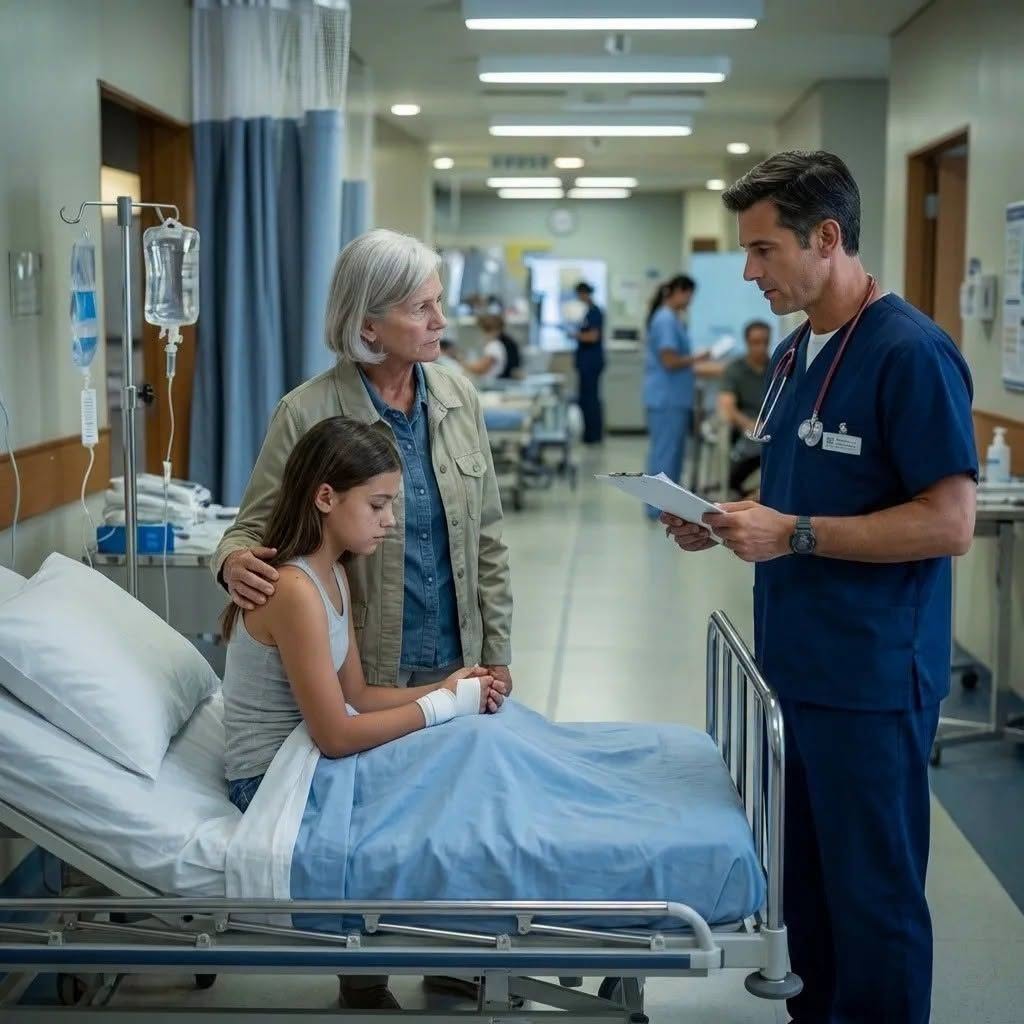
In the emergency department, I met with the attending orthopedic surgeon, Dr. James Whitaker.
After examining Brooke, he expressed concern that her arm injury did not appear entirely consistent with the explanation that had been given.
Rather than speculating, he carefully documented his clinical findings as part of her medical record.
When I finally sat beside Brooke, I did not press her with questions.
I simply let her speak.
Slowly, she described what had happened that evening and shared concerns she had been carrying for much longer.
She also spoke about her mother, Diane, whose responses had become increasingly passive during difficult situations.
Listening without interruption was one of the hardest things I have ever done.
Children often reveal the truth most clearly when they know they will not be hurried or doubted.
Protecting Through Proper Channels
Once Brooke had been examined and treated, I asked that the medical findings be recorded carefully and completely.
From there, we involved the professionals whose role was to protect children facing possible harm.
Hospital social worker Renata Vasquez met with Brooke and conducted a thorough assessment.
At the same time, I contacted my attorney, Francis Aldridge, to understand the legal options available should immediate protection become necessary.
As morning approached, I also reached out to Brooke’s school principal, Andrea Simmons, requesting any records that might help establish whether recent changes in attendance or behavior reflected a broader pattern.
Medical professionals later reviewed Brooke’s history more closely.
During that process, pediatric specialist Dr. Thomas Park identified evidence of an older, healed injury in the same area.
Taken together, the medical records, Brooke’s account, and the additional documentation raised serious concerns that required judicial review.
A Decision Focused on Safety
After reviewing the evidence presented, the court granted me emergency temporary custody so Brooke could remain in a safe environment while the matter continued through the legal system.
The order also placed immediate restrictions on contact from those under investigation.
When I later spoke with Diane, I did so quietly.
She appeared overwhelmed.
I left her my contact information and told her that whenever she was ready to seek help or speak honestly about what had happened, she would know where to find me.
Compassion for someone does not require ignoring the harm that has occurred.
Sometimes the safest response is also the kindest one.
Healing Takes Time
The legal proceedings continued through the proper courts, where Marcus was ultimately held accountable for his actions.
Those decisions belonged to the justice system.
Our family’s work was different.
It was to help Brooke heal.
She moved into my home and began meeting regularly with a trauma specialist.
Progress came slowly.
Some days were encouraging.
Others were difficult.
Healing rarely follows a straight path.
But with patience, consistency, and safety, hope gradually began to return.
The Call That Changed Everything
Today, I often see Brooke working in the spring garden outside my home.
Watching her laugh again reminds me that recovery is built through many ordinary days lived without fear.
Looking back over my career, I have cared for countless patients and made thousands of difficult medical decisions.
Yet none feels more important than the simple decision to hand my granddaughter a private phone number months before she ever needed it.
It told her, without many words, that there would always be one place where she could ask for help and be believed.
Sometimes the greatest act of protection begins long before the moment of crisis.
It begins by making sure someone knows they are never truly alone.